
Mapa mental
Chemistry Unit 2- Alkenes and Haloalkanes
Conteúdo do mapa
Chemistry Unit 2- Alkenes and Haloalkanes
Alkenes
- These are hydrocarbons that have one or more carbon-carbon double bond
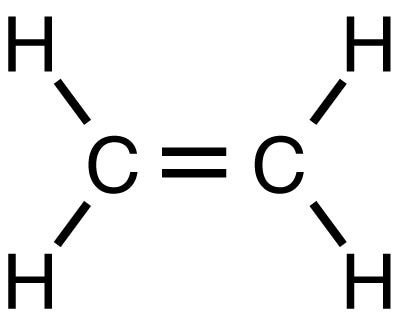
- As you can see, the atoms around each carbon form the trigonal planar shape and there is a bond agngle of 120
- Their double bond means there is restricted rotation around each carbon bond. In alkanes, the atoms have free rotatiomn around each carbon atom because they have a single bond
- E/Z isomerism is where atoms have the same molecular formula but a different 3-D spacial arrangement around each atom
- It is also called geometrical isomerism
- It can only occur if there are 2 different groups attatched to each carbon
- When trying to work out if a molecule shows E/Z isomerism, you work out where the two heaviest molecules are placed.
- If they're on the Zame Zide, then they show Z isomerism
- If they're on opposite sides, i.e. entgegen, then they show E isomerism
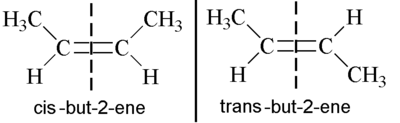
- Example, But-2-ene. The cis but-2-ene shows Z isomerism as the two heaviest molecules are on the same side
- The trans but-2-ene shows E isomerism as the two heaviest molecules are on different sides
- When trying to work out if a molecule shows E/Z isomerism, you work out where the two heaviest molecules are placed.
- It can only occur if there are 2 different groups attatched to each carbon
- They don't show position, chain or functional group isomerism
- This is caused by the restricted rotation arround each carbon
- It is also called geometrical isomerism
- Reactivity/reactions
- Alkenes are more reactive than alkanes. Why?
- Alkanes are unsaturated, meaning not all bonds are filled, they can be broken and more can be added to it
- They have a double bond, meaning there are 4 electrons within that region, which will pull the 2 carbon atoms closer together and make the bond shorter.
- This then means that there is more negativity within a smaller space.
- The double bond is said to be a region of high electron density, and this is what makes alkenes more reactive than alkanes.
- This then means that there is more negativity within a smaller space.
- They have a double bond, meaning there are 4 electrons within that region, which will pull the 2 carbon atoms closer together and make the bond shorter.
- Alkanes are unsaturated, meaning not all bonds are filled, they can be broken and more can be added to it
- Electrophilic addition:
- An addition reaction is making 2 smaller molecules into 1 bigger molecule
- An electrophile is a species that is able to ACCEPT a pair of electrons from an electron rich species
- An alkene is able to do electrophilic addition with 3 things
- H-X
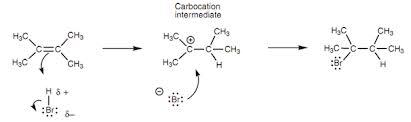
- 1. The electrons in the double bond is given to the hydrogen on the H-BR molecule
- The hydrogen now has 4 electrons, thats too many, so the Br will take its original electron and also hydrogen's electron to become Br- ion
- The hydrogen is now bonded to one of the carbons and the other carbon, has had one of its electrons take away from it. It now has a positive charge and is now called a carbocation
- So the Br- will now become attracted to the carbocation
- A haloalkane will have formed
- So the Br- will now become attracted to the carbocation
- The hydrogen is now bonded to one of the carbons and the other carbon, has had one of its electrons take away from it. It now has a positive charge and is now called a carbocation
- The hydrogen now has 4 electrons, thats too many, so the Br will take its original electron and also hydrogen's electron to become Br- ion
- There are two types of products that can be formed: A major yield and a minor yeild
- You can determine which product will be your major yeild and which will be your minor yeild by looking at the carbocation
- The carbocation that is attatched to the most carbon atoms is going to be the major yield
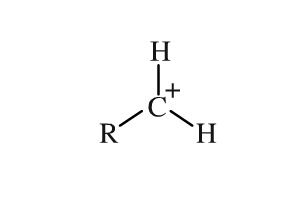
- Primary
- Attatched to only one other carbon atom
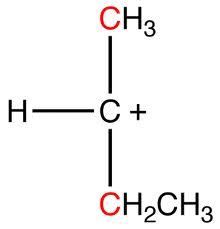
- Secondary
- Attatched to 2 other carbon atoms
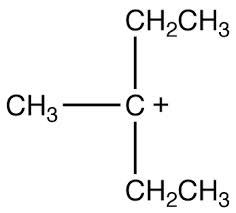
- Tertiary
- Attatched to 3 other carbon atoms
- You can't have a quaternary carbocation because the carbon can only bond to 4 things: 3 other carbon, and the positive charge.
- Out of all carbocation, a tertiary carbocation is the major product because its the most stable
- Primary
- The carbocation that is attatched to the most carbon atoms is going to be the major yield
- This s only if you have an alkene that is not symmetrical
- If you have a symmetrical alkene, then you'll get the same product
- You can determine which product will be your major yeild and which will be your minor yeild by looking at the carbocation
- 1. The electrons in the double bond is given to the hydrogen on the H-BR molecule
- X2
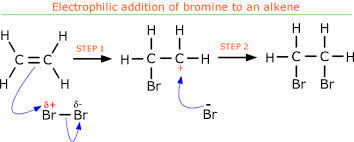
- When you react an alkene with a halogen, then you get a di-substituted haloalkane
- You dont get 2 products because the product formed is symmetrical. The X2 doesnt have a permanent dipole however it does have a temporary induced dipole
- This is because their electronegativties are the same
- This usually only works with I2 and Br2 because they're big enough to have lasting dipoles
- You dont get 2 products because the product formed is symmetrical. The X2 doesnt have a permanent dipole however it does have a temporary induced dipole
- When you react an alkene with a halogen, then you get a di-substituted haloalkane
- H2SO4
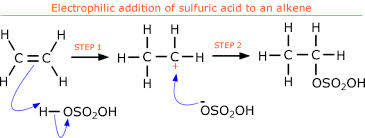
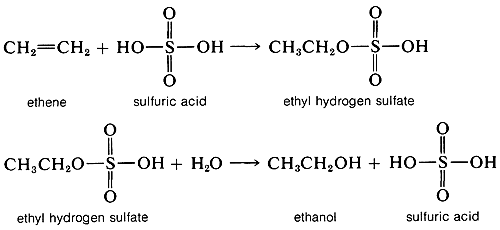
- When you react the alkene with the sulphuric acid, then you'll get an alkyl hydrogen sulphate.
- The mechanism is the same: 1. The double bond breaks and a pair of electrons are shared with the hydrogen. Then the Hydrogen will give its orginial electron to the O and it will become negatively charged. This will then react, and bond with the carbocation.
- The alkyl refers to the side group that is attatched to the hydrogen sulphate.
- Again, you can get a major product and a minor product from this. This will depend on whether the carbocation is primary, seconday or tertiary.
- Alkyl hydrogen sulphates can be converted into alcohols, by a hydrolysis reaction, i.e. the addition of water
- Notice how you get sulphuric acid at the end aswell; it acts as a catalyst
- This type of reaction is called a hydration reaction
- Notice how you get sulphuric acid at the end aswell; it acts as a catalyst
- When you react the alkene with the sulphuric acid, then you'll get an alkyl hydrogen sulphate.
- H-X
- Alkenes are more reactive than alkanes. Why?
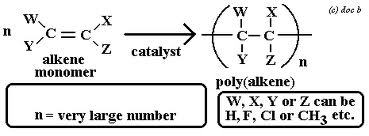
- Addition polymerisation: This is where alkenes join together in the presence of high pressure and a catalyst
- The product will be a very long hydrocarbon chain.
- You can show any polymerisation reaction by opening up the double bond and putting a bracket around it.
- These polyalkenes are saturated, and are very unreactive
- Polyethene: Plastic bags. Polypropene: straw, biros, food containers.
- These polyalkenes are saturated, and are very unreactive
- You can show any polymerisation reaction by opening up the double bond and putting a bracket around it.
- The product will be a very long hydrocarbon chain.
Haloalkanes
- Properties:
- Boiling points
- A very low, usually gaseous at room temperature. The reason for this is because there are weak intermolecular forces between them i.e. van der Waal's
- As you go down the homologous series, the boiling points get higher because there are more van der Waal's
- So more energy is required to break these intermolecular forces.
- As you go down the homologous series, the boiling points get higher because there are more van der Waal's
- A very low, usually gaseous at room temperature. The reason for this is because there are weak intermolecular forces between them i.e. van der Waal's
- Solubility:
- Haloalkanes are non polar, and so they aren't soluble in water and therefore are soluble in hydrocarbon because it is also non polar
- Bond Strength
- Decreases as you go down the group 7
- The reason for this is because they get less electronegative as you go down the group
- This is because shielding increases as well as distance. There is weaker nuclear attraction and so the bond between the group 7 atom and carbon is not as stong and gets easier to break as you go down.
- The reason for this is because they get less electronegative as you go down the group
- Decreases as you go down the group 7
- Boiling points
- Reactivity/Reactions
- There is a difference in electronegativity between the halogen and the carbon. This will create dipoles
- They go through Nucleophilic subsitution
- Substitution is replacing one atom with another
- A nucleophile is a species that is able to donate a pair of electrons to an electron deficient species
- Hydroxide/OH- ion
- Produces an alcohol
- Also alcoholic Aqeuous
- Cyanide/CN- ion
- Produces a nitrile
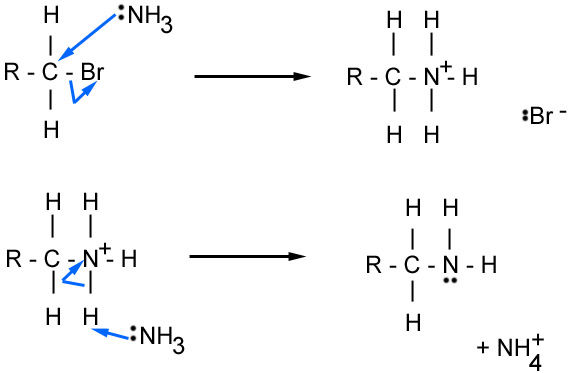
- A molecule of ammonia
- Produces an amine
- Alcholic solvent
- Produces an amine
- Hydroxide/OH- ion
- Mechanism:
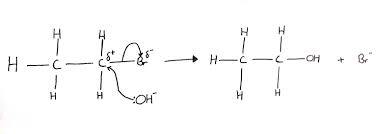
- The OH- will 'attack' the carbon as it is a delta+ species.
- The carbon now has too many electrons so the Br atoms takes its original electrons and one of the carbon's.
- The carbon now has too many electrons so the Br atoms takes its original electrons and one of the carbon's.
- Equation: C2H5Br + NaOH ------> C2H5OH + NaBr
- The carbon now has too many electrons so the Br atoms takes its original electrons and one of the carbon's.
- The carbon now has too many electrons so the Br atoms takes its original electrons and one of the carbon's.
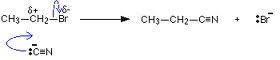
- The CN- will 'attack' the carbon as it is a delta+ species
- The carbon now has too many electrons so the Br atoms takes its original electrons and one of the carbon's.
- It becomes a Br- ion and reacts with the Na+ or K+ that's just sitting there in the solution
- We don't use HCN because its a poisonous gas
- Notice how the lone pair on the CN- is on the carbon
- Equation: C2H5Br + KCN -----> C2H5CN + KBr
- C2H5CN: Propanitrile
- Equation: C2H5Br + KCN -----> C2H5CN + KBr
- The carbon now has too many electrons so the Br atoms takes its original electrons and one of the carbon's.
- The lone pair on the nitrogen of the ammonia molecule will 'attack' the carbon as it's a delta+ species
- The carbon now has too many electrons so the Br atoms takes its original electrons and one of the carbon's.
- It forms a Br- ions
- There is a positive charge on the carbon because the nitrogen is bonded to 4 things
- In order to make it stable, we need to 'deprotonate' it. In other words, you take of a proton or H+ ions because it's the same thing
- To do this, you need another ammonia molecule which will dative covalently bond with the H+ ions to form ammonium (NH4+)
- This will then bond with the Br- ions that was formed before
- Equation: C2H5Br + 2NH3 -------> C2H5NH2 + NH4Br
- C3H5NH2-- Ethylamine
- Equation: C2H5Br + 2NH3 -------> C2H5NH2 + NH4Br
- This will then bond with the Br- ions that was formed before
- To do this, you need another ammonia molecule which will dative covalently bond with the H+ ions to form ammonium (NH4+)
- In order to make it stable, we need to 'deprotonate' it. In other words, you take of a proton or H+ ions because it's the same thing
- Conditions with ammonia:
- Sealed container as NH3 is gaseous
- High pressure: Higher rate of reaction
- Alcoholic solution for the haloalkane
- High pressure: Higher rate of reaction
- Sealed container as NH3 is gaseous
- The carbon now has too many electrons so the Br atoms takes its original electrons and one of the carbon's.
- Conditions for OH- to react:
- 1. NaOH or the reagent has to be in a polar solvent e.g. water
- 2. The haloalkane needs to be in a non-polar solvent e.g. alcohol
- Therefore, an alcoholic aqueous solution is required
- The reaction needs to take place in either room temperature or be warm, but NOT heated
- Therefore, an alcoholic aqueous solution is required
- 2. The haloalkane needs to be in a non-polar solvent e.g. alcohol
- 1. NaOH or the reagent has to be in a polar solvent e.g. water
- The OH- will 'attack' the carbon as it is a delta+ species.
- We know that the reagents are CN-, OH- and ammonia. However, you can't just go to a store and get and OH- or CN- ion of the shelf.
- It's got to be ionically bonded to something else, e.g. NaOH, NaCN, KOH, KCN etc. in order to stabilise it.
- We include the reagent in the chemical equation but not the mechanism
- The Na+, or K+ ion will act as the spectator ion
- It's got to be ionically bonded to something else, e.g. NaOH, NaCN, KOH, KCN etc. in order to stabilise it.
- Production
- 1. Electrophilic addition
- With H-X
- With X2
- Free Radical Substitution
- This uses an Alkane and a halogen
- A free radical is a species with an unpaired electron. It is very unstable and will react with almost anything
- Conditions:
- A sealed container
- UV light, this provided the energy to break the halogen bond which is extremely hard to break on its own because they have similar electronegativitys
- A sealed container
- Equation: CH4 + Cl2 ------> CH3Cl + HCl
- Mechanism:
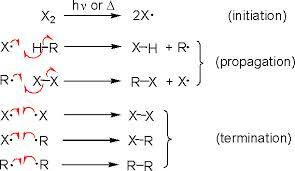
- 1. Initiation: This is where the UV light will break the bond between the Cl2. The two electrons that are shared now separates and each Cl gets its own electron and forms a free radical
- This is called homolytic fission: where a bond breaks and the electrons go seperate ways to form a free radical
- 2. Propagation I: The chlorine free radical reacts with the methane and forms a methane free radical and a HCl molecule
- Propagation II: The methane free radical will react with a Cl2 molecule to form chloromethane and a Cl free radical
- This should in theory start the cycle again because you're back to where you started.
- No more UV light is required
- 3. Termination: This is where 2 free radicals react with each other and the reaction then stops as you no longer have a free radical
- No more UV light is required
- You could get other possible propagation steps that lead to different substituted haloalkanes e.g. dichloromethane or even tetrachloromethane
- These can be separated using fractional distillation as they will have slightl different boiling points
- E.g. you could get a chloromethane react with a cl. free radical. It will form HCl and then will form a chloromethane free radical. This will then react with a chlorine to form dichloromethane
- This should in theory start the cycle again because you're back to where you started.
- Propagation II: The methane free radical will react with a Cl2 molecule to form chloromethane and a Cl free radical
- 1. Initiation: This is where the UV light will break the bond between the Cl2. The two electrons that are shared now separates and each Cl gets its own electron and forms a free radical
- Depletion of the Ozone layer
- This occurs by free radical substitution
- The ozone layer is made up of O3 and it protects the earth/land from the UV rays from the sun
- CFC's: These are chlorofluorocarbons. They used to be used as refrigerants or aerosols
- However they are now banned because they were contributing to the destruction of the ozone layer
- They are harmless on land, but when they get up in the atmosphere, the bonds start to break from the UV light found in the atmosphere to form free radicals.
- These free radicals will then react with the ozone layer
- Cl. + O3 ------> ClO. + O2
- ClO. + O3-----> 2O2 + Cl.
- In total : 2O3------> 3O2
- Although this isn't harmful, the ozone layer has been destroyed
- The cycle will start again
- In total : 2O3------> 3O2
- ClO. + O3-----> 2O2 + Cl.
- Cl. + O3 ------> ClO. + O2
- These free radicals will then react with the ozone layer
- They are harmless on land, but when they get up in the atmosphere, the bonds start to break from the UV light found in the atmosphere to form free radicals.
- However they are now banned because they were contributing to the destruction of the ozone layer
- 1. Electrophilic addition
- Elimination:
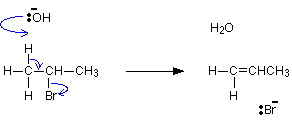
- This is where you turn a haloalkane back into an alkene
- In order to do this, we need to break 2 bonds.
- In a haloalkane, the easiest bond to break is the H-X bond because they have a greater difference in electronegativity than a C-H bond does
- The second bond to break has to be a C-H bond
- You have to get rid of a H that is ADJACENT to the carbon that you've just pulled off a halogen from in order to form a double bond
- To do this, we need a base: a hydroxide ion
- This will pull off the H+ ions as a base is a proton acceptor
- The H+ will obviously take no electrons with it
- So the carbon has one extra electron, and it will have a negative charge on it
- Both the carbons form another bond (+ and -) and the double bond has formed
- So the carbon has one extra electron, and it will have a negative charge on it
- The H+ will obviously take no electrons with it
- This will pull off the H+ ions as a base is a proton acceptor
- To do this, we need a base: a hydroxide ion
- You have to get rid of a H that is ADJACENT to the carbon that you've just pulled off a halogen from in order to form a double bond
- It will take both it's electrons with it, so there will be a plus charge on the carbon
- The second bond to break has to be a C-H bond
- In a haloalkane, the easiest bond to break is the H-X bond because they have a greater difference in electronegativity than a C-H bond does
- Mechanism:
- In order to do this, we need to break 2 bonds.
- Conditions:
- The right conditions are required otherwise the OH will act as a nucleophile and not a base
- 1. Alcoholic solution/solvent only
- Heat, not warm
- This is where you turn a haloalkane back into an alkene
- Properties:
Imagens e arquivos do mapa
Informações
- Descrição
- Mapa Mental sobre Chemistry Unit 2- Alkenes and Haloalkanes, criado por bilkis-21 em 27-05-2014.
- Criado por
- bilkis-21
- Visualizações
- 156
- Avaliação