
Notas
gradient descent
Conteúdo das notas (4)
Página 1
:why is gradient descent needed?
to find the minimum of a function...as in the cost function J(theta0, theta1)
how does it work?
start with theta0 and theta1
compute J(theta0, theta1)
modify theta0 , theta1
to minimize J(theta0,theta1)
Página 2
gradient descent function : for theta-0, theta-1
theta-j := theta-j -alpha * d/dthetaj * J( theta-0,theta1)
alpha - learning rate
theta-0, theta-1 have simultaneous update
ex.,
tempo-0 := theta-0 -alpha * d/dtheta-0 * J( theta-0,theta1)
tempo-1 := theta-1 -alpha * d/dtheta-1 * J( theta-0,theta1)
:= signifies assignment operator; like set parameter in programming;
different from = ; a:=a+1 is assignment ;
where as = is an assertive statement;
theta-0: = tempo-0
theta-1: = tempo-1
Página 3
example : cost function with one variable : J(theta1)
theta1 := theta1 - alpha * d/dtheta1 * J(theta1)
d/dtheta represents the slope of the tangent line at J(theta1) , theta1
alpha is the learning parameter ; it is positive;
if alpha is too small, the descent will be slow
alpha too high, fail to converge or even diverge
choose an alpha and no need to change it over the iterations;
Página 4
first machine learning algorithm: linear regression:
h(x) = theta-0 + theta-1 * x;
J(theta) = 1/2m * (sum of squared errors)
mean sum of squared errors = 1/2m * (sum of squared errors)
sum of squared errors = sigma (1->m) error^2
error = (theta0 + theta1*xi) - yi
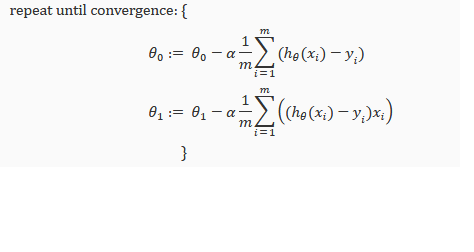
repeat until convergence :
theta0 := theta0 - alpha * d/dtheta0 * J(theta0, theta1)
theta1 := theta1 - alpha * d/dtheta1 * J(theta0, theta1)
Gradient descent for linear regression : above statement looks as :
Informações
- Descrição
- Machine Learning Notas sobre gradient descent, criado por Mukundhan Srinivasan em 18-03-2018.
- Criado por
- Mukundhan Srinivasan
- Visualizações
- 0
- Avaliação