
Notas
Notes
Conteúdo das notas (22)
Página 1
a systematic approach to operationalize the business strategy, trying to develop the improvements
supported on human resources, and when possible implementing information
systems.
Page 3:
The problem wasn't on the adoption of the technology, but clarifying what is intended to do, and to improve areas that are priority considering their business objectives.
This assumes that in some cases the work developed in the organizations is not oriented to their real needs and is a waste of resources. According to Hammer (1997) this should be eliminated, and also everything that don't generate value to the organization, which is also attuned with the concept of the value chain of Porter (1985). How to develop this assessment in sport organizations is our concern, identifying improvements based on the clarication of the organization value chain targeting the human work (e.g. training or changing how is developed), using or not technology.
The need to develop improvements in the organizations and increase their performance is one of main purposes for the managers develop their activity.
Page 5:
Our aim is to propose an approach to be adopted in sport organizations, using BPM
to support the operationalization the strategy under the assumptions that isn't properly
addressed by the research in sport management (Thibault et al., 1993; Slack, 2010;
Emery, 2010). The questions that arise are: How we can develop an approach based in
the strategy to dene improvements in the sport organization, facilitating the denition
of necessary actions to achieve the strategy? How can we get an insight in the sport
organization with the constrains of agility and simplicity, supporting the improvements
actions articulated according their business objectives?
Página 2
Action Based Research:
http://www.aral.com.au/resources/arthesis.html#a_art_datacol
https://eprints.qut.edu.au/2668/1/2668.pdf
http://www.aral.com.au/resources/guide.html
The structure of the developed research is based in the action research. Lewin (1946) considered
the founder of the action research, emphasis that is a research methodology that
supports the practitioner’s knowledge generation about the social system that intends
to change. Action-research is a methodology with the double objective of action and
research:
(1) action to change the organization, community or program and
(2) research to increase the comprehension of the researcher about the study carried, or both (Dick,
1993). J. M. Davis (2004) also considers this as the main element of this type of research.
Benbasat, Goldstein, and Mead (1987) suggest that the action researcher isn't an independent
observer, but participates in the process of change. Perry and Zuber-Skerritt(1992) proposes action research has an alternative type of research, which is appropriate to graduate management research programs, enhancing its relevance to management practice. Altrichter, Kemmis, McTaggart, and Zuber-Skerritt (1991) cited by Perry and Zuber-Skerritt (1992) points that the main aspects are:
(1) a group of people at work together;
(2) involved in the cycle of planning, acting, observing and reflecting on their work more deliberately and systematically than usual; and
(3) a public report of that experience (such as a thesis).
One of the characteristics of the action research is its non linearity (J. M. Davis, 2004) or the implied adaptability to the environment were the researcher acts (Kumar & Sankaran, 2010). Coghlan and Brannick (2005, p. 13) states that action research is appropriate when:
"...the research topic is an unfolding series of actions over time in a given group,
community or organization, and the members wish to study their own action in order
to change or improve the working of some aspects of the system, and study the process
in order to learn from it. Hence action research is akin to experiential learning and
reflective practice."
Página 3
Why BPM?
The different areas supporting BPM provides an unifying theme directed to the
improvement of organizational performance (Hammer, 2002) based on processes and
considering systematically elements like strategy, scope of change, performance measurement,
process architecture, human factors and information technology (Smart et al.,
2004). BPM tries to create value from a sustained focus on business process (Smart et
al., 2009) which is supported in the assumption that people work on functions, and that
the processes are not functional (Zairi, 1997; Ould, 2005; Sharp, 2009). The functional
approach has barriers to achieve customer satisfaction (Zairi, 1997) when removed improves
the perspective to the customer (McAdam, 1996) solving the problems created
by the Taylorism functional specialization (Hung, 2006). The work developed in departments
(organizational functions) isn't easily articulated and have conficting objectives, creating sub-optimizations, overheads and non-value-adding work1, which dicult the
identication of a responsible (Hammer, 2002).
BPM is considered the best approach to support the competitive advantage aligning
the operations with the business objectives (Hung, 2006)
Within the scope of
the BPM CBOK, Antonucci et al. (2009, p. 12) describes that is both a management
discipline and a set of technologies that supports management by processes. The same
author states that is a systematic approach to achieve consistent goals aligned with the
organization strategic goals (Antonucci et al., 2009, p. 24).
BPM supports the achievement of the organization objectives through the improvement,
management and control of the fundamental business processes (Jeston & Nelis, 2006,
p. 36). R. Davis (2007, p. 24) considers that BPM is a systematic approach to managing
and improving an organisation business by the active, coordinated management of all aspects
of the specication, design, implementation, operation, measurement, analysis and
optimization of business processes in order to eectively and eciently deliver business
objectives.
Página 4
What is a business process?
The perspectives of the practitioners in the BPM area, maintain the alignment with
the previous concepts. Antonucci et al. (2009, p. 24) dierentiating the concepts of
processes and business processes points out that:
A "process", is a dened set of activities or behaviors performed by humans or machines
to achieve one or more goal. Processes are triggered by specic events and have
one or more outcome that may result in the termination of the process or a hando to
another process. Processes are composed of a collection of interrelated tasks or activities,
which solve a particular issue. In the context of business process management, a
"business process" is dened as end-to-end work that delivers value to customers. The
notion of end-to-end work is critical as it involves all of the work, crossing any functional
boundaries, necessary to completely deliver customer value.
Tregear, Alkharashi, Leandro, and Macieira (2010) consider business process as set
of multi-functional activities that generate value for the external customer and others
stakeholders, assuming that the lack of articulation of the functional areas don't generate
value to the external customers. An organization executes the strategy using business
processes that are the mean to develop handovers between customers and the organization.
Business processes should be managed cautiously and improved continuously,
generating value to the customers and others stakeholders. This perspective incorporates
elements related to the value creation and to the alignment of organization strategy.
The Object Management Group (OMG) as the supervisor of the standard Business
Process Model and Notation (BPMN), which is used to model business processes, considers
that is a dened set of business activities that represent the steps required to
achieve a business objective, including the
ow and use of information and resources
(OMG, 2011).
Página 5
Types of Processes
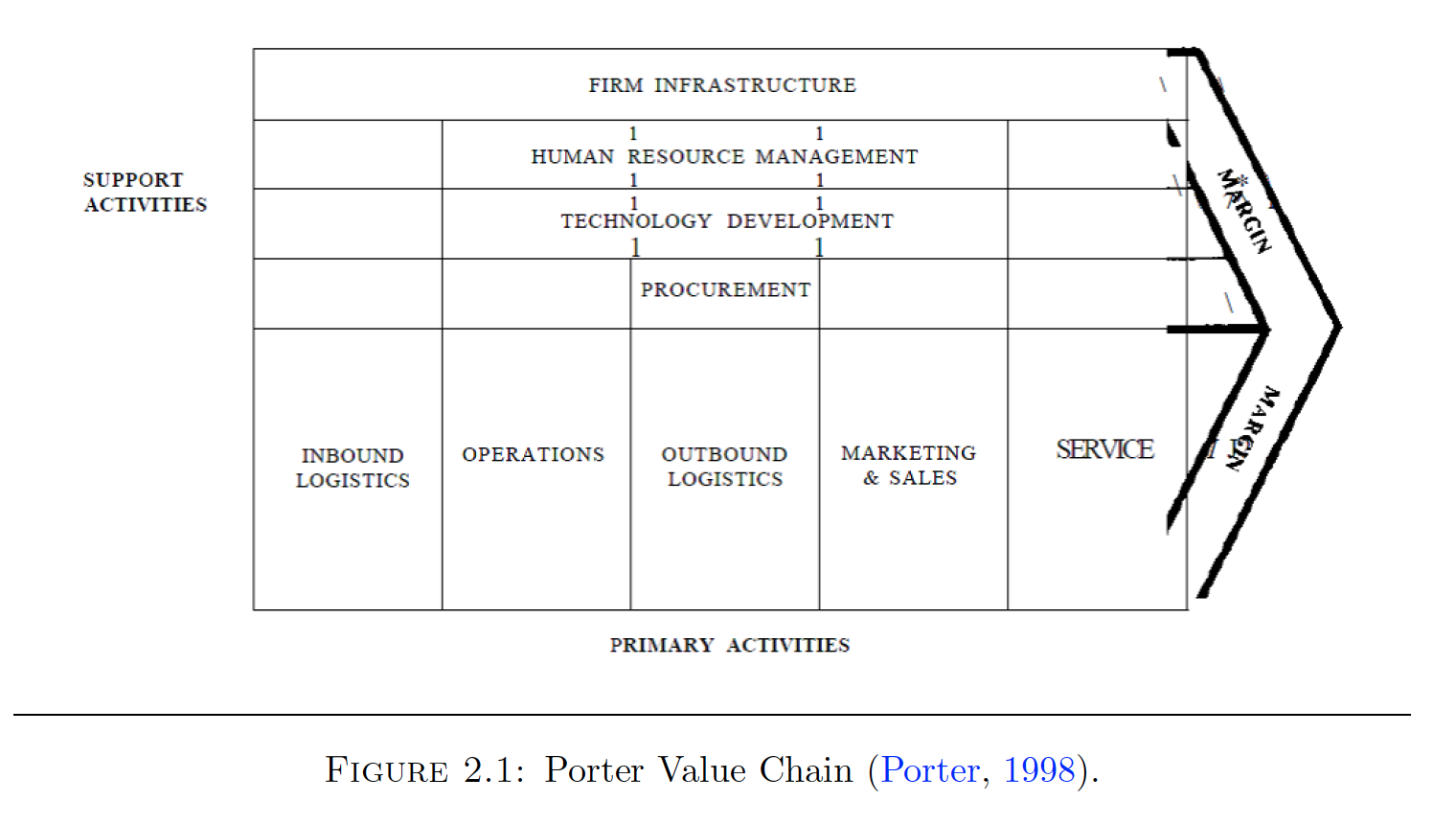
The value chain proposed by porter (Porter, 1985) considers the existence of two types of activities, primary and support (Figure 2.1).
Hammer (1997, p. 46) classify the work
activities in three categories: (1) value-adding work or the work the costumer is willing
to pay; (2) non-value adding work, or work that don't create value for the client but
is necessary to accomplish the value-adding work, and (3) waste, or work that neither
adds value nor enables value.
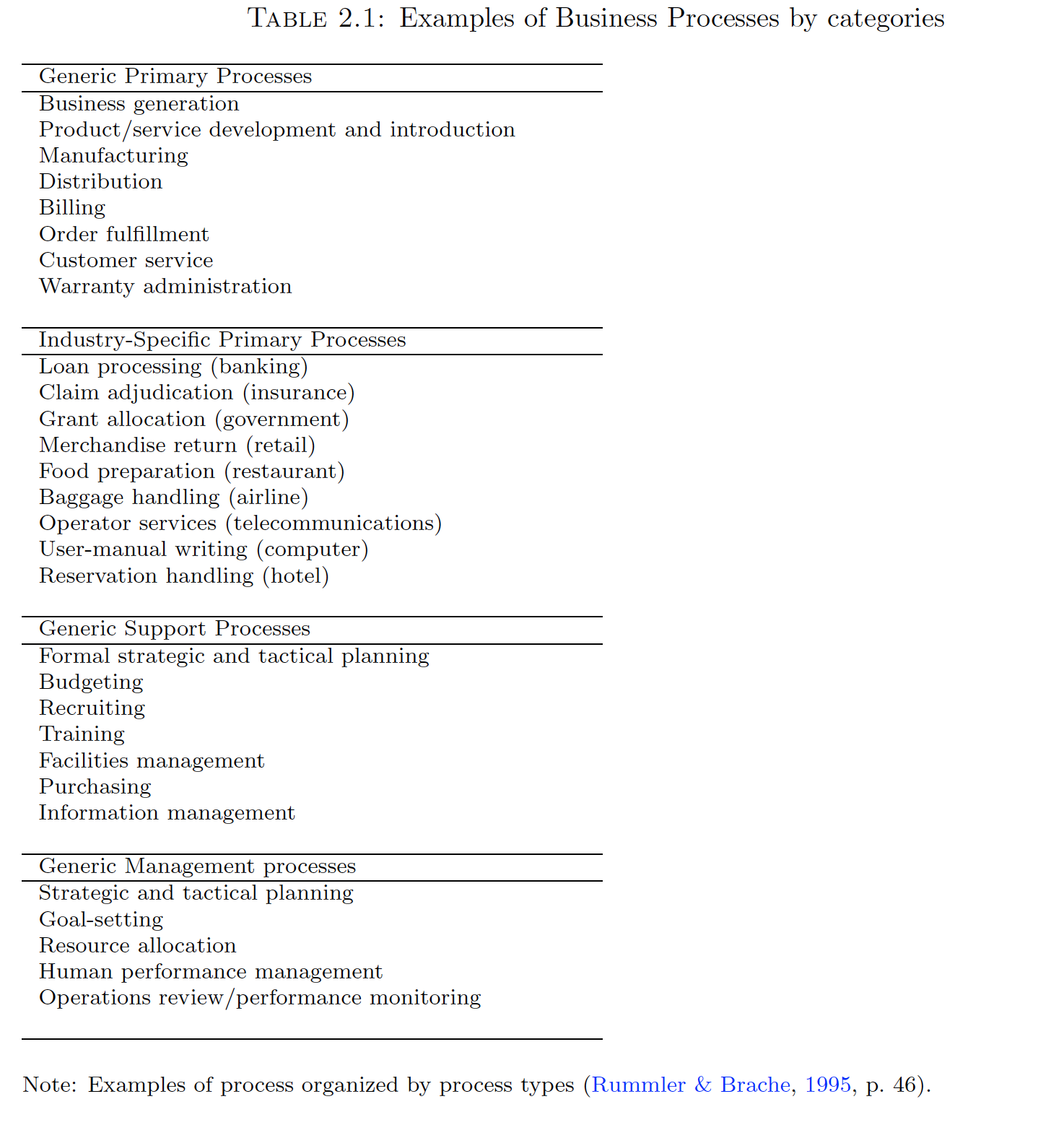
Rummler and Brache (1995, p. 45) consider that the primary processes result from a
product or service to a external customer, support processes produce results that are not
visible to the end customer, and the management processes that includes the managers
actions developed to support the processes. The types of processes are exemplied in
the table 2.1
Página 6
Process Frameworks
To identify the processes of an organization, it can be used existing industry best-practice
models as a checklist, to determine the processes of an enterprise or apply a analytic
approach (Kirchmer, 2011). The Business Process Management Body of Knowledge
identify the following approaches: MIT Process Handbook Business Activity Model;
American Productivity and Quality Council; Value Chain Group and Supply Chain
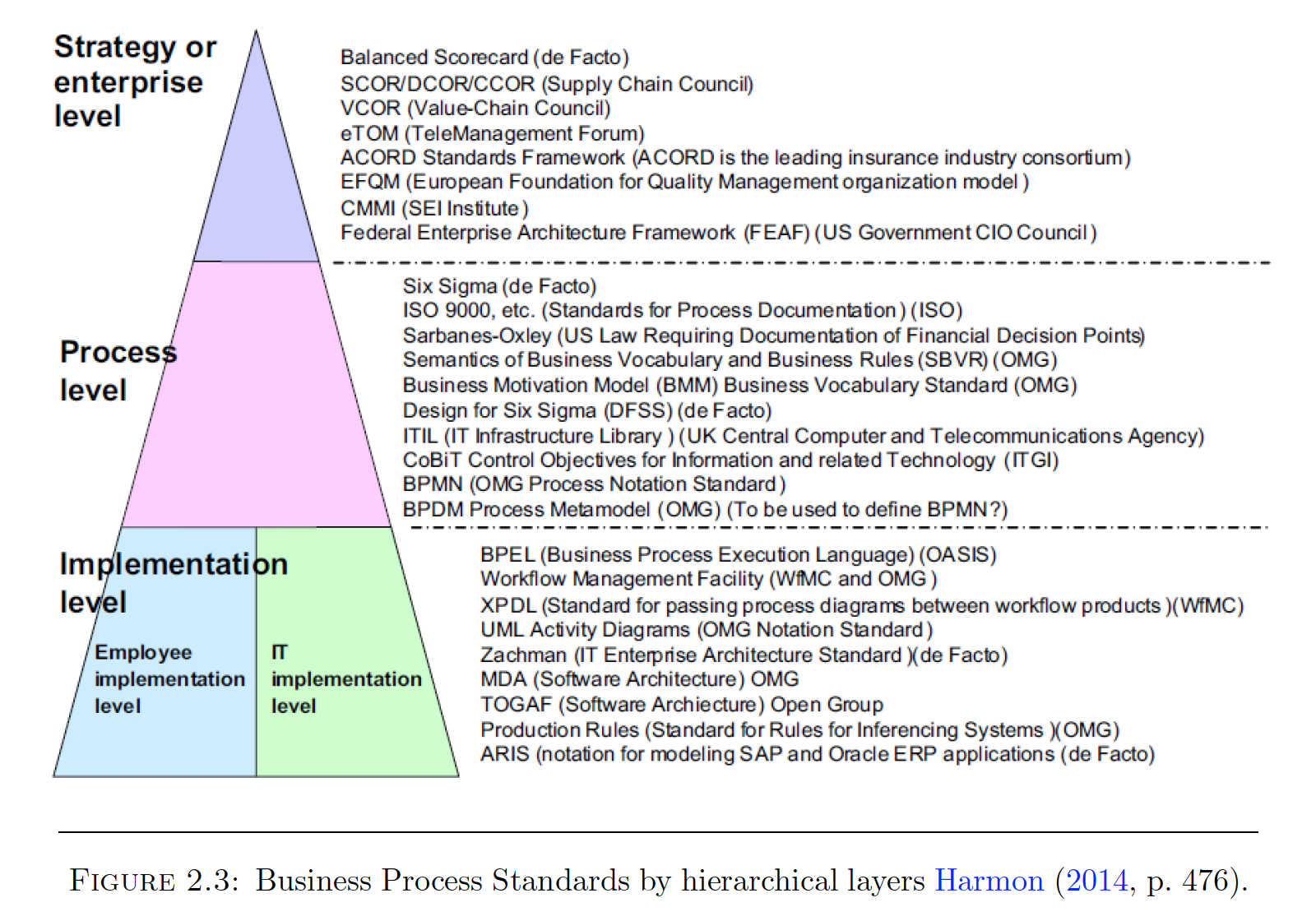
Operations Reference (SCOR) (Antonucci et al., 2009, pp. 162-168). Harmon (2014,
pp. 473-479) suggest the division of the standards related to the business processes in
three areas (Figure 2.3):
1. Enterprise Level: used by executives and senior business managers to organize their
overall understanding, evaluation, and management of a business's performance;
2. Process Level: used by managers, employees, business analysts, and human performance
analysts change how processes work;
3. Implementation Level: Technology used to implement processes according a context
dened in upper levels. It can be also develop job descriptions or hire new
collaborators.
Página 7
Hoye (2006) considers that Sport Managers have the responsibility to create the necessary conditions for the organizations react to opportunities in the market, or the demands of their stakeholders.
Zairi (1997) exemplies ve core process areas resulting from the development of
a BPM effort:
(1) supplier management;
(2) supply chain;
(3) customer development;
(4) brand development and
(5) business planning strategy.
Página 8
Process Validation
To validate if we have the processes properly identifed, Sharp (2009, pp. 39-41) provides the following perspectives:
Involves work, that can be described as a set of activities;
Is named using a verb-noun form, e.g. Perform Registration;
the verb-noun name inverted represent a process outcome, e.g. Registration Performed;
Delivers a specic and essential result, that is can be quantied, e.g. How many
registrations are performed;
The outcome of the process contributes and is essential for the organization;
The previously described process characteristics can be used to assess if the processes
are properly identifed, mitigating an improper process assessment. Additionally allow
us to verify if the decomposition is developed until an appropriate level of work, clarifying
the business capability.
Página 9
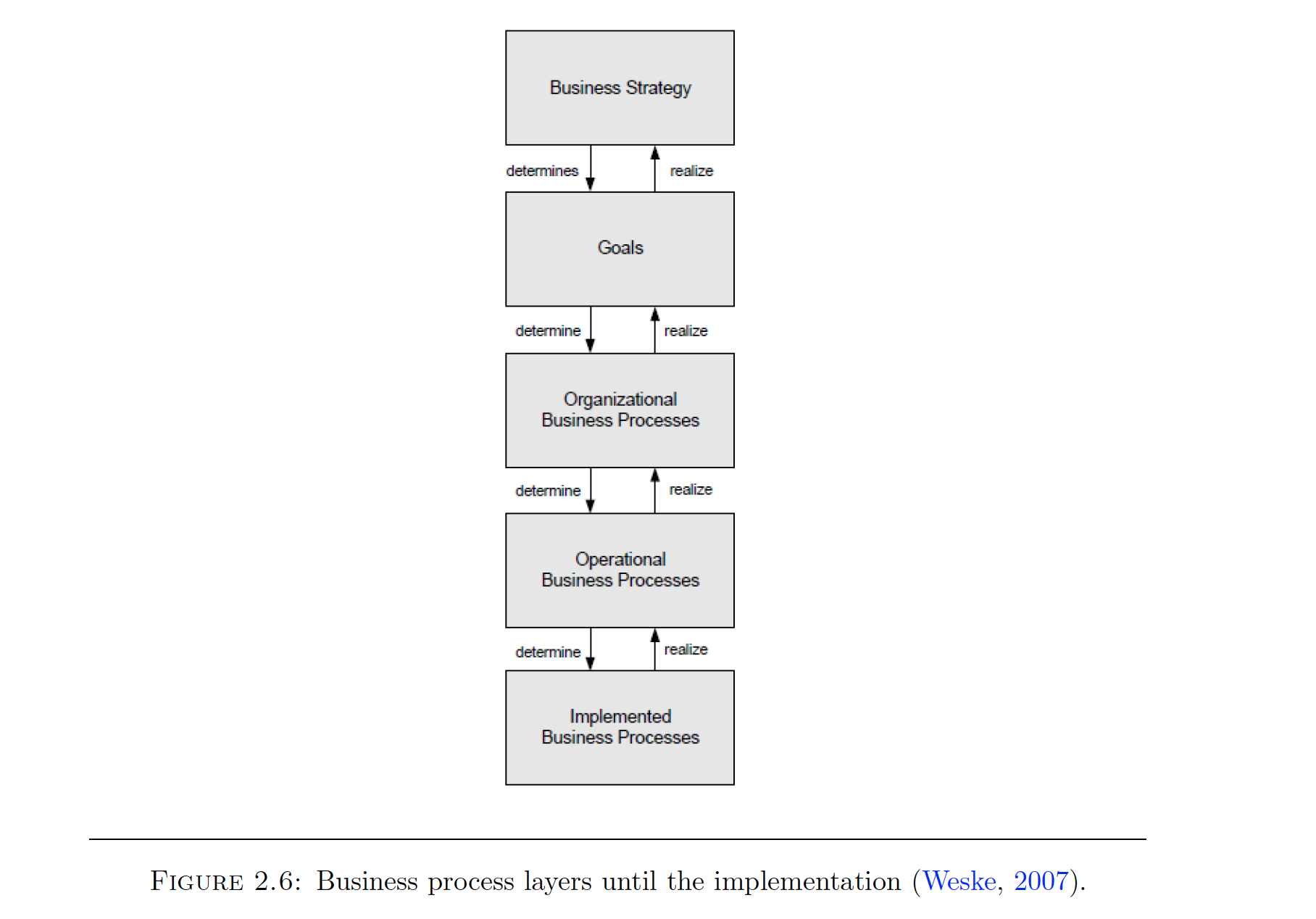
BPM practitioners consider BPM an appropriate approach to support the achievement
of organizational objectives (Antonucci et al., 2009, p. 12; R. Davis, 2007, p. 24; Jeston
& Nelis, 2006).
Página 10
Mission & Vision
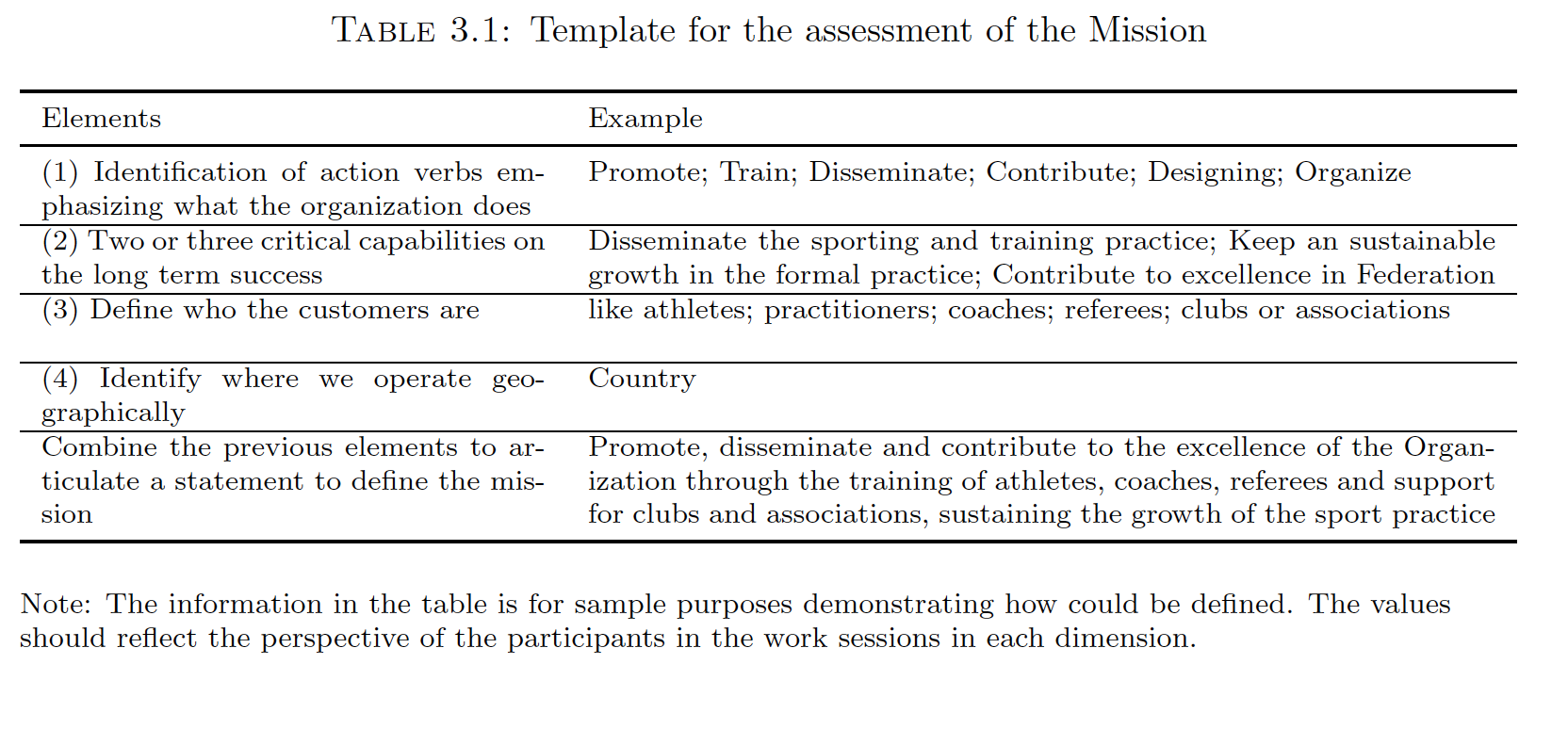
To develop the assessment of the mission, it could also be used the European Foundation
for Quality Management (EFQM) guidelines. The EFQM Toolbook (EFQM, 2001)
suggest that the mission should be developed using the following considerations:
The mission should express the reason of existence of an organization;
The mission can be restructured or adjusted;
Should re
ect what the organization is and express a motivation to the employees;
Should be relevant, credible, short and unforgettable;
To facilitate the denition recommends the following steps:
1. Identify what the organization is doing using action verbs;
2. Define 2 or 3 competences that are critical to your long term success;
3. Define the customers;
4. Define were the organization operate geographically, including cyberspace;
5. Combine the previous elements in a sentence;
Página 11
Strategic objectives
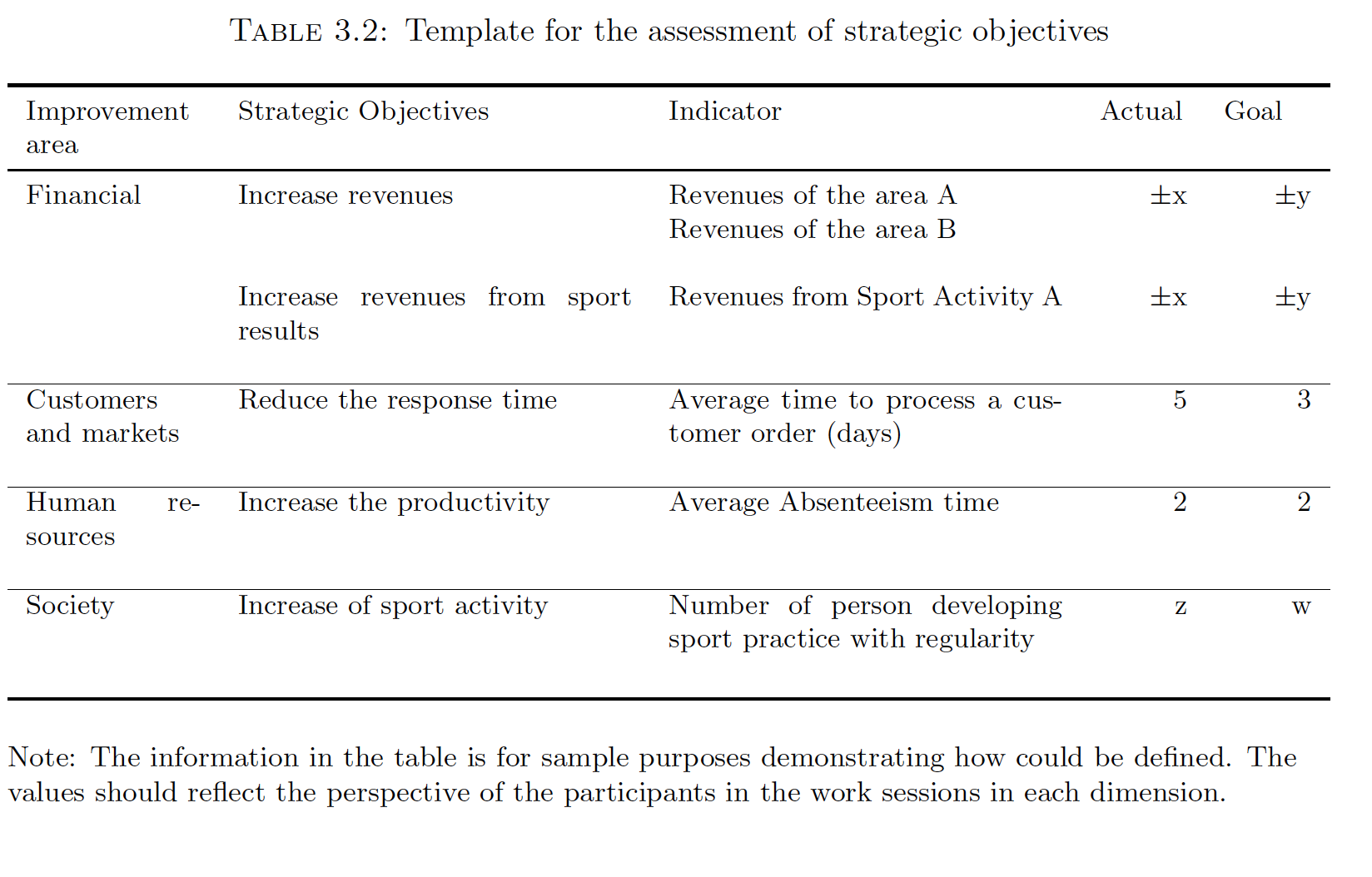
The objective denition should consider the identification of something measurable,
related to time, costs, capacity or quality. Targeting areas like marketing, innovation,
resources (human, physical or financial), productivity, social responsibility and prot.
Developed with the clarication of what is the business (current situation), and what is intended to be. In table 3.2 is presented an example to the denition of strategic objectives.
Página 12
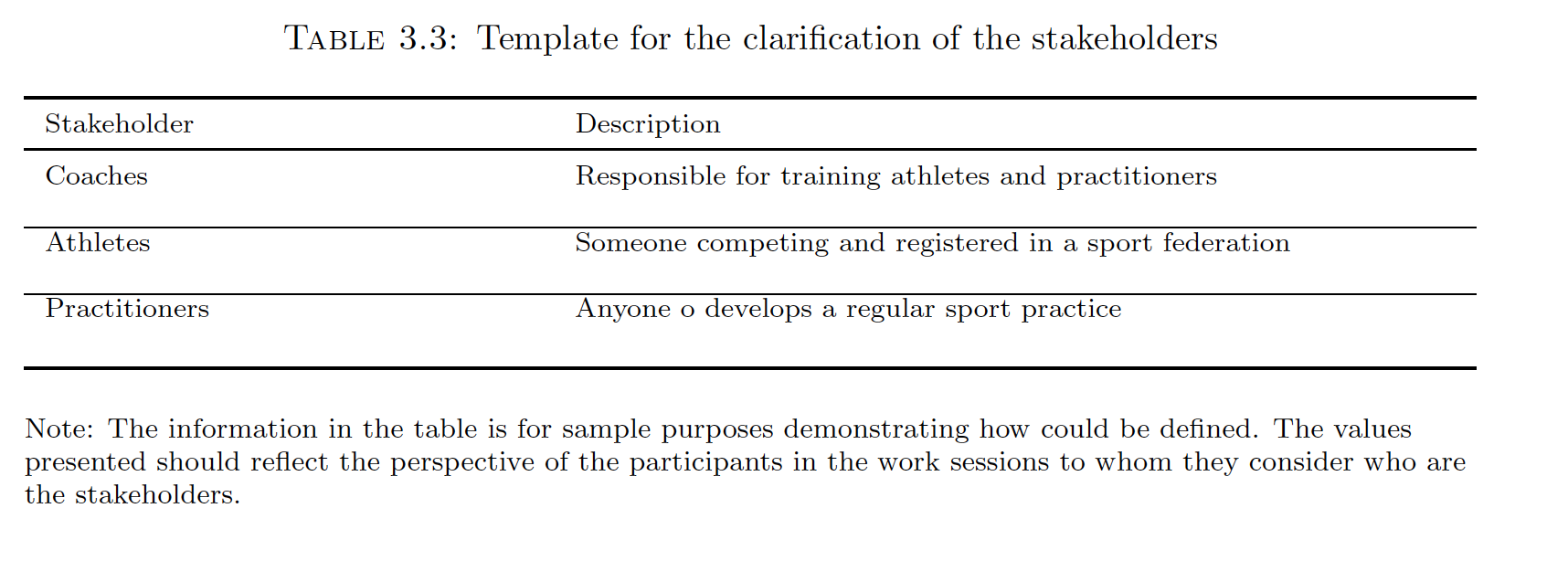
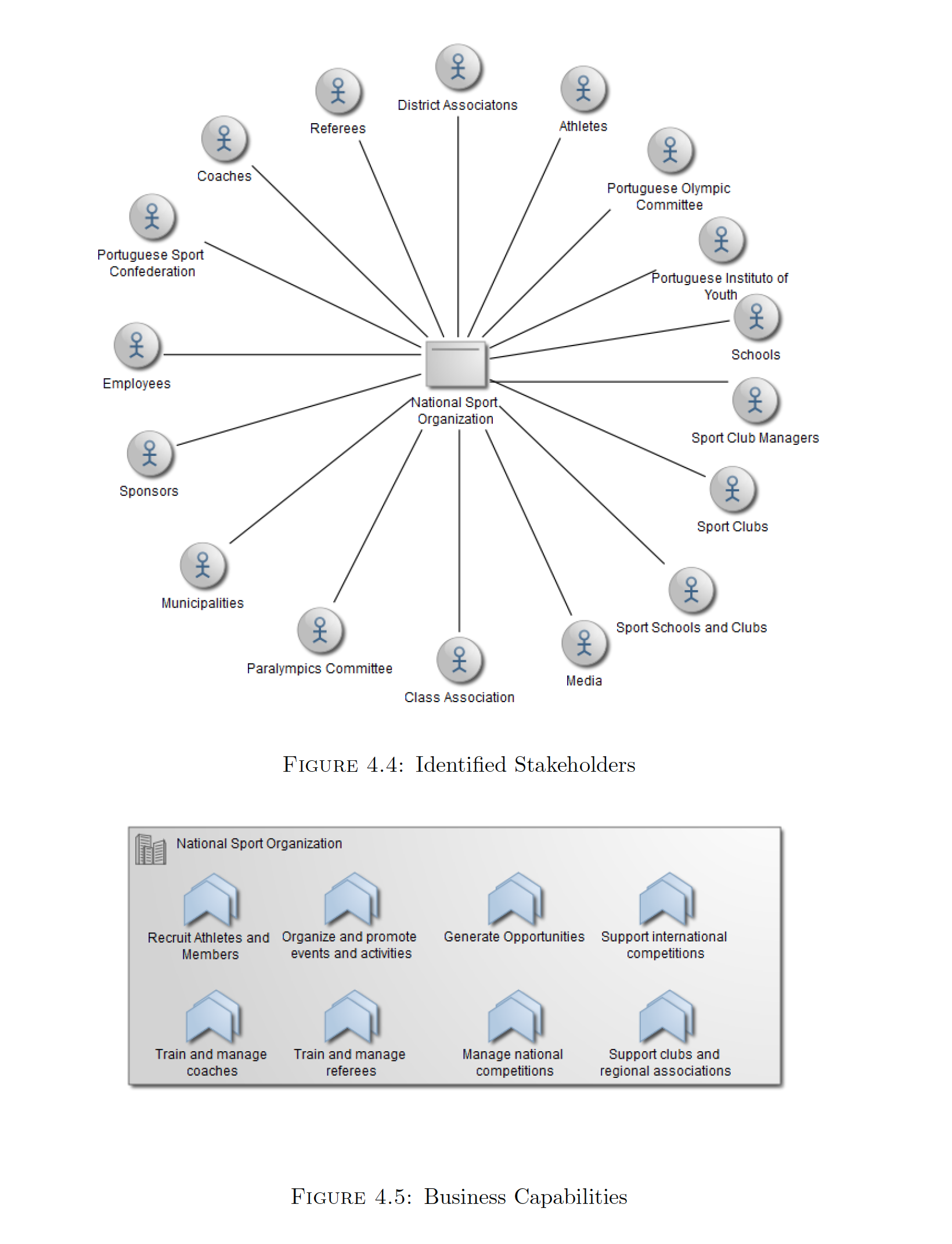
Stakeholders
Página 13
Business Capabilities
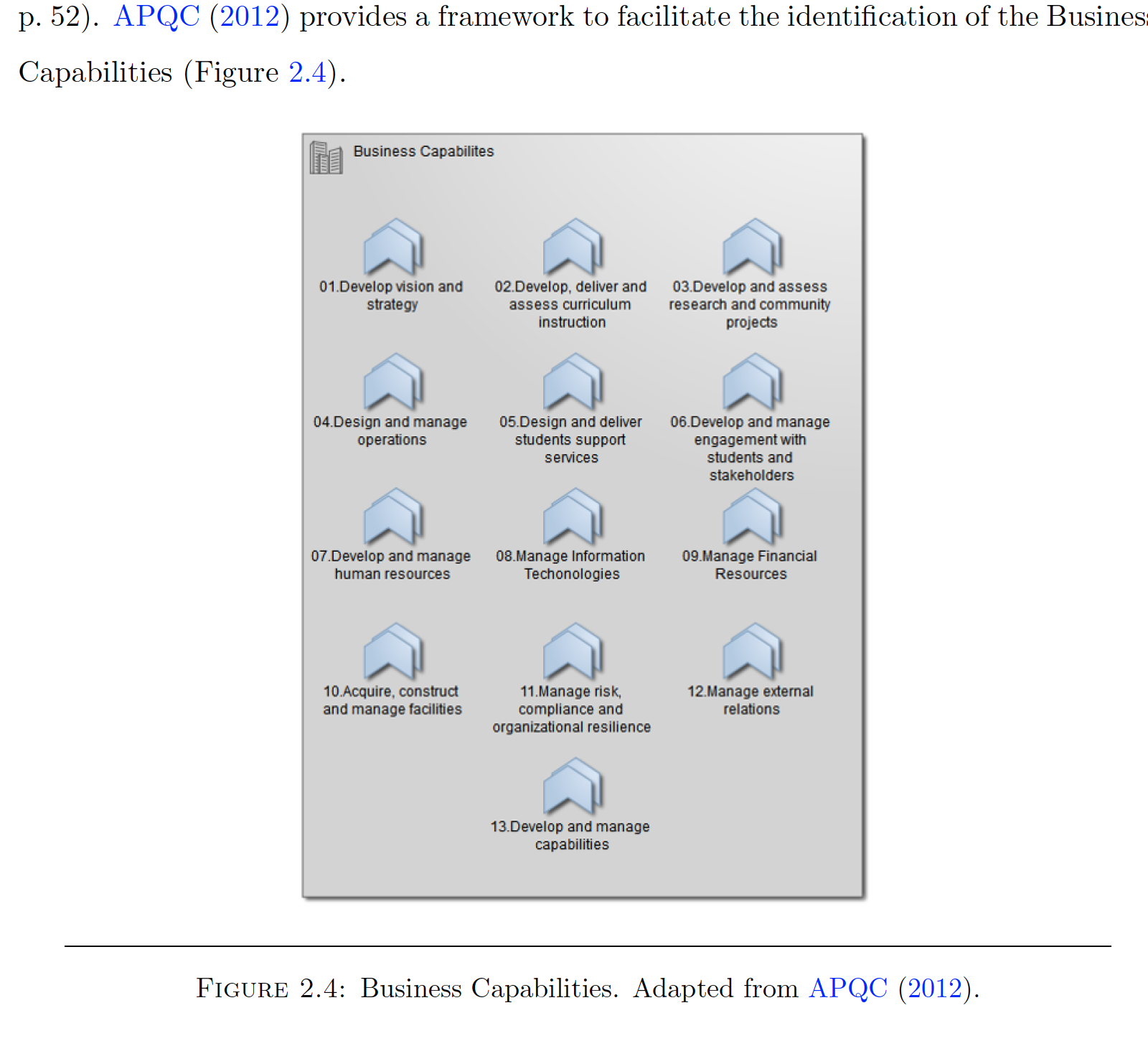
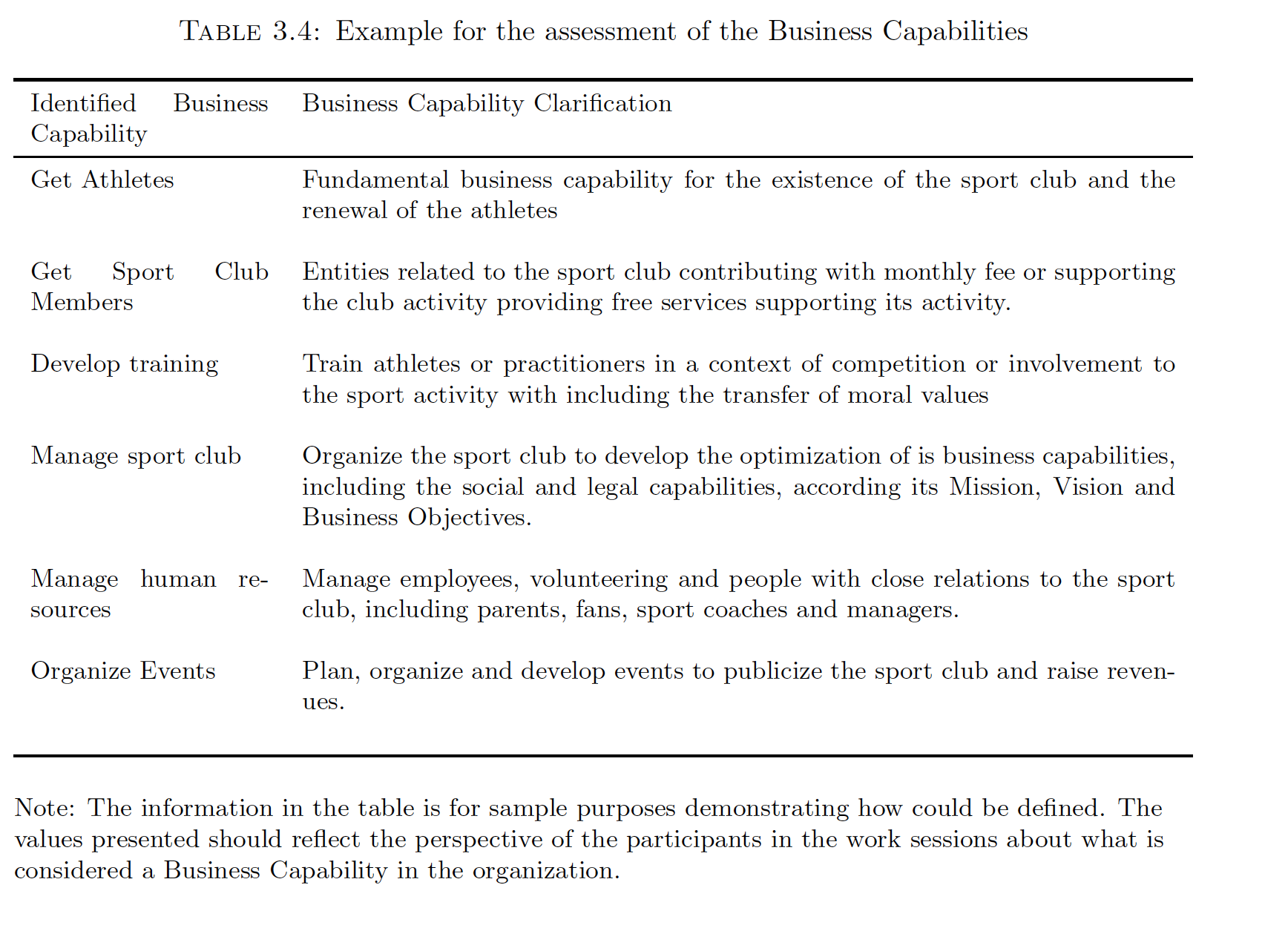
To develop the clarification of the Business Capabilities is considered that are representations
of the "what" the organization must do, to support its Mission and accomplish
its Vision, ensuring its survival, and supporting the adaptability of the organization to
the environment.
Página 14
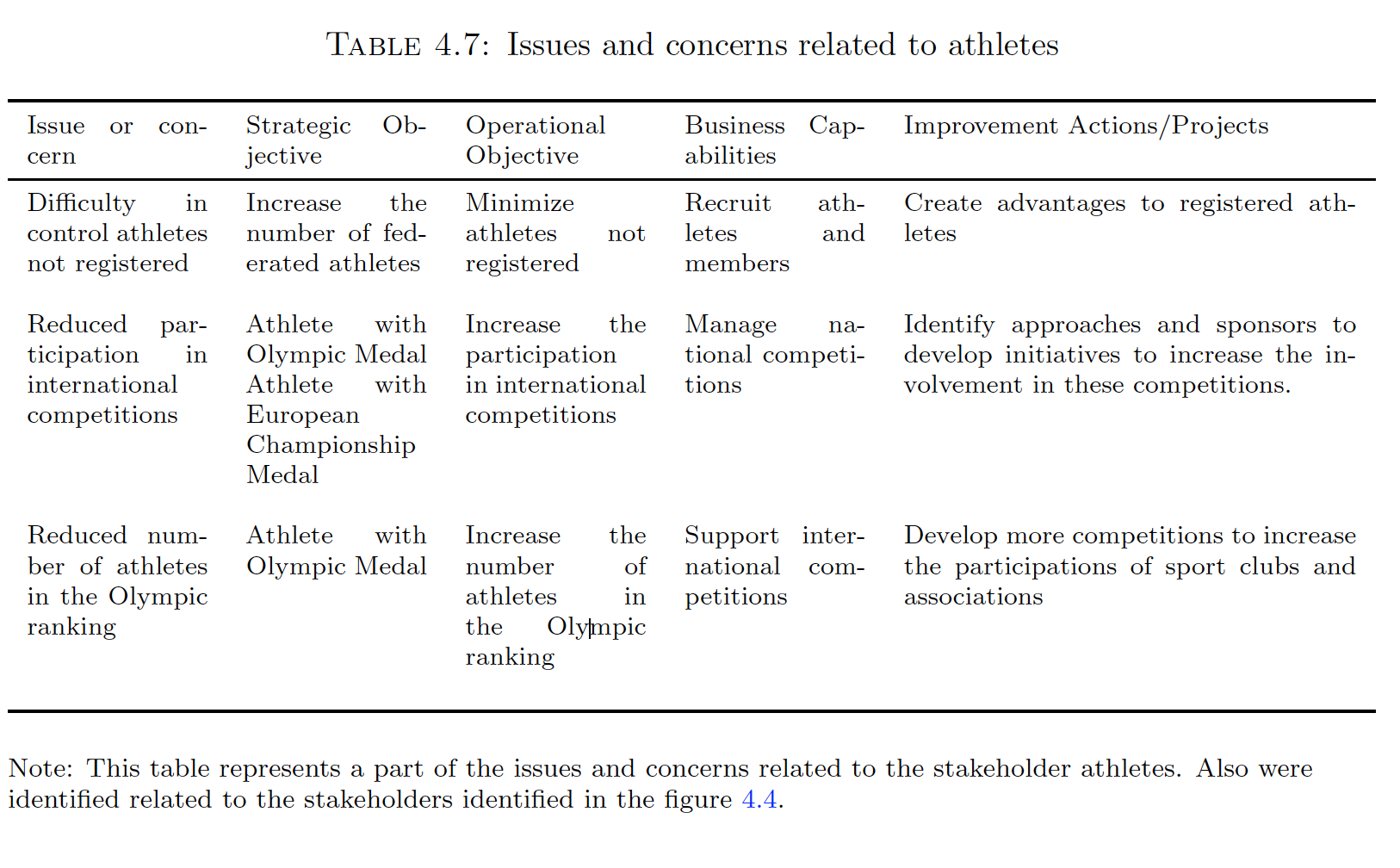
Operations Issues or Concerns
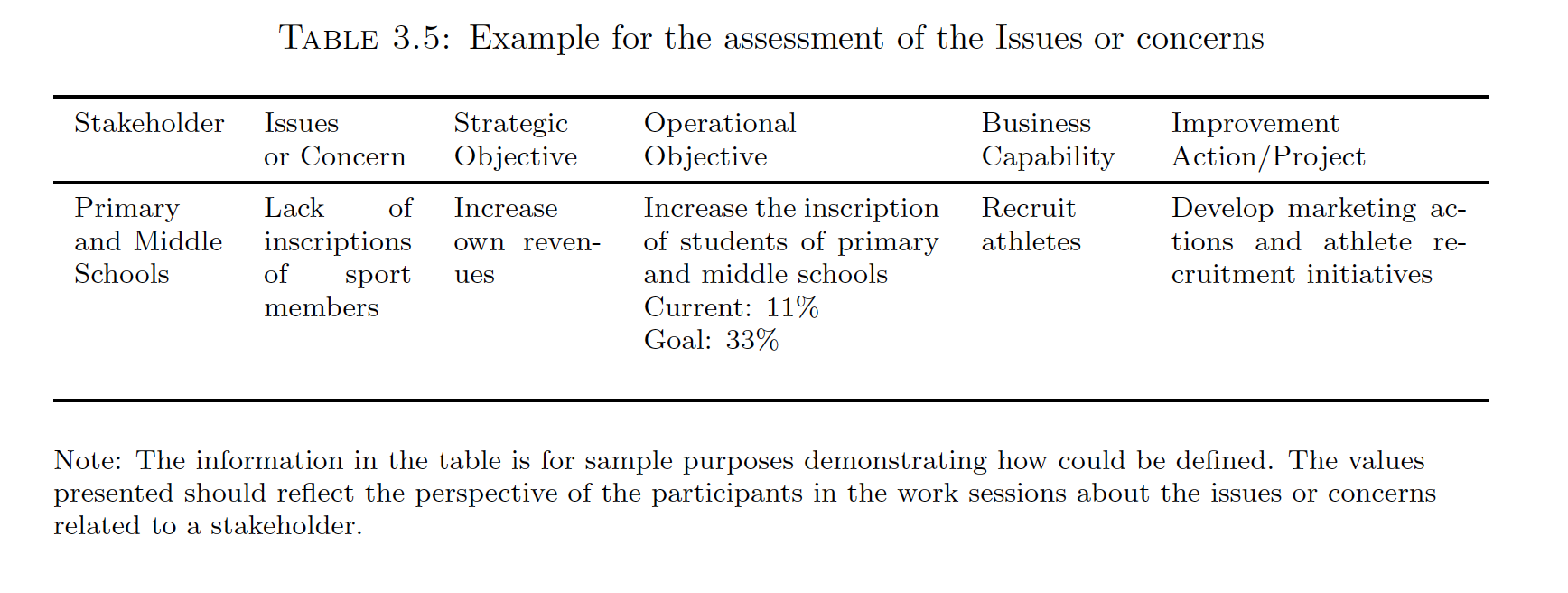
This step develops an issue and concern assessment related to stakeholders, properly
integrated in strategic objectives and framed in a Business Capability.
This step should be developed using the information retrieved in the previous steps,
namely: (1) Strategic Objectives; (2) Stakeholders and (3) Business Capabilities. In the
Table 3.5 is provided a sample of the assessment that can be developed.
Página 15
Implementation
The prioritization of the improvement projects can be developed using a decision matrix,
crossing the information and validating its consistence. After the assessment of the
project priorities the action plan can be developed to clarifying the project initiatives
considering their priorities. The development of the action plan, after the previous steps
allows a proper contextualisation and project denition according a Business Context.
Bellow we describe the Improvement Priorities and the development of the Action Plan.
Página 16
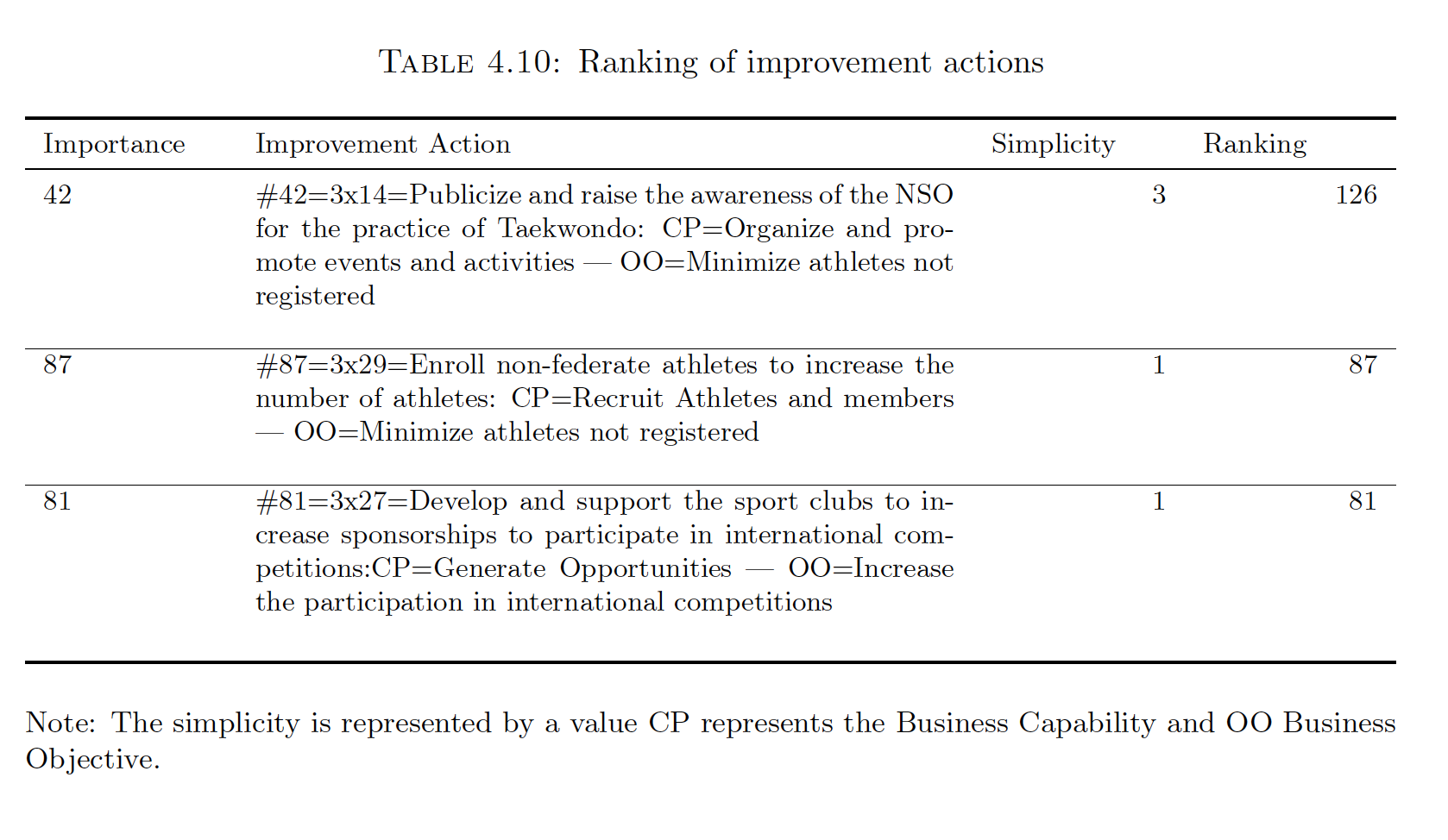
Improvement Priorities
The identication of improvement priorities is based in the assumption that resources
in the organization are limited (e.g. nancial, human or material) and that isn't easy
to develop concerted actions across all the organization, at the same time. Ohlsson,
Han, Johannesson, and Rusu (2014) addresses a method to support managers decisionmaking,
prioritizing process improvement initiatives, proposing the Process Assessment
Heat Map (PAHM). Bandara, Guillemain, and Coogans (2010) describe how to help
decision makers to take decisions considering that relevant resources are scarce, and
that the decisions must select the appropriate projects, according to the organization
Business Objectives.
The problems (issues) confronted with strategic objectives, allow the identication
of improvement areas according the organization objectives. Considering that the issues
or concerns originate Business Objectives, which requires an improvement action to
support the achievement of the objective. The decisions must be carried out when there
are several options to be considered. Kepner and Tregoe (1981) proposes an approach
to support the decision based in ve steps: (1) dene the problem; (2) describe the
problem; (3) establish possible causes; (4) test the most probable cause and (5) verify
the true cause. Bandara, Guillemain, and Coogans (2010) suggests business value for
scoring (BVS) when relevant resources are scarce, and correct decisions must be made
to make sure that those projects that are of best value are implemented. Tague (2005)
in the quality toolbox suggests several examples to be used in decisions. The described
perspectives deal with the same problem, crossing objectives, investments, resources
(what is available) with restrictions, improvements, generally what to be solved.
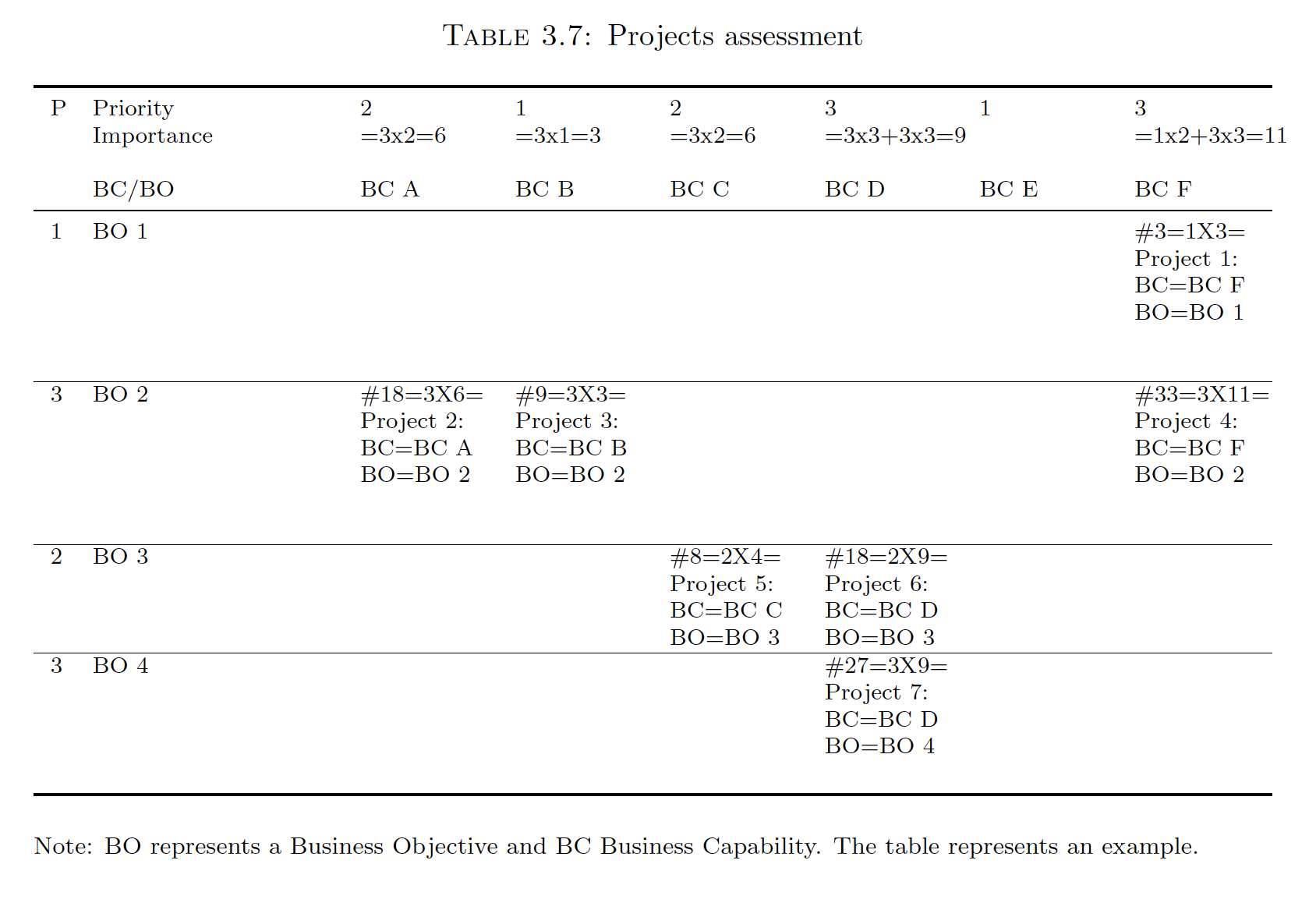
To identify the improvement priorities, we can develop the following steps (Table
3.6):
1. List horizontally the Business Capabilities;
2. List vertically the Business Objectives and quantify their importance (scale from
1 to 3);
3. Introduce a value (scale from 1 to 3) to quantify the contribution of the Business
Objective to the Business Capability;
4. Calculate the sum of the product between contribution and is importance;
5. The Business Capabilities with bigger values are priority.
Página 17
Development of the Action Plan
To enhance the Business Capabilities according the
organization Business Objectives is necessary to develop a project to correct the gap
between the actual performance and the intended one.
Sorting the projects using their ranking allow us to create a project queue that
identies what the organization must accomplish according their business objectives
and the information previously retrieved.
The action plan developed after the clarication of the strategy, operations and improvement
priorities, facilitates the project denition, which should represent a broader
perspective to move the organization to a new state, according their Business Objectives,
which needs to be achieved.
Jeston and Nelis (2006, pp. 208-209) proposes several implementation scenarios, how to address change:
(1) Big-bang for disruptive implementations;
(2) Relay producing step by step implementations;
(3) Parallel starting the new project before ending the previous one and
(4) Combination of previous three.
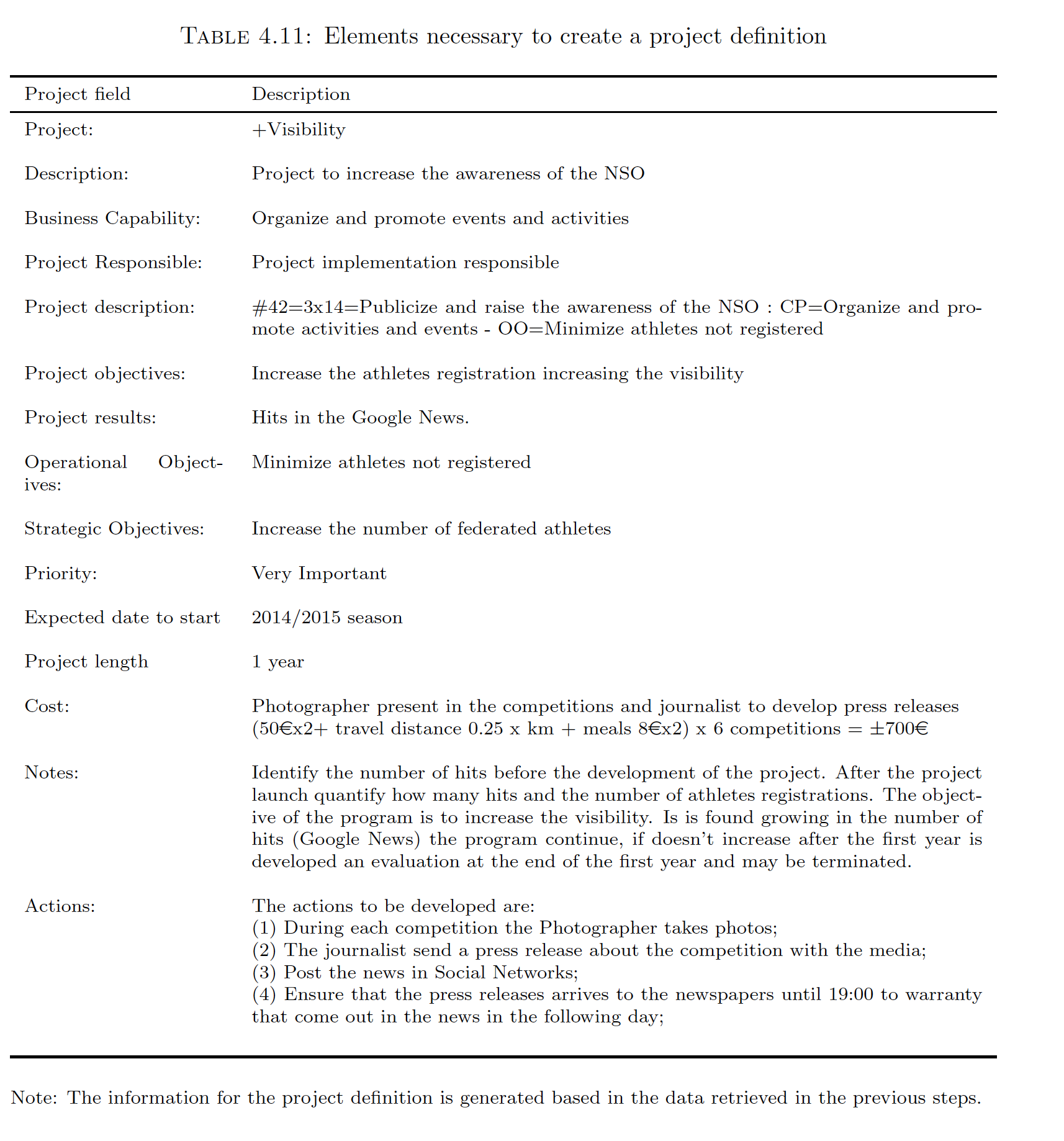
Inany of the implementation the scenarios the action plan can be used as project source.
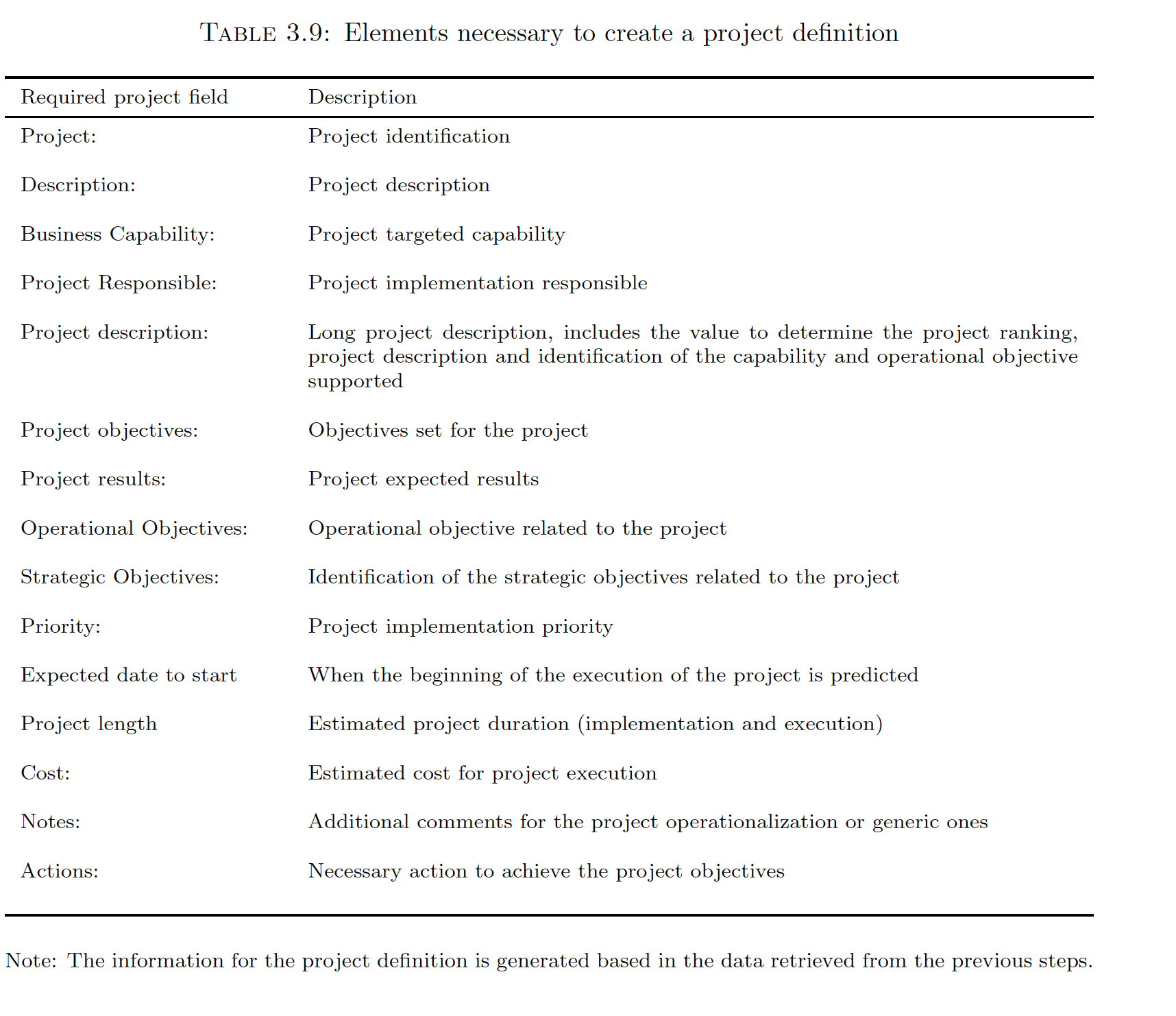
To simplify the elements to define the project, was adopted the project
charter (Tague, 2005, pp. 431-437) as exemplied in the Table 3.9.
Página 18
Improving Sport Organization Performance based on Business Capabilities integrated in a Business Process Management Approach. Article waiting submission, in articulation with Trevor Slack.
This paper proposes an approach to be adopted in sport organizations and clarify the improvement actions to develop according their strategy.
Sport organizations are social entities involved in the sport industry; are goal directed,
with a consciously structured activity system and relatively identiable boundary
(Slack & Parent, 2006).
Hoye (2006) considers that the Sport Managers have the responsibility
to create the necessary conditions for the organizations react to opportunities in
the market, or the demands of their stakeholders, maintaining adequate forms of control
and accountability.
Business Process Management (BPM) uses elements from strategy and operations, with
a horizontal perspective and the involvement of collaborators to deliver customer requirements
(Zairi, 1997; Hung, 2006).
BPM is considered the best approach to support the competitive advantage aligning
the operations with the business objectives (Hung, 2006),
BPM represent processes, using concepts, methods and techniques to support the
design, administration, conguration, enactment, and analysis of business processes
(Weske, 2007), manages the life cycle of processes (Darnton, 2012), considers processes
an organizational asset (Bandara, Chand, et al., 2010) and represents the eorts of
the organization to analyze and improve the fundamental activities (Trkman, 2010).
It is a holistic management discipline that uses technology to control and operate the
entire business, through the use of rules that dene business processes (Mller et al.,
2008), supported with methods, techniques and software to design, represent and analyze
organizational processes involving, people, organizations, applications, documents
and other sources of information (Aalst et al., 2003).
Página 19
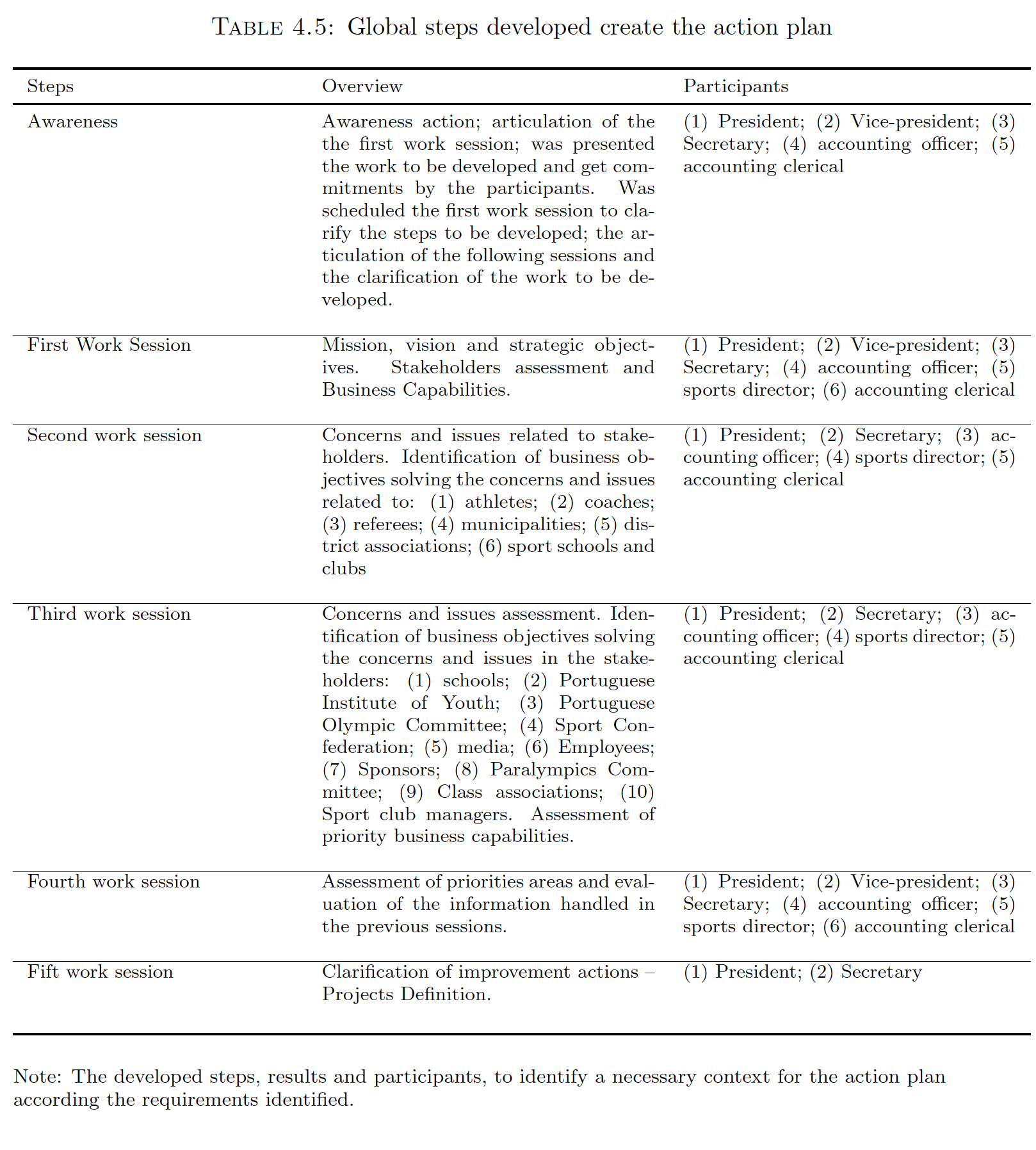
Global steps developed create the action plan
Página 20
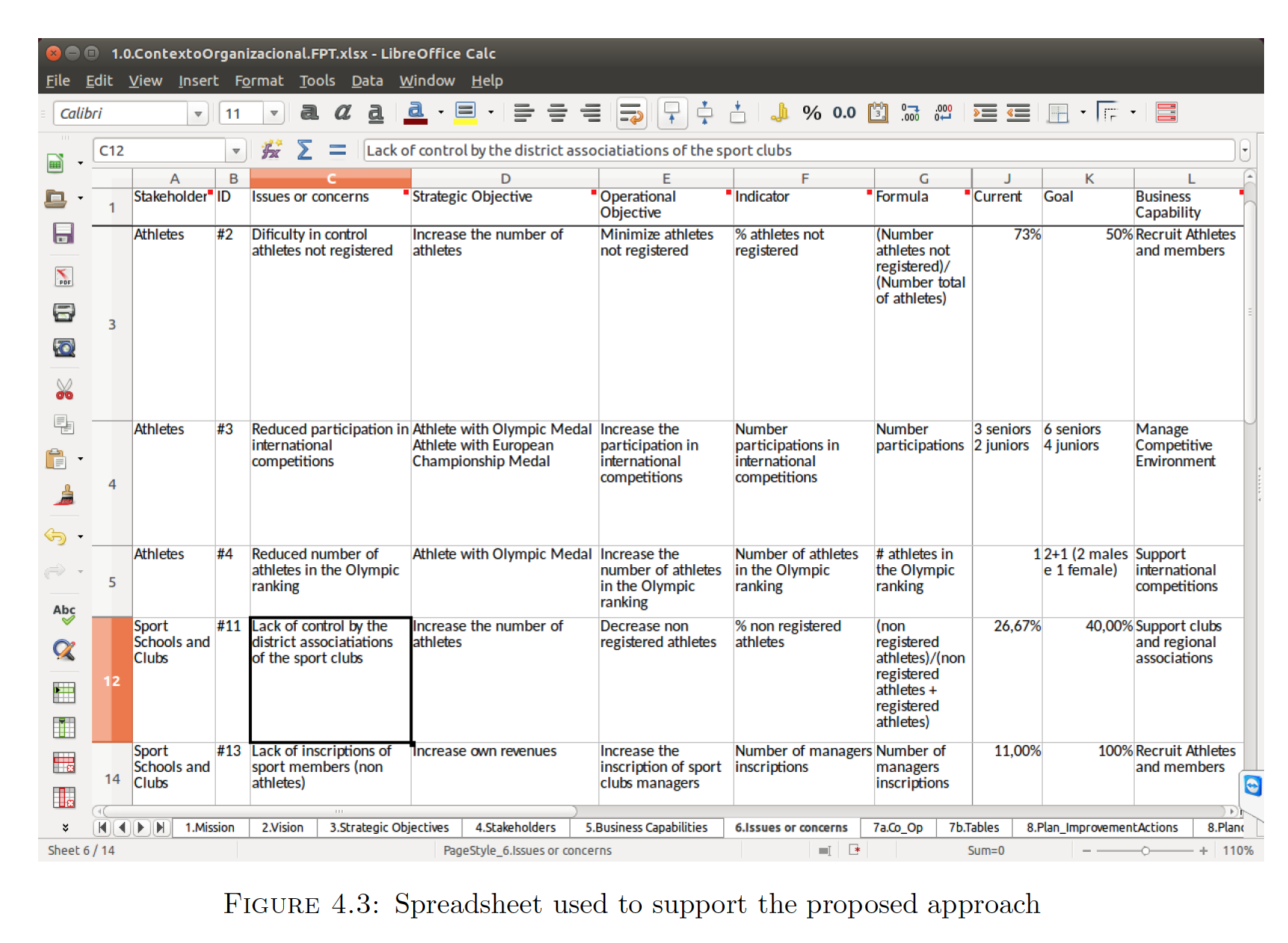
Spreadsheet used to support the proposed approach
is
The first step was the clarification of the mission and vision, considering (EFQM,
2001):
(1) the adoption of action verbs;
2) representation of two or three core business
capabilities;
(3) clarication who are the customers;
(4) where operate; and
(5) articulatethe previous elements to provide a mission statement.
Mission
Promote, disseminate and contribute to the excellence of Taekwondo
through the training of athletes, coaches, referees and support
for clubs and associations.
Vision
Be a reference in the sports of combat and martial arts, recognized
nationally and internationally
Página 21
Strategic Objectives, stakeholder assessment and business capabilities
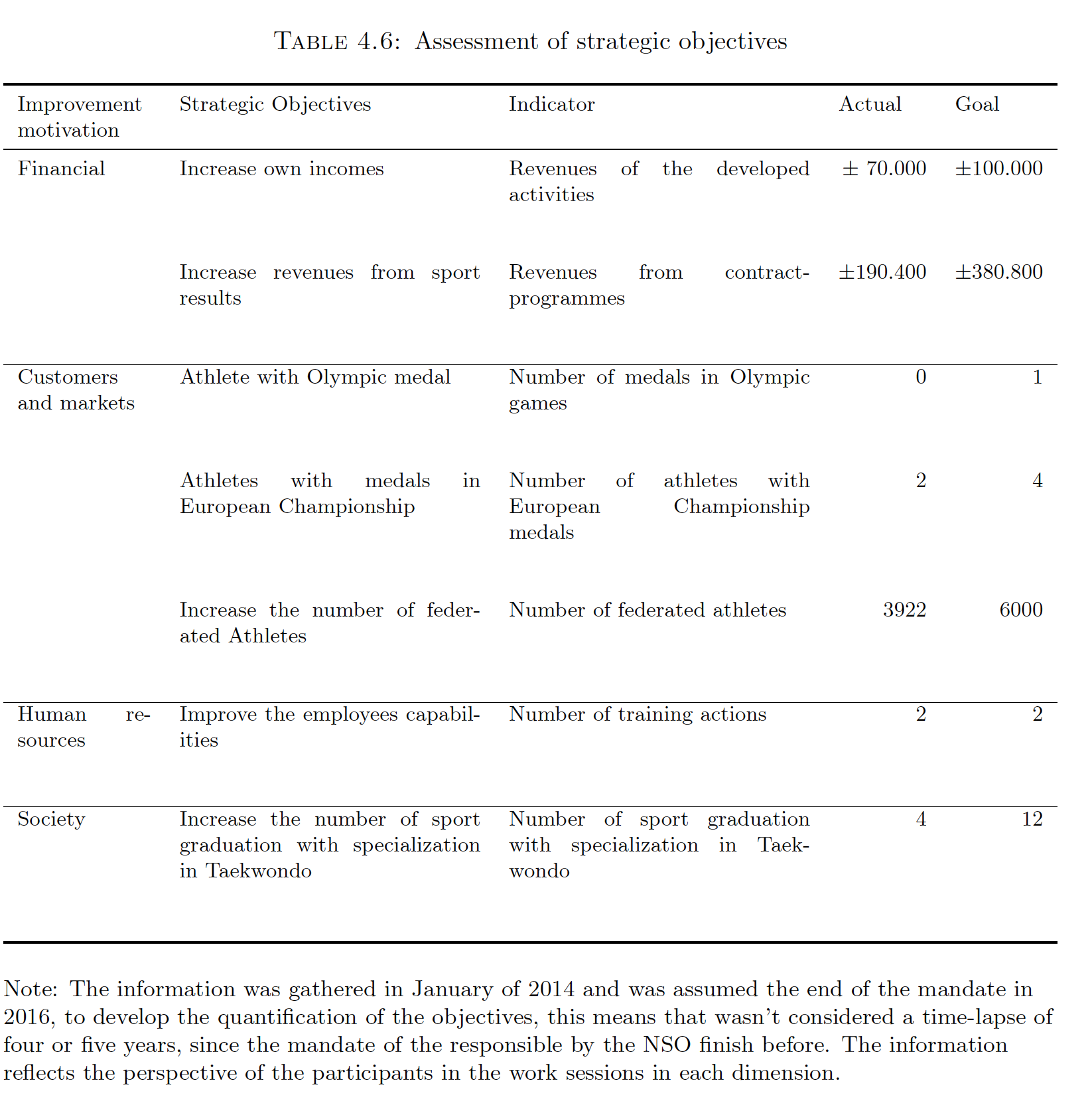
The strategic objectives were identied according the perspectives: nancial; customers
and markets; human resources and society, based in the guidelines provided in the
MLEARN (Noce et al., 2011). To each perspective were identied Business Objectives,
considered relevant by the meeting participants. These objectives re
ect a time-lapse period of four years long.
The next step was the development of the stakeholder assessment. The participants
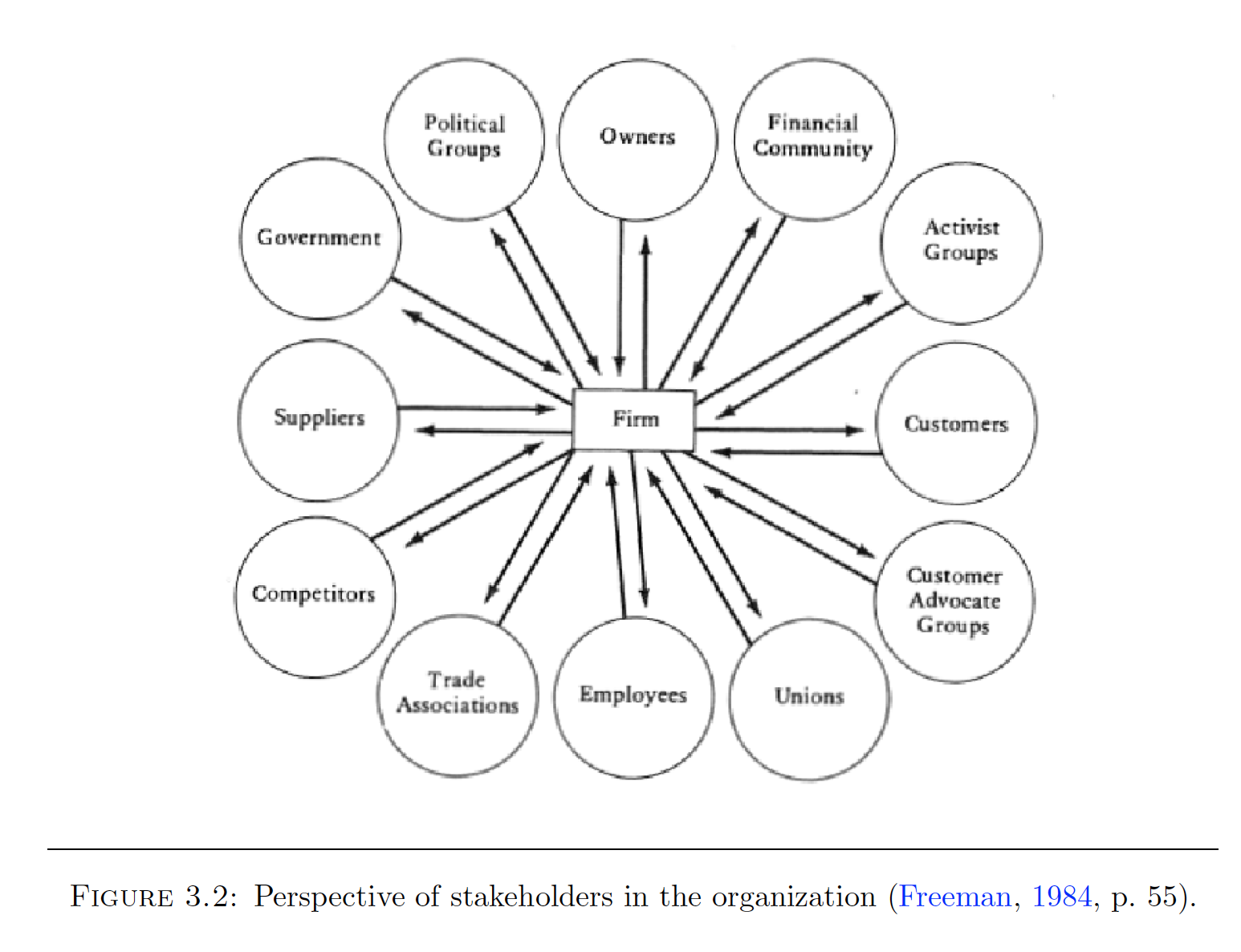
were claried about the adopted concept of stakeholder, as someone that can influence
or be influenced by the organization strategy. The stakeholder allows to clarify business
objectives and simultaneously to identify events to be processed by the organization.
The identication of the Business Capabilities was based in the assumption that
reflects what the organization has to do, without identifying how. Represents what the
organization has to do, to ensure is survival. This assessment was materialized in the
questions: "What NSO have to do for survive?", "What the NSO have to do better?"
and "What is that the NSO is good?" { presenting similarities to the identication of
the internal strengths and weakness, of the organization. It was suggested a limit of 10
business capabilities
Página 22
Sports Federation
Informações
- Descrição
- Notes from the Thesis: Approach for management by processes in sport organizations by Pedro Sobreiro September 2016
- Criado por
- Monica Bugno
- Visualizações
- 23
- Tags
- Avaliação