
Notas
Topic 4c: Electrostatics
Conteúdo das notas (5)
Página 1
Electrostatics: the study of electrically charged particles, their properties such as mass and charge, their behavior such as conservation of charge, and their interactions such as the repulsive and attractive forces.
Electric charge (q): a physical property of atoms.
expressed in units of coulombs (C).
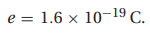
Charge can be positive or negative but the magnitude of both protons and electrons is -->
2 like charges repel each other, while positive and negative charges attract each other.
Electric charge is conserved, it can neither be created nor destroyed, only transferred; The net charge of the system remains constant.
the flow of charge is current
I= Qt (current= charge x unit time), expressed in units of (A) Amperes = C x s
Conductors: materials that allow the storage or facilitate the flow of electric charge, ex: metals.
they contain charges that move towards one or another pole when exposed to a potential difference
Página 2
Insulators: prevent the storage or flow of electric charge, ex: rubber or wood.
There are no perfect insulators with infinite resistivity, however certain materials provide a greater amount of insulation because they have very high resistivity.
High amounts of voltage can cause electrical breakdown, in which current breaks through the material and the insulator becomes a conductor.
Dielectric: an insulator typically used to fill the gap between the plates of capacitor because it increases the capacitance.
A material that can be polarized by an electric field; In the presence of an electric field, the material can shift its charge distribution, creating a weak local field within the material opposing the applied field.
Dielectric materials are characterized by a dielectric constant, κ, which describes their polarizability
κ = 1 for a vacuum, and it's slightly greater than one for air.
Página 3
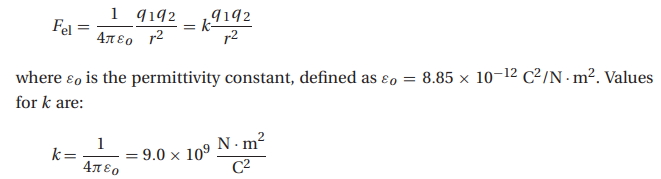
Coulomb’s law: describes the electrostatic force between two charged particles separated by a distance-->
Electrostatic force:
expressed in units of newtons
direction (repulsive versus attractive) is based on the charges involved
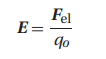
Electrostatic force can also be calculated if electric field magnitude is known

Página 4
Electric field (E): The region around a charged particle where an electrostatic force would be exerted on other charged particles.
expressed in units of newtons per coulomb (N/C).
Direction is dependent on the identity of the charge; if the other charge is negative, there's an attractive force generated and the direction of E will be towards the negative charge.
If the other charge is positive, there is a repulsive force generated and the direction of E will be away from the positive charge.
Charged particles accelerate in electric fields
Positive test charge (qo): similar to a regular charge except it does not exert an electrostatic force on any nearby charges.
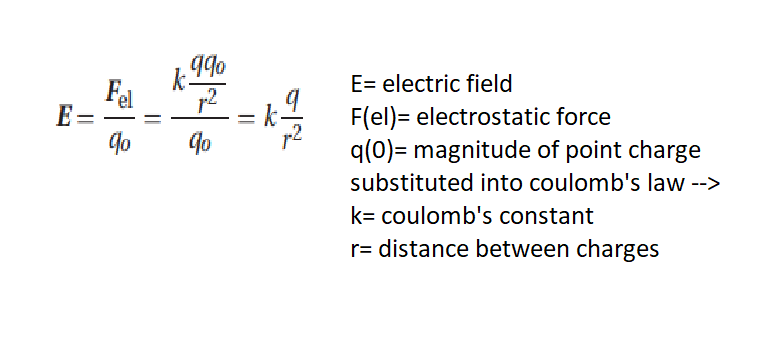
Strength of the electric field at any point in the field is equal to magnitude of electrostatic force/magnitude of point charge -->
Magnitude of electric field generated by >1 point charge is equal to (Coulomb's constant) * (magnitude of charge/distance of charges squared)-->
The magnitude increases closer to the charge and weakens the farther the region is from the charge.
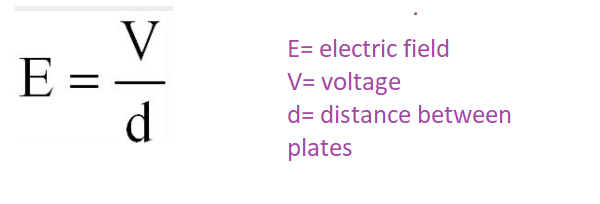
Magnitude of electric field between parallel plate capacitor
Electric field lines: imaginary lines representing the magnitude and direction of the electric field or the distribution of the electrostatic force over a region in space.
direction of the electric field is tangent to the field line at any point in space
The closer together the field lines, the greater the strength of the electric field
electric field lines can never cross
electric field lines originate on positive charges and terminate on negative charges
The lines from a positive charge are directed away from the positive charge, and the lines of force from a negative charge are directed towards the negative charge.
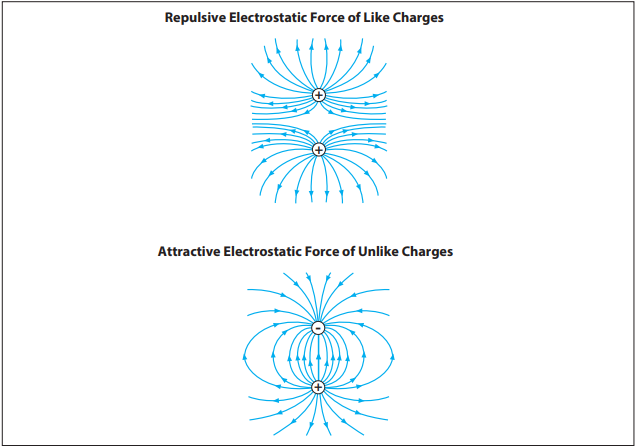
Because electric field is a vector quantity, a resultant vector can be calculated if there is more than one charge present in a defined region of space. The total electric field is the vector sum of the electric field generated by each charge in the region.

Página 5
Electric potential: electrostatic energy stored at some point as a result of work done against an electric field to move a positive test charge from one point to another.
Scalar quantity that can have a positive, negative, or 0 direction depending on the point charge and the work done.
Expressed in units of joules per coulomb (J/C), AKA volts (V).
DIFFERENT FROM ELECTRIC POTENTIAL ENERGY
electrostatic energy depends on the position and value of the test charge, whereas electric potential energy depends only on position of electric field
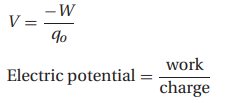
Electric potential difference: the work done by the electrostatic force on any two points A and B in an electric field two move a charge from point A to point B.
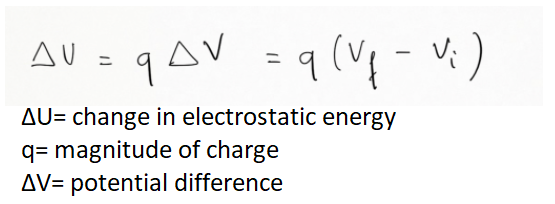
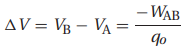
The absolute electric potential at one point at a certain distance from a charged particle at another point is dependent on the magnitude of the charge as well as the distance between the two points.
The electric potential for multiple charges can be determined by adding the electric potential values calculated for each charge.

Equipotential surfaces: represents the electric potential of any charge distribution as circles perpendicular to electric field lines.
The electric potential is at its greatest on the surface of the charge, which is why circles are drawn around the charges to represent the largest magnitude of the potential, which circles becoming larger in circumference as a distance away from the charge increases.
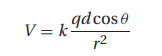
Electric dipole: two point charges typically equal in magnitude but opposite in sign come on separated by a small distance.
The electric potential (V) of the electric dipole can be found by -->
Informações
- Descrição
- Notas sobre Topic 4c: Electrostatics, criado por 000 000 em 28-02-2022.
- Criado por
- 000 000
- Visualizações
- 0
- Avaliação