
Notas
Treatment of Genetic Disease
Conteúdo das notas (1)
Página 1
In treating Genetic Disease, there are four levels we can work at:
Function
Protein
mRNA
DNA
Small molecules
Drugs that are approved to
either: treat other diseases (these can compensate for the functional deficits caused by genetic disorders)
or: treat the specific genetic disorder
EXAMPLE - Marfan Syndrome - a disorder of fibrillin, heart defects, skeletal defects, abnormally tall/thin stature
Treatment: Losartan
Angiotensin II Type I receptor antagonist
Widely used to treat hypertension
Clinical trials underway for Marfan Syndrome
Outcomes so far: reduction in enlargement of aortic root, reduction in serum TGF-beta levels (too high in Marfans because of lack of sequestering of TGF-beta by fibrillin)
Molecular Chaperons
Proteins that can: stabilise unfolded proteins, unfold them, translocate them across membranes, take them to be degraded, or assist with their proper folding or assembly.
They play a role in proteostasis:
"The concept that there are competing and integrated biological pathways within cells that control the biogenesis, folding, trafficking and degradation of proteins present within and outside the cell"
EXAMPLE - Cystic Fibrosis - caused by mutation in CFTR gene causing faulty CFTR ion channels that move sodium and chloride across epithelial membranes
F508Del - most common mutation
Affects folding of the CFTR protein and trafficking to the cell surface
HSC70 and HSP70 are molecular chaperons
HSC70 ubiquitinates mutant CFTR so that it is degraded
HSP70 helps fold CFTR to rescue some of the mutant phenotype
These molecular chaperons can be modulated to reduce some of the symptoms of CF:
Chemical Matrine downregulates the expression of HSC70, rescuing some of the mutant CFTR from degradation
Restores CFTR trafficking
Monoclonal Antibody (mAbs)
Target specific proteins
Inhibit or activate protein function
Nonsense Suppression
Normally a nonsense mutation will induce nonsense mediated decay
Aminoglycosides allow readthrough of the premature termination codon (PTC) through insertion of a novel aa
E.g. Alturen
This drug has been trialled on those with CF and DMD, still debate as to whether it works
Also being tried with siRNAs, see nonsense mediated decay section.
Exon Skipping
Method where the aim is to skip an exon during splicing
So, this exon is excised from the primary transcript
This can be done using an antisense oligonucleotide or a molecular patch
EXAMPLE
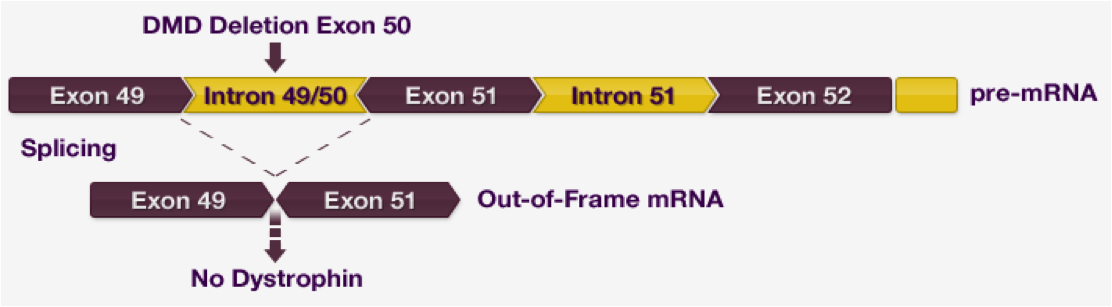
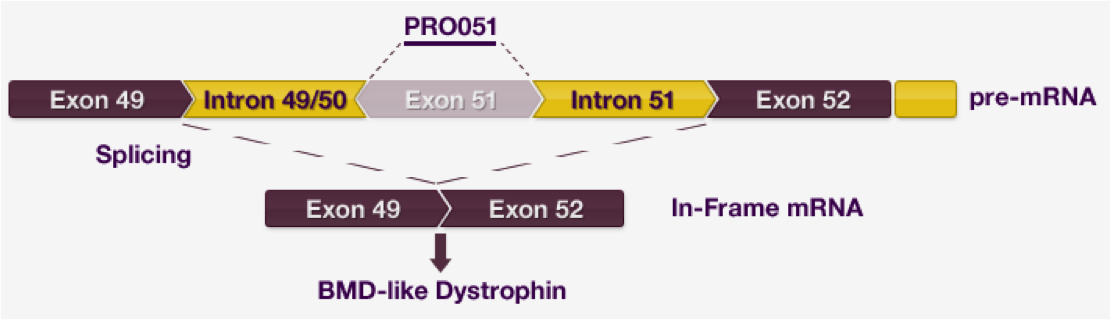
In DMD, a deletion has resulted in a frameshift, meaning that a severely truncated dystrophin protein is produced that is degraded by nonsense mediated decay
It is possible to create an in-frame transcript by inducing another exon deletion that cancels out the first (exon skipping)
This will result in a truncated but partially functional dystrophin protein being produced - BMD phenotype
RNA Interference (RNAi)
siRNA inhibits gene expression
this is beginning to be used to treat macular degeneration - shown to increase visual acuity and improve foveal thickness
Zinc-Finger Nuclease
Artificial restriction enzyme
Formed by a zinc finger (small protein motif) and a DNA cleavage domain (usually FOK1 - bacterial restriction endonuclease)
The zinc finger domain can be engineered to target specific sequences
ZFNs must dimerise to cleave so two different molecules must be used for non-palindromic sequences
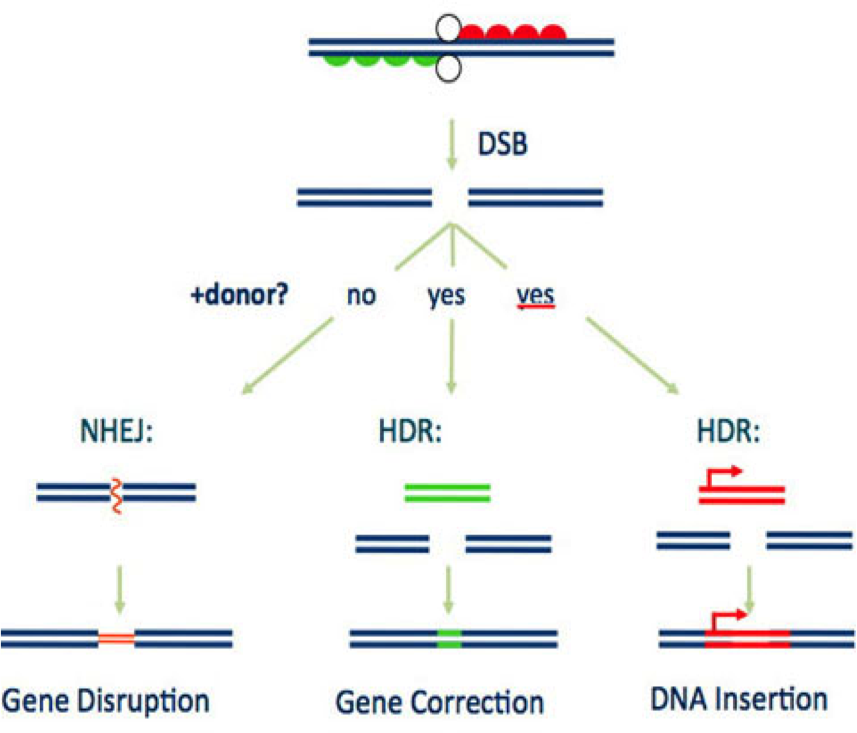
Can be used to disrupt a gene, correct a gene, or insert a section of DNA
NHEJ - non homologous end joining - no homologous donor segment, break in dsDNA is repaired but ends do not have to be homologous
HDR - homology directed repair - double stranded break is repaired, incorporating the homologous donor segment
TALENs
Transcription Activator-Like Effector Nucleases
Artificial restriction endonuclease
Has FOKI cleavage domain - nonspecific, must dimerise to function
TAL Effector DNA binding domain - can be engineered to target specific DNA sequences
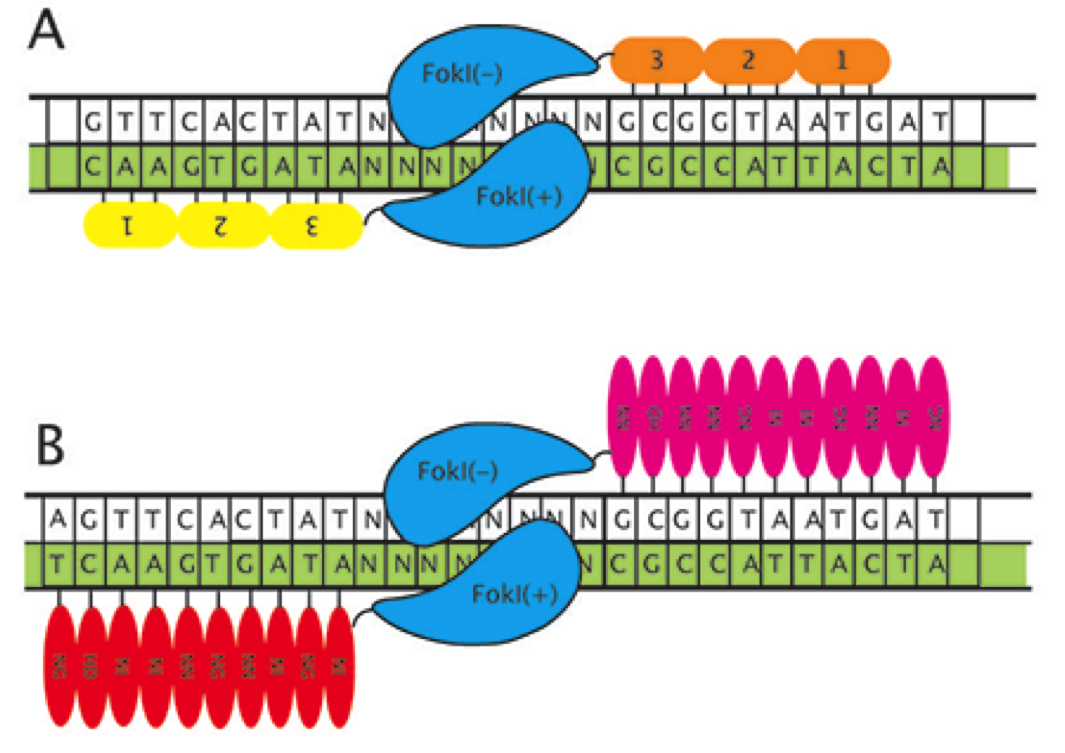
A = Zinc Finger
B = TALENs
Crispr
Developed from microbrial immune system
Intro
Function
mRNA > Protein
mRNA
DNA
Informações
- Descrição
- Notas sobre Treatment of Genetic Disease, criado por Ellie Quinn em 12-02-2014.
- Criado por
- Ellie Quinn
- Visualizações
- 781
- Avaliação