
Notas
Sem título
Conteúdo das notas (9)
Página 1
Lecture One.
Agencies in the criminal justice system:
Objectives of the CJS are to uphold the rule of law by:
Preventing crime, When crimes are committed, detecting culprit, By convicting guilty and acquitting innocent, Dealing adequately & appropriate with those who transgress.
This is a criteria to judge practices and performance of the CJS.
*The components are linked by the common denominator of processing suspects/lawbreakers
*Interdependency of agencies
*Changes in one part of the system, or wider society, may impact on the whole of the CJS
*Conflicting goals
*Police – deterrence or detection?
*Judiciary – deterrence, rehabilitation or retribution?
*Prison service
*Probation Service
*Distinctive working cultures
*Police culture
*The courts
*Probation culture
*Competition between agencies
*For resources
*Between cultures and ideologies
*Adversarial system – inConflicting goals
*Police – deterrence or detection?
*Judiciary – deterrence, rehabilitation or retribution?
*Prison service
*Probation Service
*Distinctive working cultures
*Police culture
*The courts
*Probation culture
*Competition between agencies
*For resources
*Between cultures and ideologies
*Adversarial system – innocent until proven guilty
*nocent until proven guilty
Role of State
Role of Police
'Individual must be safeguarded against excercise of arbitrary power of the state' - Due Process
- Legal protection, onus beyond reasonable doubt.
- If defendant found guilty - must receive a just penalty that reflects the seriousness of offence and blameworthiness & harm to victim.
-Parker (1868) balance between due process and crime control.
-Punishment measured by 1)Amount of harm caused by crime 2) Extent individual was to blame for causing harm
-Assumption of controlling crime
-‘[It is] based on the proposition that the repression of criminal conduct is by far the most important function to be performed by the criminal process…if the laws go unenforced – which is to say, if it is perceived that there is a high percentage of failure to apprehend and convict…the general disregard for legal controls tends to develop…in order to operate successfully the process must produce a high rate of apprehension and conviction…there must be a feeling of speed and finality…’ (Cited in King, 1981: 19)
Models of the CJS
Rehabilation
Objective of CJS should be: rehabilitation through restoration of defendant to a state of mental or social health whereby (s)he can cope with demands society makes
-help citizens, meet their needs
Management of Crime & Criminals - Burecratic - emphasis on efficiency
- Cost effective
Denunciation & Degrading
-Function of criminal courts as institutions for denouncing defendant , reducing social status and promoting solidarity within the community.
Maintenance of class dominaton
-CJS seen to promote interests of the ruling class & maintaining its position of dominance over other groups in society.
Social Control – CJS Agencies as agents of the State & ruling class
View of CJS as unjust, discriminatory & oppressive to certain groups.
Tension between formal rationality vs substantive rationality
Managing offender
-Monitoring & controlling criminals dependant on level of risj and record of offending
Risk management
Surveillance programmes and electronically monitored curfews
Just Deserts Model
Stresses importance of punishing offenders in terms of their blameworthiness and seriousness of offence, not through crude revenge or incapacitation
Página 2
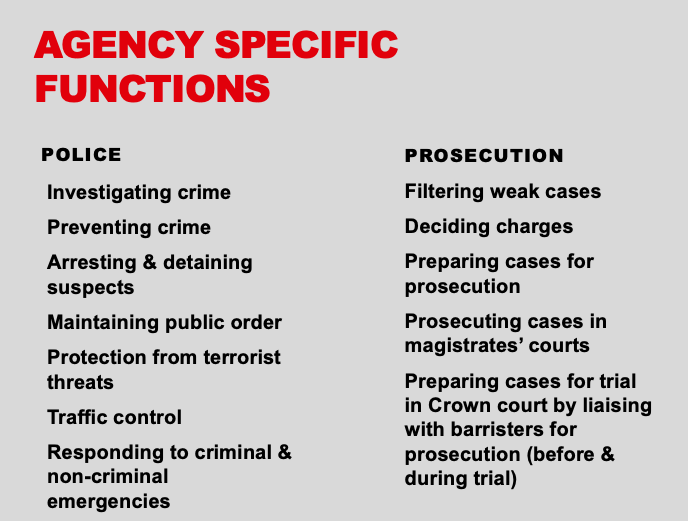
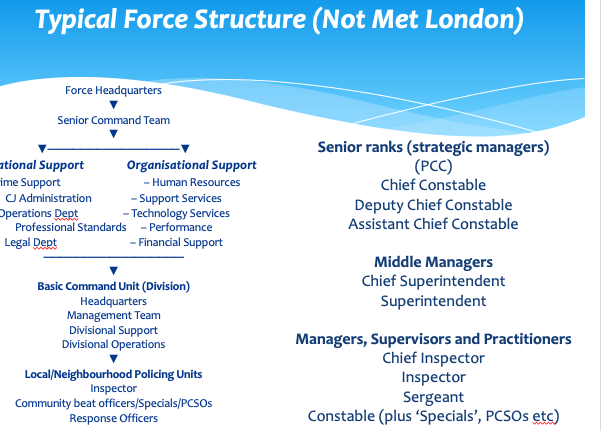
Policing, Police Custody and the CJS (an agency)
Police as the agency - criminal investigation, apprehends suspect, regulating police custody, what the rights are.
-43 police force - no nationwide. Regional devolved police forces from the very start. London MET, British Transport police.
- 1829 is foundation of metropolitan police – first large scale, organised policed force. Founded by Robert Peel. Idea of policing controversial, repressive. Threat to democratic values
New policing
Uniform – needed as a deterrent, reassurance, civil liberties – people ought to know if they are being policed. Idea of there being some overcoming policing. The idea that the police almost acting as spies. Incase they breach your rights. Visible patrols.
Preventative role – partly due to deterrence idea. Stop crime happening in the first place by their presence rather than resolving crime before that.
Idea of impartiality. – disputes between individuals, police not to take sides but to act as independently as possible. Nonn partion, non-political, citizens in union – idea police should be public, and public should be police [idea from peel]
Police should be UNARMED - Increasingly seeing armed police on our streets. Tradition has generally been that police do not have firearms
Policing has changed
-More specialised, different offences and different offenders. Designated uniits that might deal with serious crimes, child protection. Understanding that certain skillsets and ways of conducting yourself are required.
-Veichles, can tap phones. Can rely on people phoning in and then get their high speed - rapid response to policing.
-Issues policing urban areas, new crimes has required changes to policing e.g. Internet. Riots, unawareness of different cultures. Abuse. Have to police and respond to communities differently.
Police and Social Responsibility Act 2011
-laypeople had control over policing in an area, like a board, police constable would report to.
-This act replaced this with a configure head - the police and crime commisisoner and a panel. Party polictical people being voted in and setting the strategy for their party. RADICAL.
Meant to reflect concers of community, represent cositutents and ensure that it is fed into the strategy of the police. More responsive model of policing based on community preferences.
Can hire and fire chief constables
-There was a concern if people have a political agenda – will this affect the way we police?
-Policing should be Apolitica, should police without fear and favour. Still early days.
‘The police are identified primarily as a body of people patrolling public places in blue uniforms, with a broad mandate of crime control, order maintenance and some negotiable social service functions’
Reiner, R (2000) Politics of the Police, 3rd Edition page1
-Not directly true - investigatory, research role.
-Important to see how people view policing.
The perception of what policing is about is important as it shapes expectation and it can give rise to public satisfaction
Powers of Arrest
*The police need ‘reasonable grounds’ to suspect a person is involved in an crime for which their arrest is necessary – RG a matter of interpretation. But if they have reports of someone fitting your description, matched fingerprints, had reports of you somewhere.
*They may arrest a person at any time, including on the street, at home or at work
If arresting a person the police must:
*Identify themselves as the police (especially if plain clothes e.g. detectives) - should have number codes. 'Epilept numbers' - instance where this has been covered due to protests et.c. If use reasonable force have to be identifiable.
*Tell the person that they are being arrested
*Tell them what crime they think has been committed - 'I am arresting you on ----'. They will be given a police caution - I am detective -, you are being arrested,
*Explain why it is necessary to arrest them
*Explain to them that they’re not free to leave
Under 18s :
*Should only be arrested at school if it’s unavoidable and, if so, they must inform the headteacher.
*Police should also contact parents/guardians/carers as soon as possible after the detained person arrives at the police station.
*If a person tries to escape or become violent, the police can use ‘reasonable force’, for example, holding a person down so they cannot run away.
*They can also use handcuffs if they think people will strike. They have tazers. Officers have to account for their use of reasonable force.
They also have powers to search a person whilst they are arrested
Rights in Custody
Custody officer should explain rights to:
*Free legal advice
*Notifying someone of the detention - families, kids etc.
*Medical help
* Right to See the code of practice (Police and Criminal Evidence Act 1984) which regulates – stop and search, arrest, detention, investigation, identification, interviews
*See a written notice explaining these rights – e.g. breaks for food, toilet or an interpreter
A detainee will be searched and their possessions kept by the custody officer [in control and in charge of the person undeir supervision - if anything happens tehy are responsibile]whilst they are in a cell - their phone - could warn other criminal friends, druges, clothes might have evidence
Under 18s and vulnerable adults – an ‘appropriate adult’ should be identified to come to the station and help the detainee and be present during questioning and searching. This could be: parent/guardian/carer; a social worker; another family member of friend aged 18 or over; a volunteer aged 18 or over (National Appropriate Adult Network)
The police have the right to:
*Take photographs; fingerprints; DNA sample (e.g. mouth swab, head hair root; swab the skin surface of hands or arms
*They do not need permission to do this.
*Samples of blood/urine or dental impressions require both the detained person’s permission and the authority of a senior officer
*This doesn’t apply when a person is arrested in connection with drink or drug driving
*This information is stored in a police database.
Rights during questioning
*Interviews recorded is now mandatory - it used to be written (since PACE rules) - interivew not to prove that they didnt do it its for the court to prove that they did. So they can technically say nothing - you go into the police station and court innocent.
*The police caution: ‘You do not have to say anything. But, it may harm your defence if you do not mention when questioned something which you later rely on in court. Anything you do say may be given in evidence.’
*PACE clock – 24 hours before the police have to charge or release suspect.
*Authorisation to detain a suspect can be granted if a person is suspected of a serious crime such as murder (36 to 96 hours)
*Or... Up to 14 days for people arrested under the Terrorism Act. Originally pushed for 90 days without charge. But no -
Silence in interview can be used against them in the interview. Anyhing you dont say can be used against you inc court.
Release on bail
If there isn’t enough evidence to charge a person, they may be released on police bail. This may require the person to return to the station for further questioning when asked.
After charging, a person might be released on conditional bail if the police think the person might:
*Commit another offence
*Fail to turn up at court
*Intimidate witnesses
*Obstruct the course of justice
Crown Prosecution Service
•Review cases – continued or discontinued?
•Determine eligibility for conditional cautions and set conditions
•Determine criminal charge in individual cases
•Advise police
•Establish charging standards
•Liaise with barristers representing prosecution at Crown Court
•Present cases in Magistrates at pre-trial and trial stages
•Provide info for witnesses and victims.
Página 3
Criminal Courts and the trial Process
Magistrates Court The Crown Court . The Court of Appeal The Supreme Court The ECHR
Magistrates:
-Lay magistrates - justice clerk
-District Judge
*Good Character
*Understanding and Communication
*Social Awareness
*Sound Judgement
*Commitment and Reliability
Minor/Summary offences, either way offences or preliminary hearings for more serious offences.
Deal with most cases
Bail, Sumamry, Either way offences, commitment/indictment
Crown Court
Deals with either way cases sent from magistrates to more serious indictable offences
presided over by a circuit judge
Seven circuits - Midland, North West, North East, South East, South West and Wales
Legal Counsel and Other Pesonnel
Página 4
Punishment and Sentencing
Walker - 7 Feature
*Involves infliction of something assumed to be unwelcomed to recipitent
1.Infliction is intentional and done for a reason.
2.Those who order it are regarded (by family/organisation/society) as having right to do so.
3.Reason for infliction is action or omission which infringes law, rule or custom.
4.Person punished played a voluntary part in infringement (at least punishers believe/pretend this is so).
5.Punisher’s reason for punishing is such as to offer a justification for doing so (i.e. Must not be pure sadism).
6.Belief or intention of the person who orders something to be done – not belief/intention of person to whom it is done. i.e. Do not decide prison sentence is not punishment because the prisoner considers it unjust.
Consider comparing ‘punishment’ with concept of ‘revenge’
RULES OF PUNISHMENT
•Penal sanction must:
1.Create human suffering - Punishment is about the deliberate infliction of pain at its core, history used to be about infliction of physical pain - need moral justifications to do this. Philosophy of why punish? Could argue the way we punish now punishes beyond the original wrongdoer
2.Arise as a direct result of the perpetration of an offence
3.Only be directed at the person who undertook the offence i.e. The offender
4.Be the intentional creation of other humans in response to that offence
Be inflicted on an authorised body representing the embodiment of the rules or laws of the society in which the offence was committed
Its a responsive action - do it after crime.
Talking about state punishment - not punishment that people might inflict on eachother
"Infliction of discomfort" - deprivation of liberty, psycholical pain.
Can only inflict after public adjudication.
Guatanomo Bay
What do you to achieve? If we punish there has to be moral justificaitons. Some are backwards and some are forwards justifications.
Backwards justificatin 0 not concerned with what happens next, about reassuring that someone broke the law and we look back at what they had done.
Forward - This is happened, what good can now come out of it? If we do something to this individual we can rehabilitate, public awareness - deterrence. Justification prevent harm
Moral justification - emotions, how we feel aobut right and wrong.
Retribution Incapication Rehabilation Deterrence Dununciation Restitution
•Does punishment, overall, reduce or increase human pain?
•Does punishment repair the harm done in the wrongdoing?
•Does punishment reduce the recurrence of problematic incidents?
•Is the use of punishment morally justifiable?
•Why do we continue to punish people when it does not appear to work for human good?
Sentencing
SHOULD SENTENCING PERFORM A BROADER ROLE OF EXPRESSING THE COMMUNITY’S CONDEMNATION OF PARTICULAR KINDS OF BEHAVIOUR? DENUNCIATION MODEL
SHOULD SENTENCES AIM TO PUNISH OR REHABILITATE INDIVIDUAL OFFENDER?
SHOULD SENTENCES BE INDIVIDUALLY TAILORED TO NEEDS OF, OR RISKS POSED BY, AN OFFENDER OR IS CONSISTENCY OF DISPOSAL MORE IMPORTANT?
•Criminal Justice Act (CJA) 2003, s 144 (1)
•In determining what sentence to pass on an offender who has pleaded guilty to an offence before that or another court a court must take into account:
a)The stage in the proceedings for the offence at which the offender indicated his intention to plead guilty , and
b)The circumstances in which this indication was given.
•Section 174(2) (d) CJA 2003:
•Where as a result of taking into account any matter mentioned in section 144(1), the court imposes a punishment on the offender which is less severe than the punishment it would otherwise have imposed, [it must] state that fact in open court.
Sentence Discount Principle
•Criminal Justice Act (CJA) 2003, s 144 (1)
•In determining what sentence to pass on an offender who has pleaded guilty to an offence before that or another court a court must take into account:
a)The stage in the proceedings for the offence at which the offender indicated his intention to plead guilty , and
b)The circumstances in which this indication was given.
•Section 174(2) (d) CJA 2003:
•Where as a result of taking into account any matter mentioned in section 144(1), the court imposes a punishment on the offender which is less severe than the punishment it would otherwise have imposed, [it must] state that fact in open court.
Improves efficiency, easier for victims,
•the level of the reduction will be gauged on a sliding scale ranging from a recommended one third (where the guilty plea was entered at the first reasonable opportunity in relation to the offence for which sentence is being imposed), reducing to a recommended one quarter (where a trial date has been set) and to a recommended one tenth (for a guilty plea entered at the ‘door of the court’ or after the trial has begun).
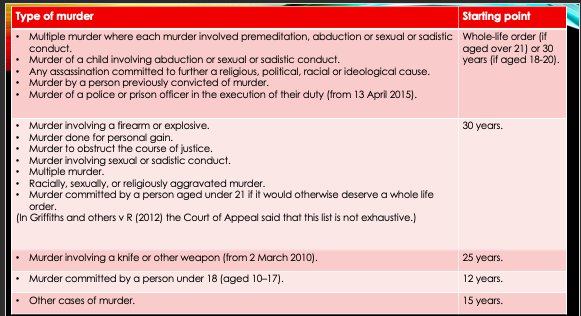
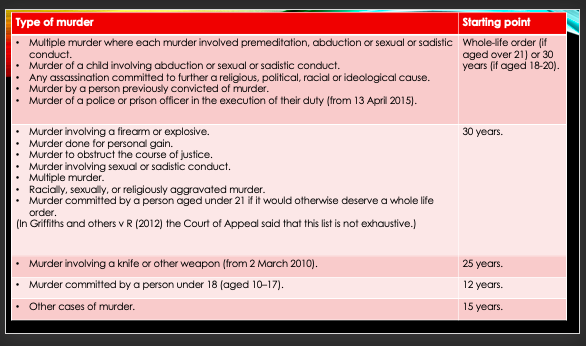
Murder
•Role of parliament in singling out specific offences for special treatment
•Murder conviction must = life sentence and minimum term to be served in prison (punitive element) before release on licence can be considered.
•Seriousness min ranges from 15-30.
Página 5
Prision and Prisonment
History: There used to be penal transportation - Australia
Benthams Panopticon Model: The plan utilised ‘[s]urveillance from one central point…to ensure that the inmates interiorised the discipline expected from them’ (Spierenburg 2005: 43).
Millbank Penitentiary: brutality by guards, large costs,
The new model prision at Pentonville: use of the ‘separate’ and ‘silent’ systems under which communication between prisoners was forbidden and activities were conducted in strict isolation.
Victorian Prision Regimes:
Incorporated what Rotman (1990: 5) later described as a ‘monastic ideal of penance’ achieved via cellular isolation and the encouragement of silent prayer.
The intention was to isolate the offender from ‘the contaminating influence of society’ and subject them to various forms of indoctrination as a kind of ‘reformative action’ (ibid.)
HMP Strangeways Riot in 1990
§Images were published by the media who kept up to date with daily goings on with the riot. This lead to other institutions wishing to express their support, causing other riots across England and Wales.
§The impact that the riot had on the media forced the government to rethink the conditions within the prisons.
The Woolf Report
Report blamed the loss of control on prison officers who abandoned the gates outside the chapel, which "effectively handed the prison to the prisoners”
It described the conditions inside Strangeways in the months leading up to the riot as "intolerable“
It commented on a "combination of errors" by staff and management at the prison and Prison Service as a central contributing factor to the riot.
Página 6
Página 7
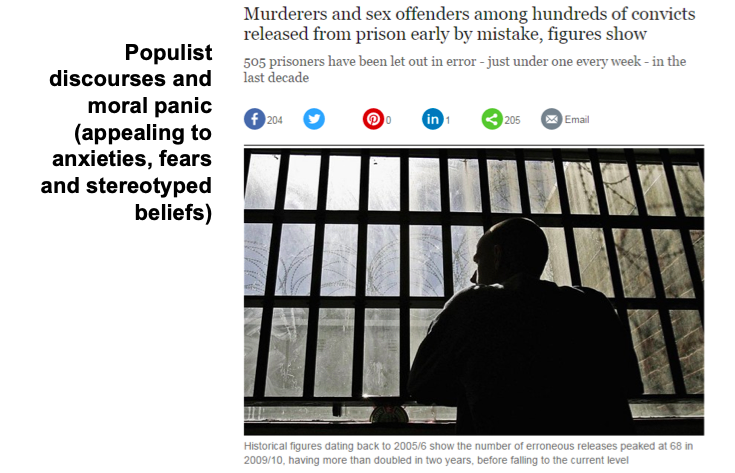
"Prison works. It ensures that we are protected from murderers, muggers and rapists - and it makes many who are tempted to commit crime think twice ... This may mean that more people will go to prison. I do not flinch from that. We shall no longer judge the success of our system of justice by a fall in our prison population."
(Michael Howard, Home Secretary, Conservative party conference, October 6, 1993)
‘Within debates on prisoners’ voting and human rights it is helpful to project ourselves into the position of subject rather than aligning ourselves with the majority on these issues.’ (Drake and Henley 2014: 149)
‘I look at it like this: prison is the idea that we are losing our liberty. That is our punishment, not all of the inhumanity and cruelty here…it’s like double jeopardy because you’re punished in your label – you’ve been labelled a criminal, but then when you come here and you are confronted with a second tier of punishment…they are forever coming up with new things and it’s really cruel, so petty, so mindless.’ (Prisoner, cited in Drake 2012: 85
In The Society of Captives, Sykes (2007 [1957]: 63-83) discusses five ‘pains of imprisonment’ linked to the experience of confinement:
•The deprivation of liberty
•The deprivation of goods and services
•The deprivation of heterosexual relationships
•The deprivation of autonomy
•The deprivation of security
Página 8
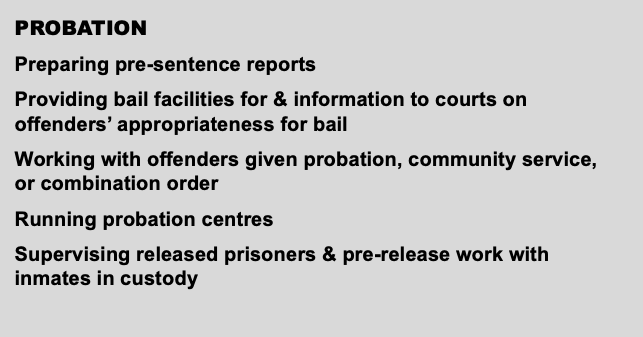
Probabtion and Community Penalties
}Mair and Burke suggest that ‘one of the founding narratives of probation is that some Warwickshire magistrates were using … [recognisance] in the 1820s to commit a young offender to the care of a suitable employer’ (2012: 14)
}Probation was not widely used by the courts until Criminal Justice Act 1925 (then a gradual increase in probation orders and a move towards a ‘fully public service’)
}The key assumption was that ‘treatment’ was needed to address clients’ individual difficulties and personal shortcomings.
}Might involve: counselling, psychotherapy, transactional analysis (Freudian – focus on the ‘ego state’), family therapy, groupwork, behaviourism and common sense advice!
Some repudiated ‘treatment’ and focussed their efforts on practical assistance: e.g. advice on accommodation, employment and welfare rights.
}Probation became seen as an ‘alternative to custody’(through community service, hostels and by supervising those released on parole – introduced by Criminal Justice Act 1967)
}
In the 1980s, Conservative govt. attempted to limit prison expansion without being seen as ‘soft’ on crime – ‘punishment in the community’ (under probation supervision) was the solution.
}New sentencing framework in the Criminal Justice Act 1991 (‘just deserts’ – though not a complete rejection of rehabilitation).
Sentencing Options available
Custodial sentences (including suspended sentences)
Community sentences (‘probation’)
Fines
Discharges (used for very minor offences, when the experience of coming to court and the acquisition of a criminal record is considered sufficient punishment)
Where do probation/community sentences fit?
As a result of the Crime and Courts Act 2013 - a community order must contain at least one punitive element.
Community Orders
}Combines punishment with activities carried out in the community. It can include one or more of 13 requirements (see next slide). It can last up to three years.
}This could be carrying out up to 300 hours of unpaid work, which might include things like removing graffiti or clearing overgrown areas.
}It could also mean the offender is required to have alcohol or drug treatment – this aims to tackle the reasons why they have committed crimes. Offenders might also be required to keep to a curfew, which aims to keep them out of trouble.
}Overall, the requirements aim to punish offenders, to change offenders’ behaviour so they don’t commit crime in the future, and to make amends to the victim of the crime or the local community.
}In 2017, 95,112 offenders were sentenced to a community sentence, representing eight per cent of offenders sentenced.
}Unpaid work for up to 300 hours
}Rehabilitation activity requirement (RAR) undertaking activities as instructed
}Undertaking a particular programme to help change offending behaviour
}Prohibition from doing particular activities
}Adherence to a curfew, so the offender is required to be in a particular place at certain times
}An exclusion requirement, so that the offender is not allowed to go to particular places
}A residence requirement so that the offender is obliged to live at a particular address
}A foreign travel prohibition requirement
}Mental health treatment with the offender’s consent
}A drug rehabilitation requirement with the offender’s consent
}An alcohol treatment requirement with the offender’s consent
}An alcohol abstinence and monitoring requirement with the offender’s consent
}Where offenders are under 25, they may be required to go to a centre at specific times over the course of their sentence.
Página 9
The Parole board and Life After Imprisionment
The Parole board was established in 1968 - 1967 Criminal Justice Act.
Needed thisbecause the life sentence created in response to the ablition of the death penalty.
Became fully independt 1986 - question if it can really be independent?? It is funded by the MoJ
Now:
Deal with 25,000 cases a year.
When cases come through it means that the defendant has completed his punishment
They look at all info - oringinal sentencing, how they behaved at prision, psychiatrics, prison staff, they invite the victim. Speak to defendant at an oral heading
Sometimes judges, ex-police offers, forensics
very risk adverse - any type of risk can block release
Number one prority is protecting public - only release if risk minimal
Do they know what led you to commit the offence? What factors could lead them to do it again?
How have they used the time in prision to work on the issues
What will life be like when you leave prision?
Will you be honest and open with your probation office
How can we be confident that they will never change.
Huge life sentence,
Parole board -quasi-judicial body, so some rights of fair trial should be applied to proceedings. should have access to legal defence - but in paper hearing this wont happen. Need to test witnesses - should psychologists be amde to justify decisions and should it be tested - most paper hearings are for determinative proceedings.
Oral hearings - might take a few weeks to find out results. Law says 14 days - but some people wait alter
John Dorby - there was a substantial number of cases that didnt go to court. that had a bearing on his risk
Idea that punishment does not end after prision. way sthat there is enduring impact as a result of the conviction. M'Collateral Consequences of Punishments' Invisible punishments - - De Facto and De Jure consequences
Informações
- Descrição
- Notas sobre Sem título, criado por Rochelle Ampomah em 22-04-2019.
- Criado por
- Rochelle Ampomah
- Visualizações
- 0
- Avaliação