
Notas
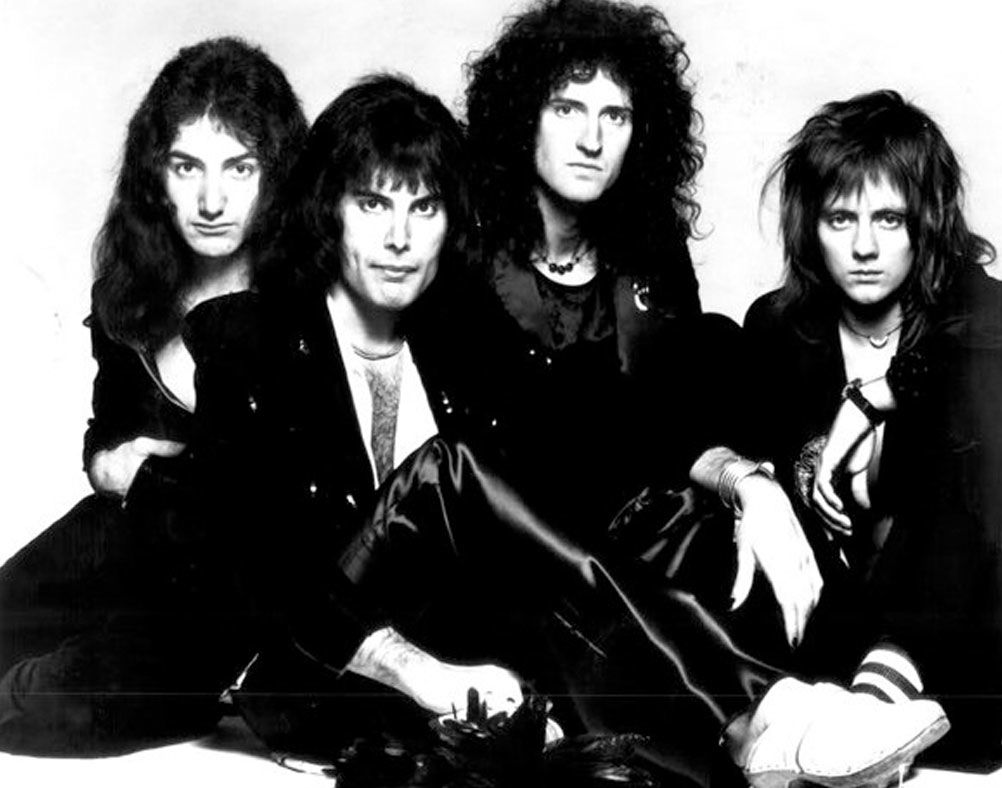
Queen: 'Killer Queen'
Conteúdo das notas (6)
Página 1
About the Piece:
Key: E♭ major (unusual for rock songs)
Tempo: Moderate
Style: Rock
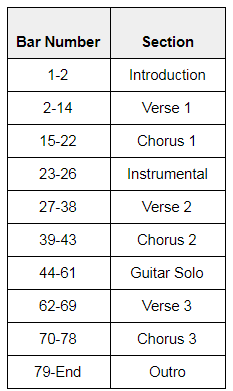
Structure: See Below
Killer Queen was the first Queen track to become extremely popular. It is the second song on the Sheer Heart Attack album, released in 1974.
Mercury usually composed the music first and added the lyrics later, but for Killer Queen, he worked the other way around, starting with the lyrics. The pictures evoked through the lyrics are clearly represented by the vaudeville-inspired music.
Although the structure of Killer Queen is similar to other songs of its time, it has quite unusual phrasing that draws attention to the song.
Killer Queen is in E♭ major but modulates frequently and makes use of harmonic sequences to create harmonic interest. The song contains extended chords, while inversions of chords are used to create scalic movement in the bass.
The time signature of the song is 12/8 . It could also be thought of as 4/4 with swung quavers.
The song has a unique introduction, consisting of 6 finger clicks starting on the third beat of the first bar. The opening introduces parts gradually: even the piano comes in one hand at a time.
Killer Queen's texture changes constantly throughout the song. The song is much more ‘orchestrated’ than a standard rock song. Only the piano seems to be present for almost all of the song. The texture is homophonic in the first part of the song and becomes polyphonic from the second verse. The second half of the guitar solo features a textural trick where the chords are gradually layered by delaying the entry of the second and third guitar parts. The use of panning creates an antiphonal feel in places. Panning is how sound is distributed in a multi-stereo system (e.g. the mix of sound between left and right earphones).
Página 2
Instrumentation in Killer Queen:
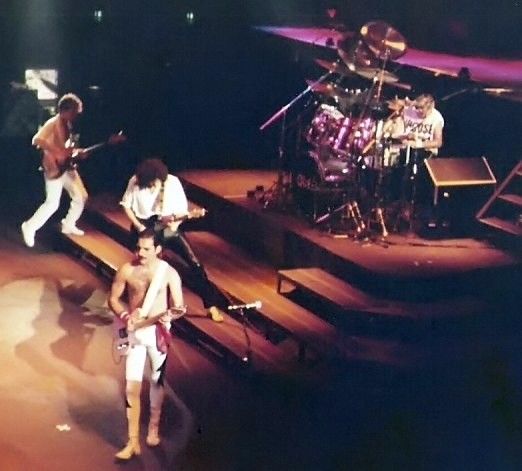
There are only a limited number of instruments used in Killer Queen but they are used very effectively to create a full sound.
Instruments used include:
piano
'jangle’ piano
electric guitar
bass guitar
drum kit and percussion
Despite being extremely popular in the 1970's, no synthesisers were used in Sheer Heart Attack. Because of this, vocal tracks were used to make a synthesised timbre.
Part of Queen’s distinctive sound is the way they build textures by recording one layer on top of another. This process is called overdubbing. In the chorus, there is a four-part choir that has been built up by recording Mercury himself singing each part individually. The backing vocals often move in parallel, but a swooping effect is created by the parts crossing over.
Both a traditional piano and a 'jangle' piano (sounding out of tune) were used to create a unique tone.
Brian May layered harmony guitar parts to created a saxophone-like sound.
The bass guitar provides unobtrusive harmonic support by playing melodic bass lines that work within the complexity of the musical texture. The drum part is played with the bass line to create a seamless piece of music.
Because instrumentation is sparse, the use of effects is very important in Killer Queen.
Panning is important in creating a rich texture
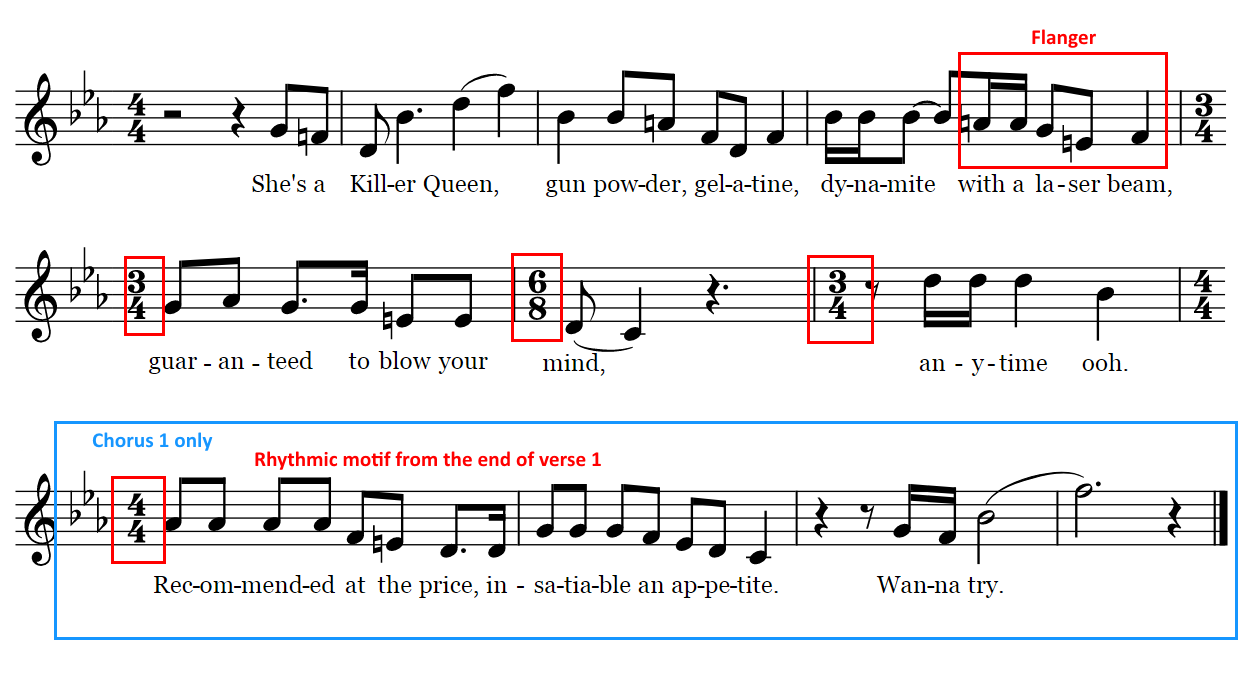
Flanger is used in the guitar parts and for word painting with the lyric "laser-beam" in the chorus
Flanging is an audio process that combines two copies of the same signal , with the second delayed slightly, to produce a swirling effect
Distortion and wah-wah are used on the guitar
Distortion is the alteration of a track and wah-wah is a type of effect pedal for an electric guitar to alter the pitch and frequency
There was clever use of microphone positioning when recording the guitars, to create different tones
Página 3
Verses:
Verse 1 and 2 have the following phrasing:
4-bar phrase oscillating between Cm and B♭7 chords
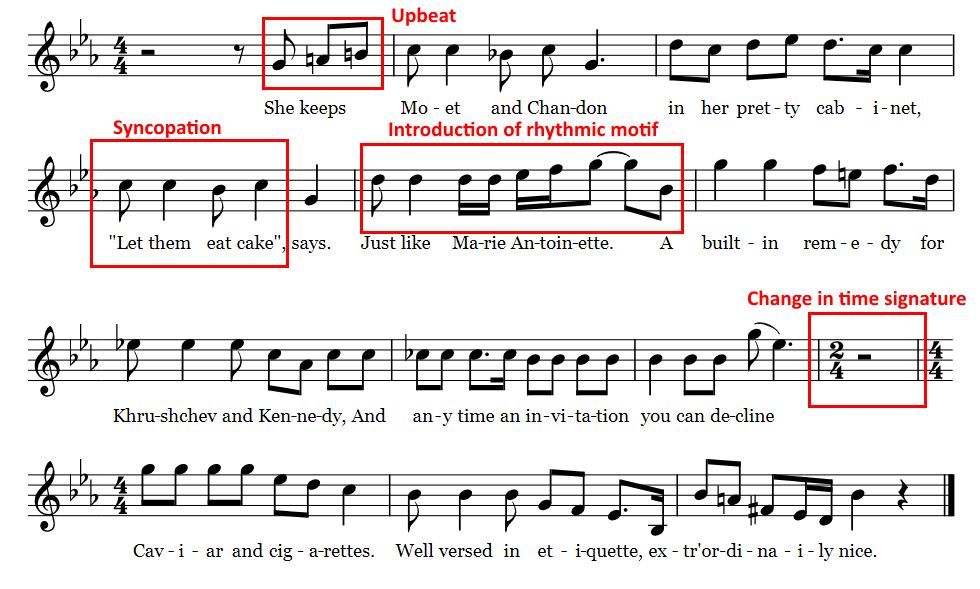
5-bar phrase ending with a 2/4 bar
3-bar phrase with last bar half-spoken to lead into the chorus
Verse 3 is a bit simpler with four 2-bar phrases.
In the first phrase, the chords last for a bar each and in the second phrase the harmonic rhythm changes to two chords per bar. Cm is the 6th chord in the key of E♭ major and B♭7 is the dominant seventh, these chords set the key and soon resolve to the tonic. The first phrase starts lower in pitch, rising over the four bars.
The second phrase starts with a descending chromatic bass line and ends with a changing time signature. We also hear the introduction of vocal harmonies acting as accompaniment for the main vocal line. The second phrase moves in the same overall direction as the falling bass line with little decorations such as in bar 8 on ‘Kennedy’ and bar 9 on ‘any time’.
The third phrase is the first appearance of a harmonic sequence. Here the chord sequence is a series of three bars of V–I, modulating quickly from C minor to E♭ major to G minor with the F chord preparing for a modulation to B♭ major in the chorus. The sequence here is moving up in thirds. The third phrase is a development of rhythmic motif, with the melodic line falling through the bar.
Página 4
Chorus:
The first chorus consists of a four-bar phrase followed by three-bar phrase that leads into a brief instrumental.
The second chorus is the same as the first, but only consisting of the first four-bar phrase.
The third chorus is the same as the first chorus with an extra bar added onto the end to give a more completed sound.
The first phrase that is present in all of the choruses has rapid modulations between B♭ major, D minor, and C major. The melody is harder to pick out due to the layered vocal harmonies and loud dynamics. There is an ascending bass line and highlights the lyrics guaranteed to blow your mind.
The following phrase (present in chorus 1) uses the circle of fifths to build the chords. The chords used are A, Dm, G7, C, and B♭. The brief instrumental gives us a little break from fast-moving chords with a piano vamp creating variety over an F in the bass. The movement of the piano accompaniment gives the chords F, B♭/F and E♭/F – a variation on a standard rock ‘n’ roll piano.
The final chorus ends with an added bar of B♭ major to sound more complete than the other choruses.
Página 5
Guitar Solo:
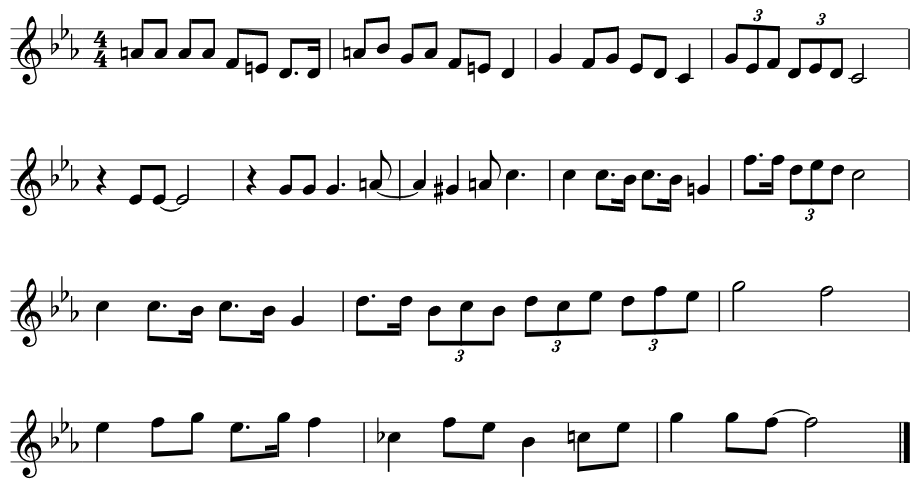
The guitar solo can be split into two parts.
In the first part, the first four bars sound like a continuation of the chorus, but they are a slight development of earlier melodies (the first bar repeats and the third bar uses Cm instead of C). The next three bars make a feature of the E♭/F (or F11) chord, repeating it to draw out the tension before the next section.
The second part (from bar 51) uses the same chord sequence as the verse up until the last two bars, which replace the last three bars of the verse. This part of the solo develops the falling melodic phrase from the third phrase of the verse. In bar 55, the top part starts the same as the second phrase of the verse, but soon introduces new melodic material.
The guitarist focuses on articulating each note in a particular way to help phrase his melodic lines. Focus is also put on the techniques being used, such as string bends, slides, pull-offs, and vibrato.
Página 6
Outro:
To solve the problem of the final chorus ending in B♭ major (the dominant) rather than E♭ major (the tonic), the outro modulates back to E♭ major.
The outro is a set of two bars that is repeated and fades out gradually.
Informações
- Descrição
- O usuário eliminou as informações de disciplina Notas sobre Queen: 'Killer Queen', criado por Usuário eliminado em 17-07-2017.
- Criado por
- Usuário eliminado
- Visualizações
- 118
- Histórico
-
- Criado por Antonia Blankenberg · 14 jul 2017
- Copiado por Antonia Blankenberg · 17 jul 2017
- Avaliação