
Notas
Santana: Migra
Conteúdo das notas (4)
Página 1
About the Piece:
This song is in protest to what was formerly the Immigration and Naturalization Service (now part of the Department of Homeland Security) and their raids of undocumented immigrants in the United States. But instead of inciting violence, the song preaches peace between Americans and immigrants. "Migra" is slang in Spanish for the Immigration and Naturalization Service.
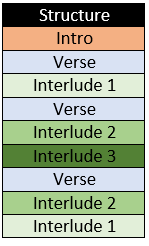
Structurally this is one of the simplest songs on the album. It consists of a verse over a bass riff, drum groove and a single chord with three contrasting interludes. These interludes add variety to what is otherwise a very repetitive structure. After all of these basic elements have been introduced they are repeated and layered together in different combinations.
Clave is the repeated rhythmic pattern used as the basis of Afro-Cuban music. There are two basic types of clave, Rhumba Clave and Son Clave. Migra uses the Son Clave. This type of rhythm became popular when it was introduced to America and was quickly adopted by Rock ‘n’ Roll musicians such as Buddy Holly and Bo Diddley. Bo Diddley used the rhythm so much that it became known as the ‘Bo Diddley Beat’. Santana’s use of the clave in Migra closely resembles the Bo Diddley Beat.
The tonality in this song is questionable. The entire song is based around a single chord of F. Since the 3rd of the chord is not present there is uncertainty as to whether the song is in F major or F minor. We call this tonal ambiguity. Overall though, there is a sense of F minor as the main tonality.
The instrumentation in this song consists of guitar, sleigh bells, keyboards, accordion, bass, drums, percussion, congas, trumpet and trombone.
Página 2
Introduction and Verse:
The song opens with a four bar tom-tom introduction on the drum kit using a clave rhythm (shown below).
The introduction continues with the introduction of a typical Santana guitar solo at bar 5 before the very simple single bar bass riff enters at bar 9. It uses just two notes, the tonic and leading note, (F & E).
There is a dynamic buildup and rising tension from the guitar line into the verse in bar 9.
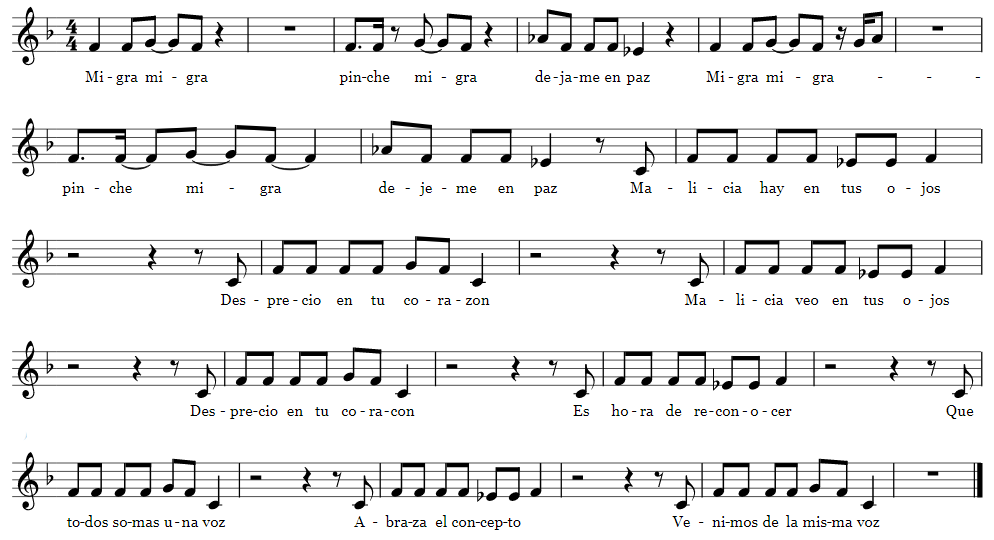
The melody in the verse is very restricted, encompassing a range of just a fifth (C – G). As with the other two set songs, there is call and response with the singer and the guitar line, creating an antiphonal texture.
These responses feature the ‘wah-wah’ pedal being employed by Santana. The pedal is linked between the guitar and the amplifier and when the pedal is pressed it produces the desired ‘wah-wah’ effect. The player controls the speed and intensity of the effect with the pedal.

Página 3
Interlude 1:
The first interlude comes after the verse. It is a catchy two bar riff played on accordion and doubled by synthesiser. It plays over the top of the same bass riff and clave rhythm.
In keeping with the vocal ideas in this song, the accordion melody is quite restricted in pitch encompassing just a perfect fourth between the tonic, (F) and subdominant (B♭). What makes this really interesting though is the use of ornamentation (turns and mordents) resulting in a highly decorated two bar phrase.
The accordion is hugely popular in Afro-Cuban music. As an instrument it is essentially a cross between a keyboard instrument and a reed instrument. The number of buttons on the accordion varies with the complexity of the instrument.
The accordion riff (shown below) is played four times after which, we return to another verse with more call and response between voice and lead guitar.

Página 4
Interlude 2 and 3:
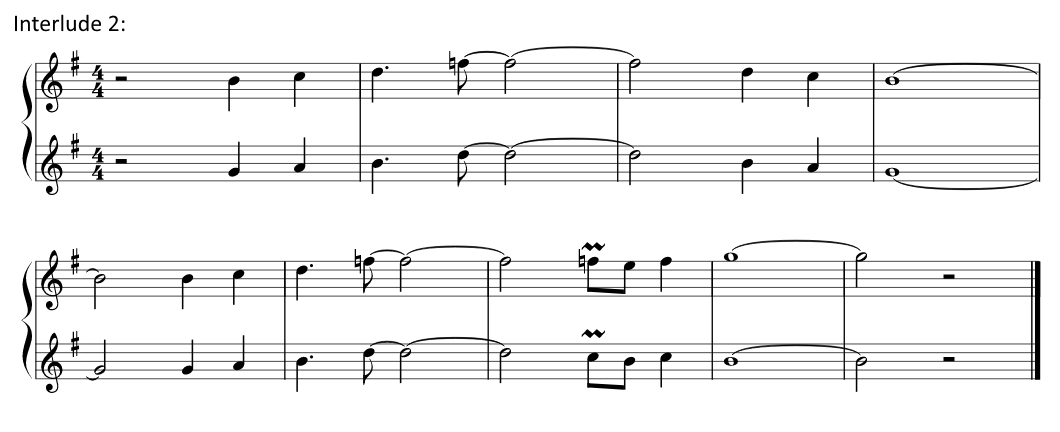
After this shortened verse we hear the second interlude. This is made up from the same bass riff and clave rhythm and a new eight bar melodic idea played on two trumpets. This is very typical of Afro-Cuban music with the two trumpets playing in harmony that is for the most part in parallel 3rds.
In the second part of this section, the bass riff drops out to leave the drum rhythm accompanied by rhythm guitar with increasing use of wah-wah pedal.
Unlike the first interlude, the second interlude doesn't lead back to a verse, instead going straight to the third interlude.
The third interlude features a much quieter and more laid back rock-rhythm, consisting of bass drum on beats 1 to 3, closed hi-hats on the second half of each beat with a strong snare drum accent on the fourth beat (shown below).
Accompanying this beat, there is a more complex bass riff (shown below) based on the root, 5th and 7th of the chord of F using dotted rhythms and syncopation.
Above the rhythm and bass the voice can be heard chanting on the first beat of every bar.
After eight bars, Santana produces the most dynamic and complex improvised solo in the song where he employs all of his usual trademark techniques: tremolo, vibrato, wah-wah, glissandi and syncopation. Unlike all of the previous sections, a huge range of notes are used.
After this solo, we hear another verse. This is followed by various repetitions of the interludes before the piece draws to the final cadence.


Informações
- Descrição
- O usuário eliminou as informações de disciplina Notas sobre Santana: Migra, criado por Usuário eliminado em 01-08-2017.
- Criado por
- Usuário eliminado
- Visualizações
- 45
- Histórico
-
- Criado por Antonia Blankenberg · 28 jul 2017
- Copiado por Antonia Blankenberg · 1 ago 2017
- Avaliação