
Notas
Processes in Hot Deserts

Conteúdo das notas (8)
Página 1
Weathering: Block and Granular Disintegration
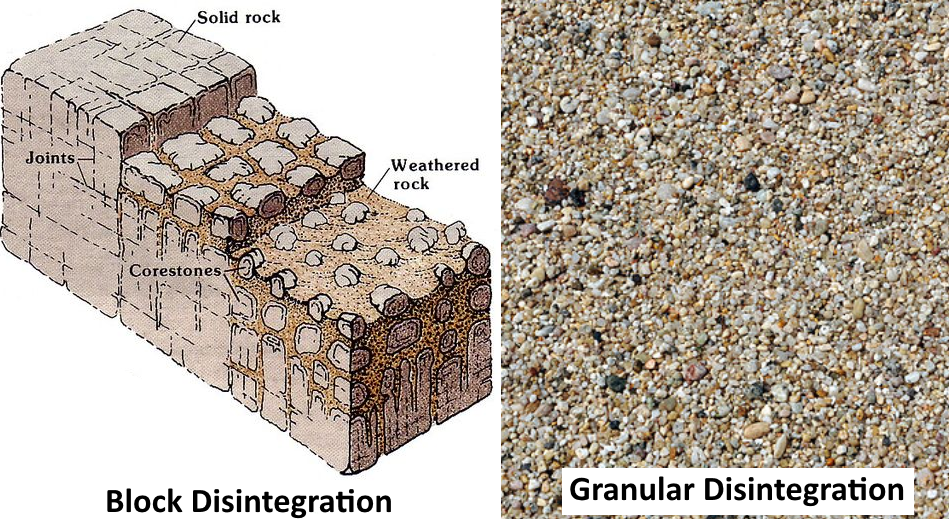
Block disintegration
The breakdown of large rocks into smaller rocks
Occurs in well-jointed rock such as granite
It is particularly effective in areas with great diurnal range of temperature and rocks without a protective vegetation cover
Rocks are split along the joints into large rectangular-shaped blocks
Granular disintegration
The breakdown of rock into fine sediment
As a result of alternate expansion and contraction of minerals in rocks
Página 2
Weathering: Thermal Fracture
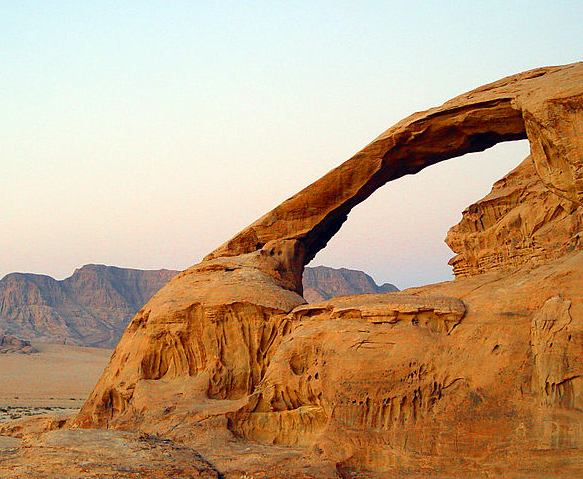
Thermal expansion and fracture occurs when repeated heating and cooling puts pressure on the surface of a rock.
This is caused by the extreme diurnal temperatures present in deserts.
Each mineral in a rock expands a different amount, causing internal pressure to build up, cracking the rock. The dark coloured minerals absorb more heat and are heated up faster. Light coloured minerals can reflect light and are heated up slower.
This process can often lead to a rock cracking into layers. This is called exfoliation or onion-peel weathering.
This is a form of physical weathering; the rock is broken down but there is no change in the chemical composition of the rock.
Página 3
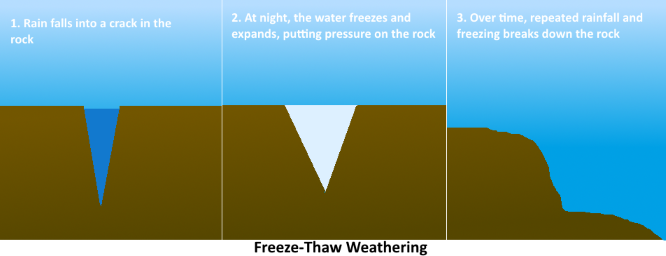
Weathering: Freeze-Thaw
Freeze-thaw weathering sometimes occurs in deserts due to the large dirunal temperature range, but is rare due to the lack of rainfall.
Small cracks in the rock surface fill with water from precipitation or melted ice.
As temperatures drop, the ice on the surface is the first to freeze over.
When the rest of the ice freezes, it expands, putting pressure on the rock and causing the crack to become bigger.
This process is repeated as the larger cracks fill with water and freeze.
This is a form of physical weathering.
Página 4
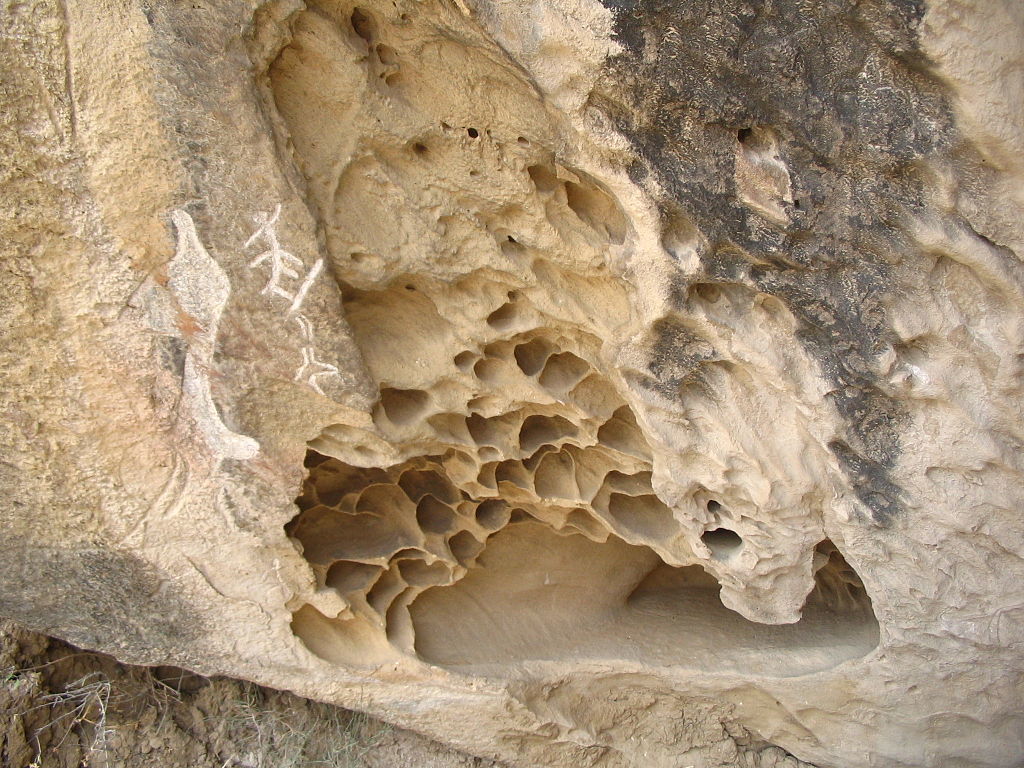
Weathering: Salt
Salt weathering occurs either with rainwater or groundwater that has risen to the surface.
When the pores of the rock is filled up with saline solution, salt crystals will grow when the water or the solvent is evaporated.
The growth of salt crystals will weaken the rock and make them easier to be eroded.
Salt weathering is common in endorheic drainage basins.
This is a form of physical weathering.
Página 5
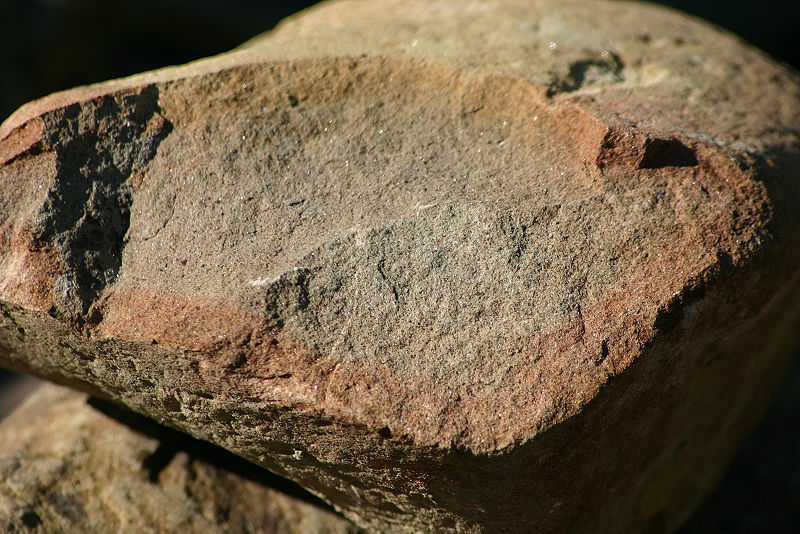
Weathering: Oxidation
Oxidation is the process of taking up oxygen from the air.
This occurs as ferric minerals react with oxygen, leaving behind rust.
When minerals in rock oxidise, they become less resistant to other forms of weathering.
This is a form of chemical weathering as it changes the composition of the rock.
Página 6
Weathering: Hydrolysis
Hydrolysis is the breakdown of minerals in rocks to form new clay minerals.
This is caused by water and dissolved carbon dioxide.
It is more common in igneous and metamorphic rocks that contain feldspar and silicate materials.
This is uncommon in deserts due to the lack of water.
This is a form of chemical weathering.
Página 7
Fluvial Processes
Transportation:
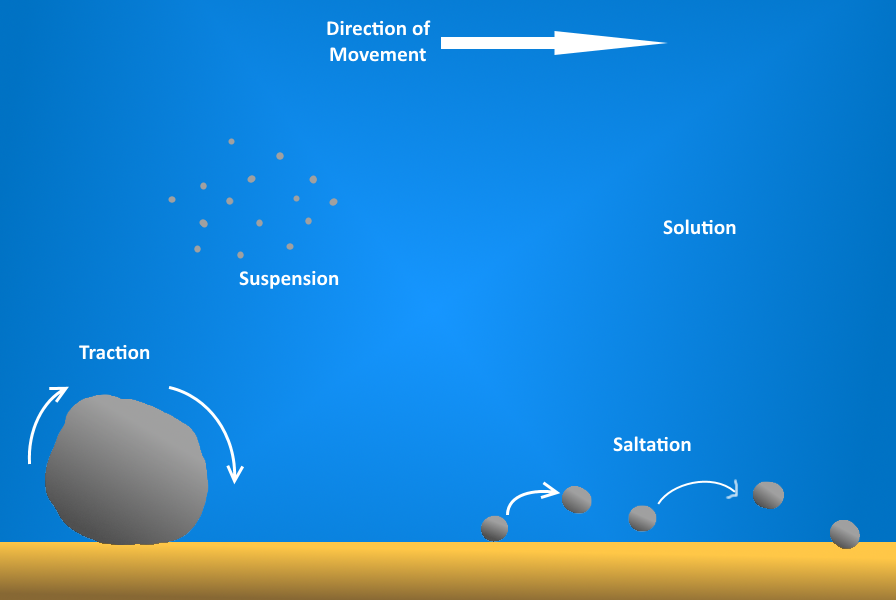
Traction is the rolling of larger rocks along the river floor.
Saltation is the hopping/bouncing of smaller rocks and pebbles across the river floor.
Very small pieces of sediment are carried through suspension.
Solution carries dissolved minerals in the water.
Erosion:
Abrasion - the force of sand and pebbles in the river scraping away at the channel.
Attrition - the wearing away of rocks in the river by hitting off one another.
Hydraulic action - the wearing away of rocks by the force of the water. This can also occur through the compression of air in small gaps by water.
Solution - the chemical breakdown of rock by water.
Factors affecting fluvial processes:
Velocity and discharge of the river affect how much sediment a river can carry.
Relief controls the velocity of the river.
Climate affects the amount of precipitation that falls and how much water is in the river.
Sediment size can play a role in the landforms formed, i.e. larger sediment is more difficult for the river to carry.
Human activity can play a large role in modifying river processes.
Página 8
Aeolian Processes:
Transportation:
Aeolian transportation is similar to transportation in rivers. However, the wind can only carry finer sediment.
Threshold velocity can be defined as velocity required to entrain (lift) a particle of a particular size.
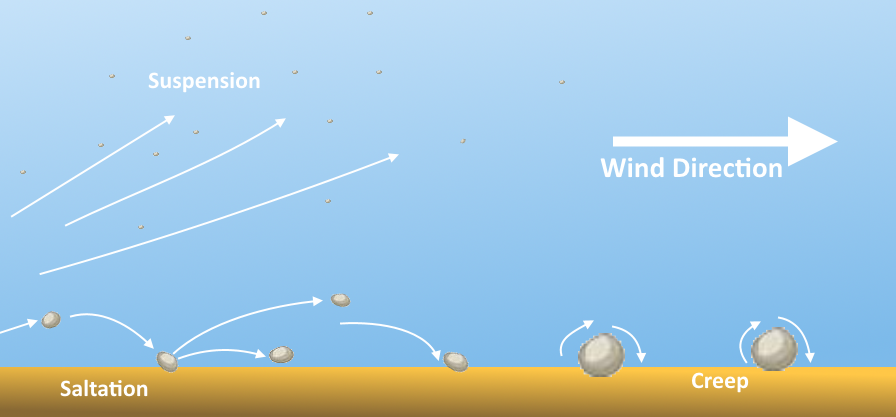
Creep is the rolling of sediment along the ground.
Saltation is the hopping/bouncing of smaller particles across the ground.
Very small pieces of sediment are carried through suspension.
Erosion:
The wind mostly erodes through the processes of deflation and abrasion.
Unlike streams, the wind has the ability to transport sediment up-slope as well as down-slope.
Erosive force increases exponentially with increases in wind velocity.
Deflation is the removal of loosened material and its transport as fine grains in atmospheric suspension.
Abrasion is erosion from the force of suspended sand grains hitting another surface.
Deposition:
Terminal fall velocity is the velocity at which a particle being transported by wind is deposited on the ground surface.
Deposition can also occur when the wind is stopped by an obstacle (plant, building etc.).
Accretion occurs when sand grains come to a rest.
Encroachment is the process of continued growth of sand accumulations.
Informações
- Descrição
- O usuário eliminou as informações de disciplina Notas sobre Processes in Hot Deserts, criado por Usuário eliminado em 17-08-2017.
- Criado por
- Usuário eliminado
- Visualizações
- 254
- Histórico
-
- Criado por Antonia Blankenberg · 16 ago 2017
- Copiado por Antonia Blankenberg · 17 ago 2017
- Avaliação