
Notas
Waves and Diffraction
Conteúdo das notas (14)
Página 1
What is a wave?
It is a collective bulk disturbance that can be created by a vibrating object, that travels through a medium (involving particle interactions: one particle applies a push or pull on its adjacent neighbor, causing a displacement of that neighbor from the equilibrium or rest position) and that transports energy. There are different types of waves: pulse (a bit like a square wave), continuous (wave of constant amplitude and frequency), travelling (travelling through a medium), standing (wave confined to a given space but that still gives out a regular wave pattern, where some points appear to be standing still) etc. You get a wave if and only if there is finite speed of propagation of the forces that move the particles.
In this first case, assume that the shape of the wave remains constant (ie: we are not in a dispersive medium)
Characteristics of a wave:
- Tension, T: assume that T is high enough that forces acting on elements of the string can be considered as solely due to the tension in the string, with negligible contribution from gravity. And assume T doesn't vary significantly when it undergoes small displacement from rest.
- Linear density, rhô (mass per unit length).
- Speed, c: determined by T and rhô. To get relationship, deduce that speed increases when the string elements are light (ie: small rhô) and that speed increases too when the force making the string elements move is strong (ie: bigger T).
Página 2
Calculation of the forces acting on a string element
This will give the derivation of the relationship between t, rhô and c, and of the general wave equation.
We will assume that there is no frictional losses both internal to the string and due to the the string moving in the surrounding medium – which typically cause the amplitude of a real wave to diminish as it propagates.
Create a diagram of all the forces at work and get the individual component of T with respect to each angle (below):
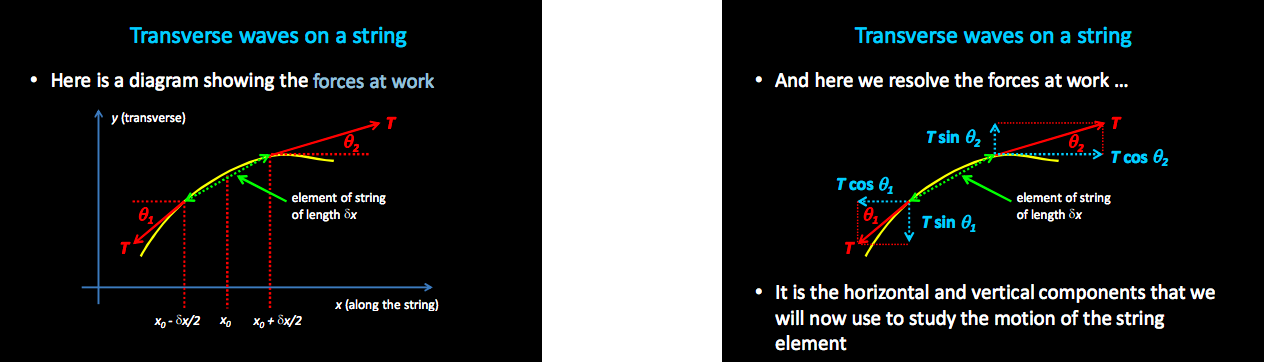
Calculate the net horizontal force (positive direction is to the right):
F(net horizontal) = T cos theta2 - T cos theta1
Because the displacement is small, use small angle approximation:
F = T - T = 0
So there is not net horizontal force felt by the element.
Now consider the gradients of the string at the two ends of the string element (below):
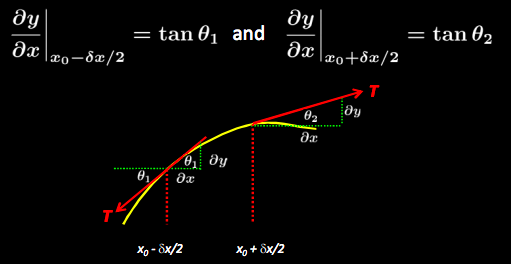
Remember that tan(x) = sin(x)/cos(x)
Calculate the net transverse force (positive direction when y increases):
F(net transverse) = T tan theta2 - T tan theta1 (first use vertical component of T, then small angle approximation gives tan)
So the element will feel a net transverse force if the gradients of the two ends of the string element are not the same.
So when the net transverse force acts on the mass element, it produces an acceleration d^2y/dt^2 at x0.
The mass of the string element is the product of it's mass density (assumed to be uniform) and its length:
m = rhô*delta(x)
We now have an expression for F, m, and a, thus:
F = m*a
Rewrite with all our expressions. Divide by delta(x) on both sides. LHS becomes the double derivative of d/dx.
Get the general wave equation and relationship between T, rhô and c:
d^2y/dt^2 = (T/rhô)*d^2y/dx^2
And c = sqrt(T/rhô) (derived in 3rd page)
Página 3
Solutions to general wave equation for a travelling wave
Case of a pulse propagating along a stretched string (constant shape):
- Attach a co-moving coordinate frame, x', y , to the pulse and let the pulse start its motion from a position to the left of the y-axis.
- Let xf be the position in the x frame of the origin of the x' frame.
- Let the x' frame travel to the right, with the time origin being when the two frames coincide.
- Then xf starts negative, goes through zero at t = 0 and continues to increase.
- Let the speed (magnitude of velocity) of both the wave and the frame that moves with it be c.
- Then we can write xf = c*t (distance = velocity * time)
We can see that x = x' +xf = x' + c*t
So x' = x - c*t
Therefore, for a pulse moving to the right:
y(x, t) = y(x - c*t)
For a pulse moving to the left:
y(x, t) = y(x + c*t)
So for a pulse going either left or right, the transverse displacement of the string can be expressed as a function of the single (composite) variable.
In this case, the principle of superposition holds: if there are the following solutions y1(x, t) and y2(x, t), then a*y1(x, t) + b*y2(x, t) is also a solution.
Check that this last result can be a solution to the general wave equation:
We have y(x, t) = y(x - c*t).
- Remember general wave equation: d^2y/dt^2 = (T/rhô)*d^2y/dx^2
- Need to first get dy/dt, then its second derivative:
Define u = x - c*t, so that dy/dt = (dy/du)*(du/dt)
du/dt = -c
dy/dt = -c*dy/du
So d^2y/dt^2 = d(-c*dy/du)/du*du/dt
d^2y/dt^2 = c^2*d^2y/du^2
- Now need to get dy/dx and its second derivative:
du/dx = 1
dy/dx = dy/du
So d^2y/dx^2 = d(dy/du)/du*du/dx
d^2y/dx^2 = d^2y/du^2
- Input these results into the general equation:
d^2y/dt^2 = c^2*d^2y/dx^2
We can also conclude from our previous results that c = sqrt(T/rhô).
Página 4
Boundaries and Conditions
For a single pulse:
- Free end point
- Fixed end point
For a free end point:
- Reflected wave has the same polarity as the incident wave (no phase change),
- Restoring force at the boundary is 0.
For a fixed end point:
- Reflected wave has an inverted polarity as the incident wave (phase change of 180°),
- Displacement at boundary is 0.
Página 5
Energy Density and Power
The energy density is the energy per unit length of the string.
We need to find the kinetic and potential energies of an element of the string:
- KE = (1/2)*m*v^2.
Whilst here, we consider a small string element, so its mass is delta(m) and only has a transverse (y-axis perpendicular to direction of propagation) velocity, v(t):
KE = (1/2)*delta(m)*v(t)^2, but delta(m) = rhô*delta(x),
KE = (1/2)*rhô*delta(x)*(dy/dt).
- Potential energy of the string element arises because the element is stretched – from its neutral length – by the travelling wave (below):
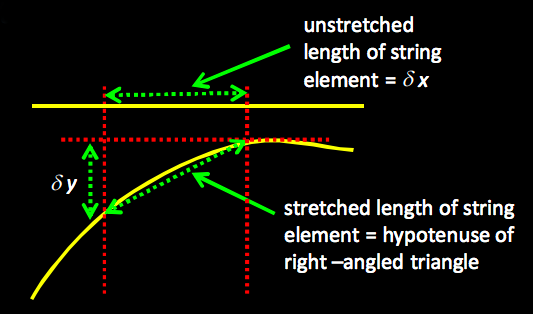
The potential energy of the string element is the extension/new stretched length multiplied by the tension.
So we can calculate the new stretched length using the regular formula for length:
New stretched length of the element = sqrt((delta(x)^2+delta(y)^2)
Provided the gradient (dy/dx) of the string element is small, this new length can be approximated using the Binomial expansion:
New stretched length of the element = delta(x)*sqrt(1+(gradient)^2),
New stretched length of the element = delta(x)*(1+(1/2)*gradient)^2.
So the stretched length of the string element = delta(x)/2*gradient^2 because we are only interested in the second term of the previous equation.
We can now multiply this by the tension:
PE = (delta(x)*T)/2*gradient^2.
We can now get the total energy of the string element:
E = (1/2)*rhô*delta(x)*(dy/dt) + PE = (delta(x)*T)/2*gradient^2
The total energy density of the string element is E divided by its length, delta(x):
Energy density = (rhô/2)*(dy/dt)^2 + (T/2)*(dy/dx)^2
The total energy of the string is found by integrating over the full length of the string (below):
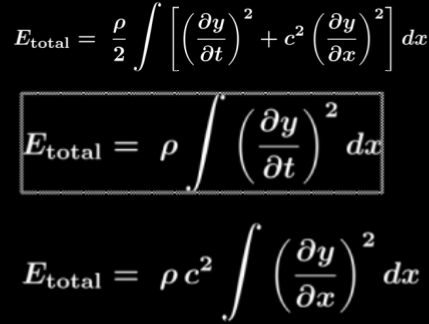
Remember T = rhô*c^2.
The last two expressions are the 2 equivalent ways in which you can calculate E(total) for a constant shape travelling wave.
Try an example with y(x, t) = a*sin(k(x - c*t))
Remember angular frequency, omega = k (wave number) *c
So power transported by a sinusoidal wave is:
P = (1/2)*rhô*a^2*omega^2*c = (1/2)*a^2*omega^2*sqrt(T*rhô)
Página 6
Sinusoidal Waves
They are a particular example of constant shape waves. The typical expression for one is:
y(x, t) = a*sin(k(x+-c*t)+phi).
k is the wavenumber: k = (2*pi)/lambda.
Variables are related such that: c = lambda*f = omega/k.
Exercise: verify it satisfies the general wave equation.
Página 7
Standing Waves
It is when each element of the string appears to execute – synchronously – the same transverse motion, differing only in the magnitude of the motion. A standing wave can be observed in the presence of same frequency and amplitude counter propagating waves. It is just their sum.
They are described as a product of one function solely depending on time and another solely dependent on position:
y(x, t) =X(x)*T(t).
Calculate the second derivatives:
d^2y/dt^2 = X(x)*d^2T/dt^2
d^2y/dx^2 = T(t)*d^2X/dx^2
Insert this into the general wave equation to see if it is a reasonable candidate:
X(x)*d^2T/dt^2 = c^2*T(t)*d^2X/dx^2
Do separation of variables: all functions of X on one side and T on the other.
Both sides must equal the same constant value, which we will set to be – k^2. That way, you get 2 second order differential equations.
Their respective possible solutions are therefore:
X(x) = X0*sin(k*x+phi),
T(t) = T0*sin(omega*t+phi).
Thus, the standing wave solution is:
y(x, t) = y0*sin(k*x+phi)*sin(omega*t+phi), where y0 = X0*T0.
Página 8
Impedance
It is a measure of how hard it is to move the string up and down. In the case of a string, it is hard to make it move because we have to act against the transverse component of the tension.
We waggle the end of the string to create a sinusoidal wave and have to apply a time varying force. We need to balance that force previously mentioned: F = T*sin theta.
So we have to apply the counter balancing force: F = -T*sin theta (use small angle approximation for sin = tan).
You get F = -T*gradient at x = 0.
Remember gradient = dy/dx.
Remember for a constant shape travelling wave: dy/dt = -c*dy/dx. So you can get an expresion for dy/dx that you can replace in the force equation. dy/dt at x = 0 is the transverse velocity.
So Fy(t) = (T/c)*dy/dt at x = 0,
Fy(t) = sqrt(T*rhô)*dy/dt at x = 0.
So impedance is the ratio of the transverse force applied and the resulting transverse velocity:
Z = F(t)/v(t) = sqrt(T*rhô).
We will frequently use F(t) = Z*v(t).
From the previous derivation, we can see that the driving force required depends on the component of the T, Ty, not T itself, that has to be balanced by the driving force. Thus, it is the gradient of the string that determines the component.
Remember -i = exp(-i*pi/2).
Página 9
Reflection and Transmission at Boundaries
There are 2 conditions:
- Geometrical boundary condition: the displacement at x = 0 must be continuous at all times.
- Dynamical boundary condition: transverse force at x = 0 must be continuous.
Suppose 2 different strings which are joined at x = 0 so the tension cannot vary between them, only rhô can differ:
- Incident wave: yi = A*exp(omega*t - k1*x),
- Reflected wave: yr = B*exp(omega*t + k1*x) at the boundary,
- Transmitted wave: yt = C*exp(omega*t - k2*x) at the boundary.
Here we have different wave numbers but same angular frequency as rhô varies from one string to the other.
Relation between A, B and C for the geometrical boundary:
Because of what it implies, at all times we have:
yi(x = 0) + yr(x = 0) = yt(x = 0),
So A + B = C.
Relation between A, B and C for the dynamical boundary:
The only element we know/have is that the transverse force at x = 0 must be continuous. As we have seen before, at the boundary, the transverse force component is given by F = T2*sin theta2 - T1*sin theta1.
Remember small angle approximation turns sin into tan and tan is the gradient of the tension. Thus, for the general case, there is no net force at a massless boundary so:
T2*dyt/dx (at x = 0) = T1*d(yi+yr)/dx (at x = 0).
For our simple case, assume T1 = T2 = T.
So dynamical boundary can be re-written in this case:
- The product of T and the gradient must be continuous,
- If T is the same in both strings, only the string gradient has to be continuous.
As we have an expression for yi, yr and yt, can calculate the gradient dyi/dx, dyr/dx and dyt/dx and re-write the boundary condition at x = 0:
dyi/dx + dyr/dx = dyt/dx and calculate when x = 0.
We get: -k1*A + k1*B = -k2*C, using geometrical boundary condition:
-k1*A + k1*B = -k2(A + B).
If we want B/A, we need to eliminate C like we just have.
Multiply both sides by T so that later on we can use impedance. Use k = omega/c, c = sqrt(T/rhô) and sqrt(T*rhô) = Z too:
-Z1*A + Z1*B = -Z2*A - Z2*B, giving
B(Z1 + Z2) = A(Z1 - Z2)
So B/A = (Z1 - Z2)/(Z1 + Z2).
When you add a point mass at the join, the geometrical boundary condition doesn't change but the dynamical one does. It changes because this time there will be a net transverse force at the location of the mass (that's the force that causes the mass to accelerate). Therefore, the gradient doesn't have to be continuous, there is a possibility of a kink (petit défaut) at the join.
The dynamical boundary condition for 2 strings with an added mass is gotten from F = m*a. You get the same equation as before but mass is M.
We have the wave equations yi, yr and yt, so we can calculate the gradients and second derivative, d^2yt/dt^2. remember lastly the unconstrained case where T1 = T2.
Remember k*T = omega*Z.
Finally, we find that B/A = (Z1 - Z2 - i*M*omega)/(Z1 + Z2 + i*M*omega).
Página 10
Energy on Reflection and Transmission
We are often interested in travelling waves because of the energy they transfer through a medium. Remember previously that the power "transported" by the incident wave is:
Pi = (1/2)*rhô*A^2omega^2*c. Using relationship between Z, T, rhô and c, we get:
Pi = (1/2)*A^2*Z1*omega^2.
So power reflected and transmitted is therefore:
Pr = (1/2)*B^2*Z1*omega^2,
Pt = (1/2)*C^2*Z2*omega^2.
When there is no point mass at the join:
B/A = (Z1 - Z2)/(Z1 + Z2),
C/A = (2*Z1)/(Z1+Z2),
Pi + Pr = Pt.
The reflected intensity coefficient is given by:
Reflected Energy/Incident Energy = (Z1/Z1)*(B^2/A^2).
The transmitted intensity coefficient is given by:
Transmitted Energy/Incident Energy = (Z2/Z1)/(C^2/A^2).
Página 11
Impedance Matching
We have seen that the simple (no mass load) joined string shows no reflection if Z2 = Z1. But is there any other way to join strings when Z1 and Z2 are different without having reflected power? Yes, if you insert a 3rd element with particular length and impedance.
Let there be 3 strings joined together, with boundary between string 1 and 2 at x = 0 and between 2 and 3 at x = l. The tension will be the same in each string, but we allow the three strings to have different impedances arising from their different linear densities.
We're now considering 5 waves: 2 incident ones, 2 reflected ones and one transmitted. We want to calculate A3/A1, which will show that with a suitable impedance and length of middle section, we can achieve no reflected energy. There are 4 boundary conditions in order to eliminate the unwanted variable, A2, B1 and A1.
- At x = 0:
A1 + B1 = A2 + B2 [1], using this and our previous results, we get:
Z1(A1 - B1) = Z2(A2 - B2) [2].
- At x =l:
A2*exp(-i*k2*l)+B2*exp(i*k2*l) = A3 [3], here we allow A3 to be without any explicit phase factor because we allow it to have a phase factor included – e.g. by allowing it to be complex.
We also have Z2(A*exp(-i*k2*l) - B2*exp(i*k2*l) = Z3*A3 [4].
Now use [1] and [2] in order to get A1 in terms of A2 and B2. When we define r12 = Z1/Z2, we get:
A1 = (1/2)*(1/r12)*(A2*(r12 + 1) + B2*(R12 - 1)) [5].
Now we want A2 and B2 in terms of A3
Use [3] and [4] to get A2 in terms of A3 and you get:
A2 = (Z3+Z2)*A3*exp(i*k2*l)/2*Z2
Here, we define similarly as before r23 = Z2/Z3 so we have:
A2 = (r23+1)*A3*exp(i*k2*l)/(2*r23) [6].
Similarly, using [3] and [4], you get:
B2 = (r23-1)*A3*exp(-i*k2*l)/2*r23 [7].
We can now insert [6] and [7] into [5]
Define r13 = (Z1/Z2)(Z2/Z3) = Z1/Z3.
A1 = (A3/2*r13)*((r13 + 1)*cos(k2*l)+i*(r12 + r23)*sin(K2*l).
So:
(A3/A1)^2 = ((2*r13)/((r13 + 1)*cos(k2*l)+i*(r12 + r23)*sin(K2*l)))^2.
So the ratio Transmitted Energy/Incident Energy = (Z3*A3^2)/(Z1/A1^2) = (1/r13)*(A3/A1)^2 = 4*r13/((r13+1)^2*cos^2(k2*l)(r12 + r23)^2*sin^2(k2*l))
But this still looks very complicated, so let's choose:
l = lambda2/4,then k2*l = (2*pi)/lambda2 * (lambda2/4) = pi/2.
This gives: cos(k2*l) = 0 and sin(k2*l) = 1.
So the ratio above now becomes 4*r13/(r12 + r23)^2.
Then, let's say r12 = r23 then r13 = r12*r23 = r12^2.
So Transmitted Energy/Incident Energy = 1. This corresponds to choosing Z1/Z2 = Z2/Z3.
Giving: Z2 = sqrt(Z1*Z3).
Therefore, we can see that we achieve matching by choosing the matching string to be a quarter wavelength long and having an impedance that is the harmonic mean of the impedances of the two strings to be matched.
Página 12
Standing Waves on a Stretched String
A sinusoidal wave incident on a fixed or free end gives rise to a reflected wave – and that when the incident and reflected waves are added the result is a standing wave pattern:
y(x, t) = y0*sin(kx - phi)*sin(k*c*t + phi).
This is the standard form for solutions to the wave equation for a standing wave.
We know T and rhô determine c. We now need to know which values of k are allowed (using boundary conditions and phi).
Case of a stretched string of length L that is fixed at both ends:
There are nodes (= positions where there is no transverse movement of the string, ie the string doesn't seem to move) at both ends of the string.
We have:
- y = 0 at x = 0, so phi = 0,
So y = y0*sin(kx)*sin(k*c*t + phi).
- y = 0 at x = L, so the possible values of k allowed are given by sin(kn*x) = 0,
So kn = (n*pi)/L, with n = 1, 2, 3...
Therefore, we have a set of solutions for standing waves:
yn(x, t) = y0n*sin(n*pi*x/L)*sin((n*pi*c*t/L) + phi).
So the allowed wavelengths/frequencies are restricted to:
lambdan = 2*pi/kn = 2L/n,
fn = c/lambdan = n*c/2L.
We can write this family of solutions this way:
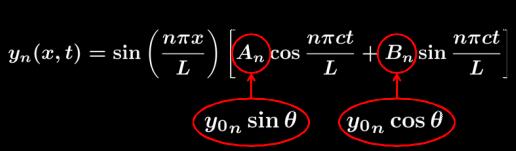
For each n, An and Bn will be determined by the initial conditions of the string as it is set in motion. Remember that the original wave amplitude is:
y0n = sqrt(An^2 + Bn^2).
Each normal mode satisfies the boundary condition of the string being fixed at each end. Normal mode frequencies are integer multiples of the lowest mode frequency = c/2L (n = 1, it is called the fundamental mode or 1st harmonic).
Case of a stretched string where both ends are free:
A similar argument holds, but instead of y = A*sin(k*x)*sin(omega*t + phi) as a solution, this time the boundary conditions are satisfied by y = A*cos(k*x)*sin(omega*t + phi). With cos(kn*L)= 0 so kn = n*pi/L, with n = 1, 2, 3...
So the normal modes are the same, it is just the position of nodes and antinodes that is swapped.
Case of a stretched string where one end is fixed (at x = 0) and the other free (at x = L):
You would choose a solution that looks like this: y = A*sin(k*x)*cos(omega*t + phi). With sin(kn*L) = 1 so kn = (2n - 1)*pi/2L, with n = 1, 2, 3...
Página 13
Energy in a Normal Mode
Remember that you get the total energy of the string by integrating the energy density over the whole string:
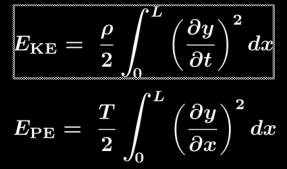
Remember that our general harmonic is:

Using this, you can calculate (dy/dt)^2 and (dy/dx)^2 to plug back into the energy equation.
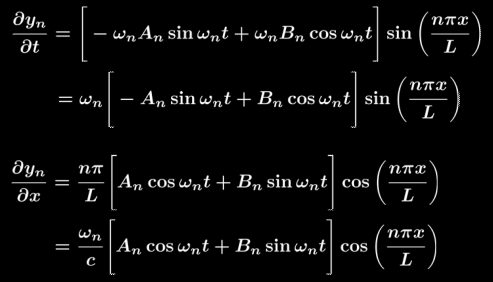
It thus follows that:
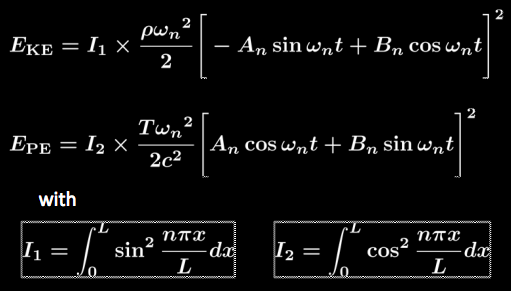
I1 = I2 = L/2 and m is the mass of the whole string:
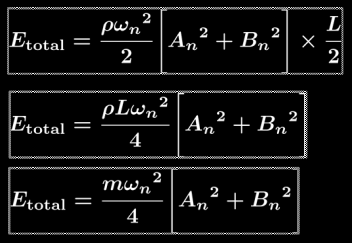
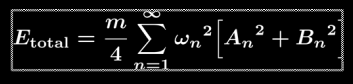
So the total energy of the vibrating string, fixed at 0 and L , is the sum of the energies of all the normal modes of vibration.
Página 14
Trig expansions etc
y0*sin(k*x)sin(omega*t) = (1/2)y0*(cos(k*x-omega*t)cos(k*x+omega*t))
cos(k*x-omega*t) = cos(k*x)cos(omega*t) + sin(k*x)sin(omega*t)
Informações
- Descrição
- Physics (Waves and Diffraction) Notas sobre Waves and Diffraction, criado por Sia N em 29-10-2017.
- Criado por
- Sia N · out 2017
- Atualizado
- 1 nov 2017
- Visualizações
- 18
- Avaliação