
Flashcards
DNA III - Eukaryotic genomes and structure
Flashcards do conjunto (23)
- 1What is the nucleoid?The nucleoid is a circular strand of supercoiled DNA in prokaryotes which is anchored in place by proteins which comprise ~2% of the mass of the nucleoid and isn't enclosed by a membrane
- 2What is meant by the term "genophore"?The genophore is all the genetic information of a prokaryote
- 3Why is the nucleoid necessary?The nucleoid is necessary as DNA needs to be compressed
- 4What is typical of bacterial genomes?Most often prokaryotes have only 1 chromosome that is circular and therefore has no free ends, most prokaryotic DNA is organised into genes and encodes proteins i.e. exons
- 5What are the features of a plasmid?(7)1. Accessory circular DNA molecules seperate from the chromosome
2.Size range from 1kb-400kb
3.Cells may contain 1-200 copies of a particular plasmid
4.Plasmids carry non-essential genes
5.They are readily conjugated between cells
6.Have an origin of replication - 6Describe eukaryotic nuclear genomesMost eukaryotic DNA are introns - non-coding DNA
~50% of the human genome is repetitive DNA
i.e. non-coding sequences present in thousands of copies. - 7Describe Eukaryotic chromosomesEukaryotes have a number of linear chromosomes that are only visible at mitosis/meiosis.
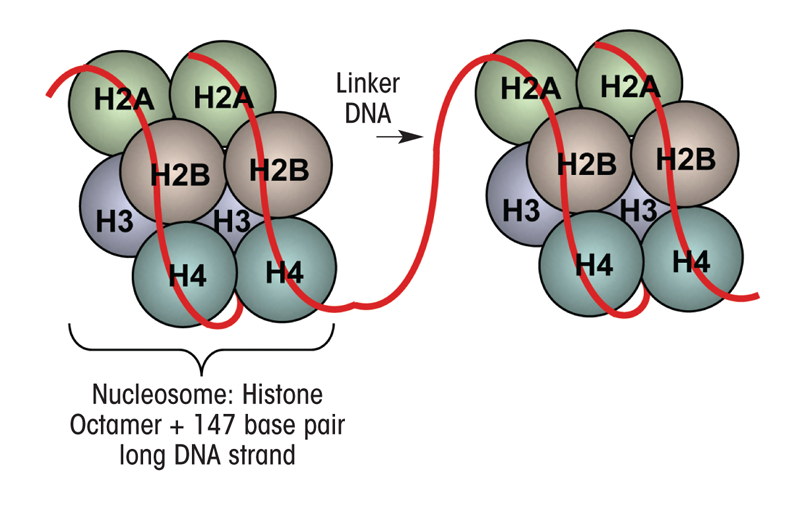
Two copies of a particular chromosomes are homologous to one another - 8Compare eukaroytic genome/prokaryotic genome (5)(Usually) multiple chromo / (usually) one chromo
Linear chromo / circular chromo (usually)
Plasmids very rare / plasmids common
Many introns / few introns
Gene numbers similar between both organisms i.e. yeast ~4000 / E.Coli ~ 4300 - 9What is the composition and function of a mitotic chromosome?(4)Compresses DNA
1/3 DNA (one long molecule)
1/3 histone proteins
1/3 non-histone proteins - 10Draw a chromosome(chromosome/chromatid/centromere labelled)
- 11Name the 5 relevant histone proteinsH1/H2A/H2B/H3/H4
- 12What do all histone proteins have in common? (5)Basic:~20% of amino acids are arginine or lysine and are charged
Leaving plenty of room for hydrostatic interactions between DNA and histone proteins
Highly conserved between species - 13What is the packing ratio of DNA during mitosis?packing ratio=length of DNA/Length of structure DNA is packed into
e.g. smallest human chromo during mitosis=2um, contains 14mm DNA
P.R.=14000/2=7000. - 14How is compression achieved during mitosis?Formation of nucleosomes.
When interphase nuclei are lysed in low ionic strength buffer and viewed through an electron microscope a "beads on a string" structure known as the '10mm filament' is observed. The beads are known as a nucleosome - 15Describe nucleosome structureA nucleosome is 14bp of DNA wrapped around a core particle consisting of:2 H2A molecules / 2 H2B molecules / 2 H3 molecules/ 2 H4 molceules
- 16Draw the structure of a nucleosome
- 17What is the role of Histone H1?H1 binds to DNA outside core particle, sealing DNA to particle
- 18How is a higher order structure achieved?(3)Long regular structures made from nucleosomes (e.g. a helix with 6 nucleosomes per turn) are formed.
This form doesn't exist in vivo.
Nucleosomes are packed into the nucleus of an interphase cell in disorded chains with varying degrees of nucleosome densities - 19What are mitotic chromosomes?Chromosomes visible at mitosis/meiosis consisting of a scaffold of non-histone proteins (e.g. condensins) that anchors long loops of nucleosomes in the 10mm filament form
- 20Draw a schematic diagram of this compression(10mm filament->nucleosome->scaffold
->mitotic chromosome - 21How can eukaryotic gene expression be regulated?By covalent modification of histone proteins i.e. acetylation
- 22What does acetylation do?Acetylation removes positive charges from side chains and weakens interactions between histones and negatively charged DNA
DNA associated with acetylated histones are much more readily transcribed than DNA associated with unmodified histone proteins. - 23Why are unmodified histone proteins less likely to lead to gene expression?As DNA is tightly associated with nucleosomes and is not very accessible for transcription - The gene is switched off.
DNA that has a looser association with nucleosomes are more accessible for transcription - gene is switched on.
In vivo this is always due to DNA partially unwinding to form a replication fork.
Informações
- Descrição
- O usuário eliminou as informações de disciplina FlashCards sobre DNA III - Eukaryotic genomes and structure, criado por Usuário eliminado em 17-12-2017.
- Criado por
- Usuário eliminado · dez 2017
- Atualizado
- 17 dez 2017
- Visualizações
- 21
- Tags
- Histórico
-
- Criado por J yadonknow · 16 dez 2017
- Copiado por J yadonknow · 17 dez 2017
- Avaliação