
MODAL VERBS by Hills
Slides do conjunto (9)
-
- OBLIGATION: HAVE TO, MUST, SHOULD
- HAVE TO / MUST + INFINITIVE:
- To talk about obligation or something that it is necessary to do.
- MUST (debe) is a modal verb. It only exits in Present, but it can be used with a future meaning. Use HAVE TO with other verbal tense.
- Past of MUST is HAD TO.
- HAVE TO / MUST for strongs recommendations,, when you are not giving your personal opinion.
- Both have similar meaning, and you can usually use either form:
- HAVE TO is more common for general, external obligations. (viene dada por una tercera persona o por normas).
- MUST is more common for specific or personal obligations. Moral duty. La obligación expresada por must está impuesta por el hablante o el que escribe la frase:: Passengers must fasten their seatbealts.
- HAVE TO is a normal verb and it exits in all tenses and forms.
- HAVE TO: In questions and negatives we use DO / DOES or DID + HAVE TO, never HAS TO.
- HAVE GOT TO is often used instead of HAVE TO / MUST in spoken english.
- DON'T HAVE TO / MUSN'T:
- DON'T HAVE TO: When there is no obligation to do something. Things that are not necessary.
- MUSTN'T: When something is prohibited.
- You can often use CAN'T or NOT ALLOWED to instead MUSTN'T.
- ADVICE: SHOULD / SHOULDN'T + INFINITIVE (MODAL VERB) == OUGHT TO / OUGHT NOT TO:
- SHOULD( (debería) is not as strong as MUST / HAVE TO. We use it to give advice or an opinion, if we think something is right / wrong thing to do.
- OUGHT TO / OUGHT NOT TO: Polite.
- POSSIBILITY OR DEDUCTION: MAY, MIGHT, COULD, CAN'T, MUST
- MIGHT / MAY / COULD (puede que, podría): When you think something is possible true (50%). Polite.
- MUST: When you are sure something is true (100%).
- We don't use CAN instead of MIGHT / MAY.
- CAN'T: When you are sure something is impossible / not true.
- In some context the opposite of MUST is CAN'T.
- We can use COULD instead of MIGHT in positive sentences.
- We often use BE + Gerund after MIGHT / MUST / CAN'T.
- ABILITY AND POSSIBILITY: CAN, COULD, BE ABLE TO
- CAN / COULD:
- it only has a present form (wich can be used with future meaning) and a Past or Conditional form (COULD).
- COULD: Polite form. Only sentences of possibility, not ability.
- For all other tenses and forms, we use BE ABLE TO + INFINITIVE.
- Meaning: i can do something, I know how to do it, It is possible for me to do it.
- BE ABLE TO + INFINITIVE:
- Especially where there is no form of CAN: future, present perfect, infinitive, gerund.....
- We sometimes use in the present and past if we want to be more formal.
- --------------------------------------------------------------------------
- ----------- OBLIGATION (PRESENT) ++++++++++
- SHOULD OUGHT TO NEED MUST / HAVE TO
- ----------- OBLIGATION (NEGATIVE) ++++++++++
- DON'T HAVE TO / NEEDN'T MUSTN'T / CAN'T / NOT ALLOWED
- ------- POSSIBILITY, NECESITY, DEDUCTION (PRESENT) ++++++++
- CAN'T (0% TRUE) MIGHT / MAY / COULD MUST(100% TRUE)
- ------- POSSIBILITY (PAST) ++++++++
- CAN'T HAVE (0% TRUE) MIGHT/MAY HAVE MUST HAVE(100% TRUE)
- --------------------------------------------------------------------------
- Would you like ...? == Do you want ...?
- I would like ... == I want .... Polte form.
-
-
-
- MODAL VERBS
- - Los verbos auxiliares modales en inglés son: WILL, CAN, COULD, SHOULD, MAY, MIGHT, MUST, SHALL, WOULD, OUGHT TO
- - Existen otros verbos que actúan como semi-modales y, por tanto, no siguen las reglas que explicamos más abajo. Estos verbos son:
- need, have to , be able to, be allowed to
- - Tienen en común las siguientes características:
- 1. Su forma no cambia. No lleva -s en la tercera persona del singular, ni -ed en el pasado ni -ing en el gerundio.
- Ej: He can swim. He cans swim He canned swim
- 2. Siempre van seguidos de infinitivo sin 'to'.
- Ej: I can dance (not He can to dance), You should stay, He must study
- 3. Hacen la negación usando not o n't. No utilizan don't, doesn't o didn't.
- Ej: You shouldn't talk / you should not talk (not You don't should talk)
- He cannot drive / he can't drive
- They couldn't come / they could not come
- Se usan las formas no contraídas en un registro formal y las formas contraídas en un registro más informal.
- Las formas negativas serían:
- will = will not / won't
- can = cannot / can't
- could = could not / couldn't
- should = should not / shouldn't
- may = may not
- might = might not
- must = must not / mustn't
- shall = shall not / shan't
- would = would not / wouldn't
- ought to = ought not to / oughtn't to
- 4. En preguntas, siempre van delante del sujeto. No utilizan do, does ni did.
- Ej: Can you dance? (not Do you can dance ), Can he dance?, Could you wake me up?
- 5. Nunca pueden aparecer dos modales juntos.
- Ej: He will can
- Recuerda
- Se usan las formas no contraídas en un registro formal y las formas contraídas en un registro más informal.
- ---------------------------------------------------------------------------
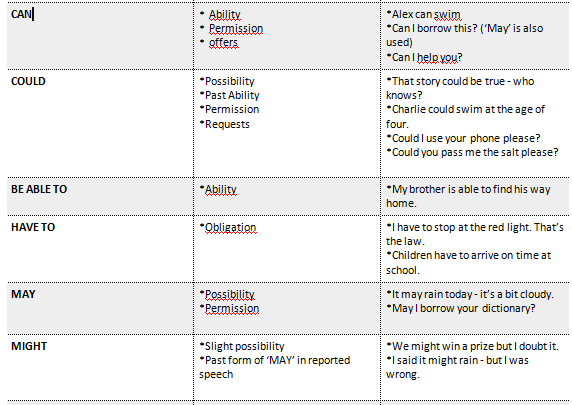
- OBLIGATION: MUST, HAVE TO
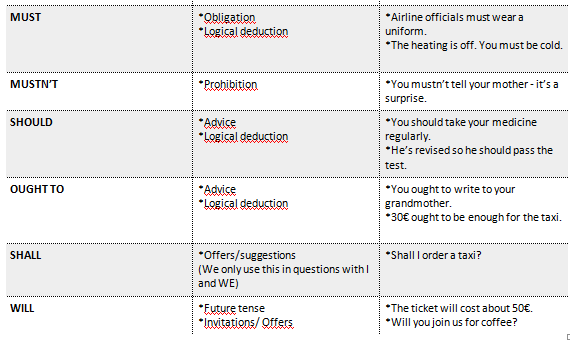
- PROHIBITION: MUSN'T
- PERSUASION: MUST
- POSSIBILITY: COULD, MAY, MIGHT
- ABILITY: CAN, BE ABLE TO, COULD (PAST)
- ADVICE, OPINION: SHOULD, OUGHT TO
- LOGICAL DEDUCTION: MUST, SHOULD, OUGHT TO
- SUGGESTION: SHALL
- OFFERS: CAN, SHALL, WILL
- INVITAION: WILL
-
- MUST
- Must es un verbo modal que se traduce por "deber" y se utiliza en afirmativas y en negativas. Como verbo modal, seguirá las reglas de todos los verbos modales, es decir:
- → En frases afirmativas irá seguido de infinitivo sin to.
- I must study, You must study, He/she/it must study, We must study, They must study
- → En frases negativas hará la negación usando not o n't
- I mustn't smoke, You mustn't smoke, He/she mustn't smoke, We mustn't smoke, They mustn't smoke
- USOS
- Usamos el verbo modal must para expresar:
- 1. Obligación
- El semimodal Have to también se usa para expresar obligación. La diferencia radica en que la obligación expresada por have to es externa (viene dada por una tercera persona o por normas) mientras que la obligación expresada por must está impuesta por el hablante o el que escribe la frase. Además, la obligación con must tiene intención futura.
- I must write an e-mail to my cousin (debo escribir un e-mail a mi primo) → Es algo que me impongo yo mismo. Todavía no lo he hecho, tiene intención futura.
- Passengers must fasten their seatbealts (los pasajeros deben abrocharse el cinturón de seguridad) → Es algo que impone la compañía que ha escrito la frase.
- I have to wear uniform at work (tengo que llevar uniforme en el trabajo) → Es algo que me imponen en el trabajo.
- 2. Deber moral
- You must respect your parents (debes respetar a tus padres)
- 3. Consejo (persuasión)
- Aquí es muy importante que se distinga del "should" que también se usa para expresar consejo. Usamos must para expresar fuerte recomendación o consejo, hasta el punto de querer persuadir al interlocutor.
- You must go and see that film (Debes ir y ver esa película)
- You must clean your car (debes limpiar el coche)
- 4. Necesidad fuerte
- Aquí hemos de distinguirlo del semi-modal have to que también expresa necesidad. Must se usa para expresar una necesidad fuerte.
- I must tidy my bedroom. It's a mess (debo ordenar mi habitación. Está hecha un desastre)
- Además, sólo usamos must para expresar una fuerte necesidad en presente. Si queremos usar otros tiempos verbales, deberemos recurrir a have to.
- I'll have to go to the doctor (tendré que ir al médico) → futuro
- I had to leave early (tuve que marcharme temprano) → pasado
- 5. Deducción afirmativa.
- You got up very early. You must be tired (te levantaste muy temprano. Debes estar cansado)
- The lights are on. She must be home. (las luces están encendidas. Debe estar en casa)
- Para deducciones negativas usaremos el modal can't.
- You can't be 30! You look younger. (¡No puedes tener 30 años! Pareces más joven)
- MUSTN'T
- La forma negativa de must, es decir, must not o mustn't se usa para expresar prohibición.
- You mustn't be late. (No puedes llegar tarde)
- You mustn't smoke in schools (No puedes fumar en los colegios)
- Importante:
- → no olvidar poner la "t" al negar mustn't ✓ musn't
- → No confundir mustn't (prohibición) con don't have to (ausencia de obligación)
- I don't have to work tomorrow. (No tengo que trabajar mañana) → No estoy obligada.
- I mustn't smoke at work (No puedo fumar en el trabajo) → Lo tengo prohibido.
-
- SHOULD
- Should es un verbo modal que usamos en inglés cuando queremos indicar que algo es lo correcto y, por tanto, se debería hacer. Se utiliza para dar y pedir consejos y se traduce como "debería".
- You should work harder (deberías trabajar más).
- You shouldn’t smoke so many cigarettes (no deberías fumar tantos cigarrillos).
- ¿Cómo se forma?
- Afirmativas: Sujeto + should + infinitivo (sin to)
- You've got temperature.You should go to the doctor (Tienes fiebre. Deberías ir al médico)
- His car is very old. He should buy a new one (Su coche está muy viejo. Debería comprarse uno nuevo)
- They are friends. They should make up. (Ellos son amigos. Deberían hacer las paces)
- Negativas: sujeto + should not / shouldn't + infinitivo (sin to)
- You shouldn’t bite your nails / You should not bite your nails (no deberías morderte las uñas) (=no es lo correcto)
- He shouldn’t watch TV all the time / he should not watch TV all the time (no debería ver la tele todo el tiempo) (=no es lo correcto)
- They shouldn’t go to bed too late / they should not go to bed too late (no deberían irse a la cama demasiado tarde) (=no es lo correcto)
- Interrogativas: Should + sujeto + infinitivo (sin to)
- Should I have my hair cut? (¿Debería cortarme el pelo?)
- Should he go to the doctor? (¿Debería ir al médico?)
- Should we study harder? (¿Deberíamos estudiar más?)
- Respuestas cortas:
- Should I have my hair cut? Yes, you should / No, you shouldn't
-
- Needn't, Needn't have and Didn't need to
- Hay que tener ciudad con el uso de needn't, needn't have y didn't need to porque es fácil confundirse.
- Se forma:
- Sujeto + needn't + verbo infinitivo (sin to)
- Sujeto + didn't need to + infintivo
- Sujeto + needn't have + participio pasado
- Ejemplos:
- You needn't arrive early. No hace falta que llegues temprano.
- I didn't need to arrive early. Yo no tenia que llegar tan temprano.
- I needn't have arrived so early. No tenia que haber llegado tan temprano.
- Cuando se usa needn't significa que no es necesario hacer algo.
- Cuando se usa didn't need to significa que no has hecho la acción porque no era necesario.
- Cuando se usa needn't have significa que has hecho la acción aunque no fue necesario.
-
- Can y Be able to en inglés
- Se usan can y be able to para hablar de habilidad en inglés.
- A veces se puede usar los dos para hablar de lo mismo. PERO hay veces que es necessario usar solo una forma ó la otra.
- 1. Habilidad en el presente
- Se puede usar ambos be able to y can. PERO can es mas commun, especialmente cuando estamos hablando de una habilidad aprendida.
- Ejemplo:
- Peter can speak French es mas commun que Peter is able to speak French.
- 2. Habilidad en el futuro
- Siempre se usa will be able to para hablar del futuro
- Ejemplo:
- I will be able to speak Chinese next year. Podré hablar Chino el año que viene.
- 3. Habilidad general en el pasado
- Se puede usar could or was/were able to. PERO could es mas commun.
- Ejemplos:
- I could swim when I was 5 years old es mas commun que I was able to swim when I was 5 years old.
- I could play the piano when I was young es mas commun que I was able to play the piano when I was young.
- 4. Habilidad de hacer algo en una ocasion ESPECIFICA en el pasado
- NO SE PUEDE usar could. Se usa was/were able to
- Ejemplos:
- I was able to catch the 5 o'clock train to London. Pude coger el tren de las 5 a Londres.
- He was able to finish his project before the deadline. Pudo terminar el proyecto antes del plazo de entrega.
- 5. Cuando la frase es NEGATIVO en el PASADO se puede usar COULDN'T en todas las frases.
- Ejemplos:
- I couldn't catch the 5 o'clock train to London. No pude coger el tren a Londres.
- He couldn't finish his project before the deadline. No pudo terminar el proyecto antes del plazo de entrega.
-
- HAVE TO
- Have to es un verbo semi-modal que se usa muy frecuentemente en inglés para expresar obligación. Decimos semi-modal porque no sigue las reglas de los verbos modales (ver post).
- ¿CÓMO SE FORMA?
- Afirmativas
- I have to wear, You have to wear, He/she/it has to wear, We have to wear, They have to wear
- I have to wear uniform at work (tengo que llevar uniforme en el trabajo)
- The doctor says she has to stop smoking (el médico dice que ella tiene que dejar de fumar)
- Negativas
- I don't have to wear, you don't have to wear, he/she/it doesn't have to wear, we don't have towear, they don't have to wear
- I don't have to pay this bill until November (no tengo que pagar esta factura hasta noviembre)
- She doesn't have to work on Saturdays (ella no tiene que trabajar los sábados)
- Interrogativas*
- Do I have to wear...? Do you have to wear...? Does he/she/it have to wear...? Do we have to wear...? Do they have to wear...?
- Do they have to work everyday? (¿tienen ellos que trabajar todos los días?)
- Does she have to take an exam? (¿tiene que examinarse?)
- * Véase cómo se hacen preguntas en inglés
- ¿CUÁNDO USAMOS HAVE TO?
- Usamos el semi-modal have to para:
- 1. Expresar obligación
- Recordamos que must también se usa para expresar obligación. La diferencia radica en que la obligación expresada por have to es externa (viene dada por una tercera persona o por normas) mientras que la obligación expresada por must está impuesta por el hablante o el que escribe la frase.
- I have to work on Saturdays (tengo que trabajar los sábados) → Es algo que estoy obligada a hacer por contrato.
- I must write an e-mail to my cousin (debo escribir un e-mail a mi primo) → Es algo que me impongo yo mismo. Todavía no lo he hecho, tiene intención futura.
- 2. Expresar necesidad (en presente, pasado y futuro)
- Recordamos que must también se usa para expresar necesidad. La diferencia está en que con must la necesidad es más fuerte y únicamente se puede usar en presente. Para expresar necesidad en otros tiempos verbales usaremos have to.
- I have to do the shopping (tengo que hacer la compra) Es necesario.
- I must do the shopping (debo hacer la compra) → Es muy necesario. Quizás no tengo nada en el frigorífico.
- En otros tiempos verbales:
- My throat is sore. I'll have to go to the doctor (Me duele la garganta. Tendré que ir al médico)
- I had to leave early (tuve que marcharme temprano)
- DON'T HAVE TO / DOESN'T HAVE TO
- Usamos la forma negativa del verbo have to para expresar:
- 1. Ausencia de obligación
- I don't have to pay this bill until November (no tengo que pagar esta factura hasta noviembre) → No estoy obligada a pagarla hasta noviembre.
- 2. Ausencia de necesidad
- You don't have to do the shopping (no tienes que hacer la compra) → No es necesario
- Cuidado
- No confundir mustn't (prohibición) con don't have to (ausencia de obligación)
- I don't have to work tomorrow. (No tengo que trabajar mañana) → No estoy obligada
- I mustn't smoke at work (No puedo fumar en el trabajo) → Lo tengo prohibido
Informações
- Descrição
- First Certificate of Cambridge Inglés Slides sobre MODAL VERBS by Hills, criado por José L. em 15-01-2018.
- Criado por
- José L. · jan 2018
- Atualizado
- 15 mai 2018
- Visualizações
- 22
- Avaliação