
Flashcards
Periodic Trends in Melting and Boiling Points
Flashcards do conjunto (8)
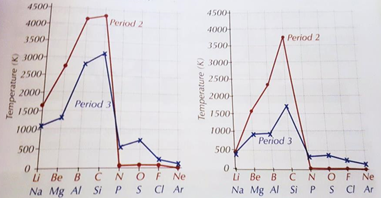
- 1Describe the trend in melting/boiling points of Period 2 and 3 elementsThe melting/boiling points of the Period 2 and 3 elements generally increase from the first to the fourth elements in the period, but then decrease from the fourth to the eighth elements
- 2Name the metals in Period 2 and 3PERIOD 2 = Li, Be
PERIOD 3 = Na, Mg, Al - 3Describe and explain the melting and boiling points for the metalsFor the metals (Li, Be, Na, Mg and Al) melting/boiling points increase across the period because the metal-metal bonds get stronger. The bonds get stronger because the metal ions have...
1. A greater charge
2. An increasing number of delocalised electrons
3. A decreasing ionic radius
This leads to a higher charge density, which attracts the ions together more strongly - 4Name the elements with giant covalent structures in Period 2 and 3PERIOD 2 = B, C
PERIOD 3 = Si - 5Describe and explain the melting and boiling points for the giant covalent structuresThe elements with giant covalent structures (B, C and Si) have strong covalent bonds linking all their atoms together. A lot of energy is needed to break these bonds, therefore they have the highest melting/boiling points in their periods
- 6Name the elements with simple covalent structures in Period 2 and 3PERIOD 2 = N, O, F (,Ne)
PERIOD 3 = P, S, Cl (,Ar) - 7Describe and explain the melting and boiling points for the simple covalent structuresThe covalent bonds between the atoms in a molecule are very strong but the melting/boiling points depend upon the strength of the London forces between their molecules. These forces are weak and easily overcome. More atoms in a molecule mean stronger London forces.
E.g. in Period 3, sulfur (S₈) is the biggest molecule so it has a higher melting and boiling point than P₄ or Cl₂ - 8Describe and explain the melting and boiling points for the noble gasesThe noble gases have the lowest melting and boiling points because they exist as individual atoms (they're monatomic), resulting in very weak London forces
Informações
- Descrição
- O usuário eliminou as informações de disciplina FlashCards sobre Periodic Trends in Melting and Boiling Points, criado por Usuário eliminado em 05-03-2018.
- Criado por
- Usuário eliminado · mar 2018
- Atualizado
- 5 mar 2018
- Visualizações
- 20
- Histórico
-
- Criado por Yinka F · 3 mar 2018
- Copiado por Yinka F · 5 mar 2018
- Avaliação