
Flashcards
Action of Enzymes
Flashcards do conjunto (16)
- 1What is the role of enzymes?Speed up chemical reactions by acting as biological catalysts
Catalyse metabolic reactions (e.g. respiration and digestion)
Affect structures in an organism as well as functions
Can be intracellular or extracellular - 2Name examples of intracellular and extracellular enzymesINTRA = catalase
EXTRA = amylase, trypsin - 3Describe the structure and function of catalaseSTRUCTURE:
Intracellular
4 polypeptide chains and a haem group with iron
FUNCTION:
Catalyses H₂O₂ → O₂ + H₂O - 4Describe the structure and function of amylaseSTRUCTURE:
Extracellular
Found in saliva
Secreted by cells in salivary glands
FUNCTION:
Catalyses starch → maltose - 5Describe the structure and function of trypsinSTRUCTURE:
Extracellular
Produced by pancreas
Secreted into the small intestine
FUNCTION:
Hydrolysis of peptide bonds - 6Complete the sentences: Enzymes are _______ proteins. They have an ________ ______ (where the substrates bind to). The active site has a specific _______ (determined by the enzyme's _______ structure).Enzymes are GLOBULAR proteins. They have an ACTIVE SITE (where the substrates bind to). The active site has a specific SHAPE (determined by the enzyme's TERTIARY structure).
- 7Complete the sentences: For enzymes to work, its shape has to be _______________. This means that enzymes are very _________. When a substrate binds to an enzyme, an ______-_____ complex is formed.For enzymes to work, its shape has to be COMPLEMENTARY. This means that enzymes are very SPECIFIC. When a substrate binds to an enzyme, an ENZYME-SUBSTRATE complex is formed.
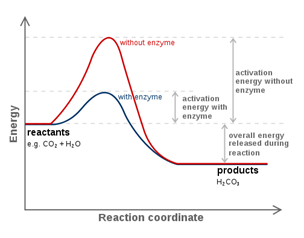
- 8How do enzymes speed up reactions?Enzymes reduce the amount of activation energy, making reactions happen at a lower temperature. This speeds up the rate of reaction.
- 9What is activation energy?The amount of energy needed to be supplied to the chemicals before the reaction will start
- 10How does forming an enzyme-substrate complex lower the activation energy?ANABOLIC
Building up molecules
Attaching substrates to the enzyme holds them close together, reducing any repulsion so they can bond more easily
CATABOLIC
Breaks down molecules
Fitting into the active site puts a strain on bonds in the substrate; the substrate molecule breaks up more easily - 11What are buffers?Buffers resist changes in pH and can accept or donate H⁺ ions
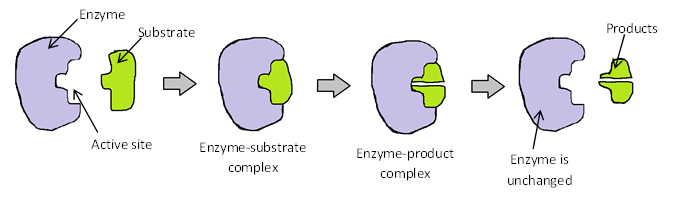
- 12What are the two models for the mechanism of enzyme action?Lock and key model
Induced fit model - 13What is the lock and key model?The substrate fits into the enzyme like a lock and key; the active site and substrate have a complementary shape
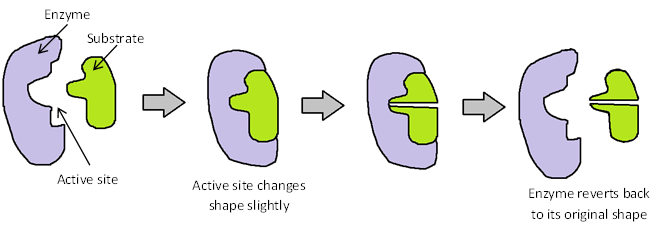
- 14What is the induced fit model?The substrate does not only have to be the right shape to fit the active site, it has to make the active site change shape in the right way as well
- 15What is the temperature coefficient?The Q₁₀ value shows how much the rate of reaction changes when the temperature is raised by 10°C.
At temperatures before the optimum, a Q₁₀ value of 2 means the rate doubles when the temperature is raised by 10°C.
Most enzyme-controlled reactions have a Q₁₀ value of around 2 - 16What is the reaction for the temperature coefficient?Q₁₀ = rate of reaction at (T+ 10)°C /
rate of reaction at 10°C
Informações
- Descrição
- O usuário eliminou as informações de disciplina FlashCards sobre Action of Enzymes, criado por Usuário eliminado em 05-03-2018.
- Criado por
- Usuário eliminado · mar 2018
- Atualizado
- 5 mar 2018
- Visualizações
- 29
- Histórico
-
- Criado por Yinka F · 26 jan 2018
- Copiado por Yinka F · 5 mar 2018
- Avaliação