
Flashcards
Passive Transport Mechanisms
Flashcards do conjunto (27)
- 1What are the 3 passive transport mechanisms?Diffusion
Osmosis
Facilitated diffusion - 2What does it mean by 'passive'?No energy (ATP) is needed for the process to happen
- 3Define diffusionDiffusion is the net movement of particles (molecules or ions) from a region of high concentration to a region of low concentration (down the concentration gradient) until they are spread out evenly
- 4What are the factors that affect the rate of diffusion?Concentration gradient
Thickness of the exchange surface
Surface area
Temperature - 5How does the concentration gradient affect the rate of diffusion?The higher the concentration gradient, the faster the rate
- 6How does the thickness of the exchange surface affect the rate of diffusion?The thinner the exchange surface (the shorter the distance the particles travel), the faster the rate
- 7How does the surface area affect the rate of diffusion?The larger the surface area, the faster the rate of diffusion
- 8How does the temperature affect the rate of diffusion?The higher the temperature, the faster the rate as particles have more kinetic energy
- 9Define osmosisOsmosis is the diffusion of water molecules across a partially permeable membrane from an area of higher water potential to an area of lower water potential, down a water potential gradient
- 10TRUE OR FALSE: Pure water has the highest water potentialTRUE
Pure water has a water potential of 0Ψ - 11If two solutions are isotonic, what does that mean?When two solutions have the same water potential, they are said to be isotonic
- 12Complete the sentences: Cells in an _________ solution will not lose or gain any water - there is no ______ movement of water molecules as there is no difference in _______ ___________ between the cell and the surrounding solutionCells in an ISOTONIC solution will not lose or gain any water - there is no NET movement of water molecules as there is no difference in WATER POTENTIAL between the cell and the surrounding solution
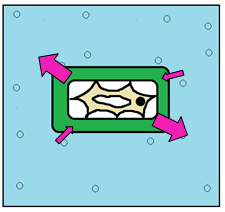
- 13If two solutions are hypotonic, what does that mean?Solutions with a higher water potential compared with the inside of the cell are called hypotonic.
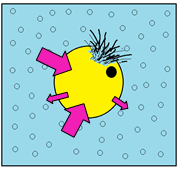
If a cell is placed in a solution that has higher water potential, water will move into the cell by osmosis - 14What happens when an animal cell is placed in a hypotonic solution?An animal cell in a hypotonic solution will swell and lysis occurs
- 15What happens when a plant cell is placd in a hypotonic solution?If a plant cell is placed in a hypotonic solution, the vacuole will swell and the contents of the vacuole and cytoplasm will push against the cell wall. This causes the cell to become turgid.
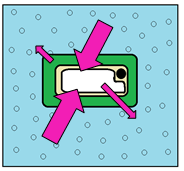
- 16An animal cell bursts in a hypotonic solution, but a plant cell does not. Why?The cell will NOT burst as the inelastic cell wall is able to withstand the increase in pressure
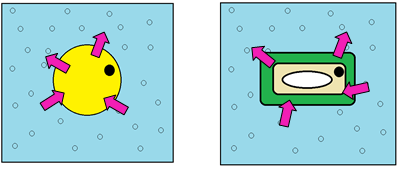
- 17If two solutions are hypertonic, what does that mean?Solutions with a lower water potential than the cell are called hypertonic. If a cell is placed in a solution that has a lower water potential, water will move out of the cell by osmosis.
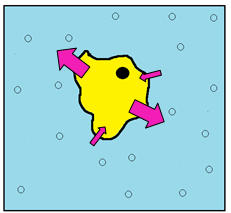
- 18What happens when an animal cell is placed in a hypertonic solution?If an animal cell is placed in a hypertonic solution, it becomes crenated and shrivels up
- 19What happens when a plant cell is placed in a hypertonic solution?If a plant cell is placed in a hypertonic solution it will become flaccid. The cytoplasm and plasma membrane will eventually pull away from the cell wall. This is called plasmolysis
- 20What types of molecules/particles would diffuse extremely slowly through the phospholipid bilayer?Some larger molecules (e.g. amino acids, glucose)
Charged particles (e.g. ions and polar molecules) - 21Why do some larger molecules and charged particles diffuse slowly through the phospholipid bilayer?LARGER MOLECULES = they are too big
CHARGED PARTICLES = they are water soluble and the centre of the bilayer is hydrophobic - 22What does facilitated diffusion do?Facilitated diffusion moves particles down a concentration gradient, from a higher to lower concentration, using carrier/channel proteins
- 23What do carrier proteins move?Carrier proteins move large molecules (including polar molecules and ions) into or out of the cell, down their concentration gradient
- 24Give an example of a carrier proteinGLUT1 is a carrier protein found in almost all animal cells. It specifically helps to transport glucose across the plasma membrane
- 25How does facilitated diffusion via carrier proteins work?1. A particular molecule attaches to the carrier protein at its bonding site
2. This causes the protein to change its shape
3. The molecule is released on the opposite side of the membrane - 26How do channel proteins work?Channel proteins form pores in the membrane for smaller ions and polar molecules to diffuse through, down their concentration gradient
- 27Complete the sentences: The pores that _________ proteins form in the membrane are lined with ________ groups, allowing charged ____ to pass through. Usually each channel protein is _________ for one type of ionThe pores that CHANNEL proteins form in the membrane are lined with POLAR groups, allowing charged IONS to pass through. Usually each channel protein is SPECIFIC for one type of ion
Informações
- Descrição
- O usuário eliminou as informações de disciplina FlashCards sobre Passive Transport Mechanisms, criado por Usuário eliminado em 05-03-2018.
- Criado por
- Usuário eliminado · mar 2018
- Atualizado
- 5 mar 2018
- Visualizações
- 28
- Histórico
-
- Criado por Yinka F · 29 jan 2018
- Copiado por Yinka F · 5 mar 2018
- Avaliação