
Quiz
Neuropathology :)
Este quiz tem tipos de pergunta que abrem no player de sempre.
Perguntas do quiz (60)
1Neuralation happens in week [blank_start]3[blank_end] of embryonic development. The brain, the spinal cord, [blank_start]central[blank_end] [blank_start]canal[blank_end] and [blank_start]ventricles[blank_end] all originate from the neural tube. Meanwhile the [blank_start]sensory[blank_end] ganglia of the spinal and cranial nerves, the [blank_start]autonomic[blank_end] ganglia, and [blank_start]Schwann[blank_end] cells are all from the [blank_start]neural[blank_end] [blank_start]crest[blank_end] cells.
- A3
- Bcentral
- Ccanal
- Dventricles
- Esensory
- Fautonomic
- GSchwann
- Hneural
- Icrest
2A patient presents with a headache, nausea and vomiting, cognitive difficulty, sleepiness, seizures, balance and gait disturbances, visual abnormalities, and incontinence. An MRI scan is performed and this showed dilated lateral ventricles and dilated third ventricles. What is the most likely diagnosis
- AHydrocephalus: Too much CSF in the ventricles.
- BAqueduct stenosis: Narrowing of the cerebral aqueduct
- CSubarachnoid haemorrhage
- DExtradural haemorrhage
- ESubdural haemorrhage
3A patient has loss of sensation to pain and temperature on their right side. The patient can’t sense vibration on the left side and seems to fall towards the left. There is a loss of motor function of their left upper limb and lower limbs. What is the most likely diagnosis?
- ARight middle cerebral artery occlusion
- BLeft middle cerebral artery occlusion
- CRight hemisection of the spinal cord
- DLeft hemisection of the spinal cord
- ETransection of the spinal cord
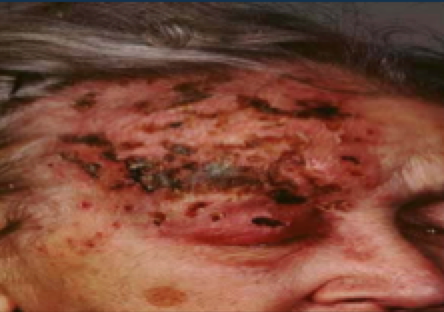
4A 70 years old woman presents with a painful rash on her forehead as shown below in the diagram. What is the most likely diagnosis
- A
- BCellulitis
- CImpetigo
- DHerpes simplex
- EHerpes zoster
- FMeasles
- A
5A patient has a lesion on the right optic tract. What would be the presenting complaint of the patient?
- ALeft homonymous hemianopia
- BBitemporal hemianopia
- CComplete blindness in right eye
- DRight homonymous hemianopia
- EComplete blindness in left eye
6A patient presents with loss of sensation and strength on the right side of their face and their right upper limb. The patient can still wrinkle their forehead. What is the most likely diagnosis?
- ALeft anterior cerebral artery occlusion
- BRight anterior cerebral artery occlusion
- CLeft middle cerebral artery occlusion
- DRight middle cerebral artery occlusion
- EBell’s palsy
7Which of the following is false about the blood supply of the brain?
- AThe internal carotid arteries give off the anterior cerebral arteries and middle cerebral arteries.
- BThe subclavian artery gives off the vertebral artery
- CTwo internal carotid arteries join up to make the basilar artery.
- DThe basilar artery gives off the posterior cerebral arteries.
- EThe two vertebral arteries join to form the basilar artery.
8What is true regarding the Sonic Hedgehog (SHH) signalling molecule?
- Aproduced by the notochord
- Bhelps pattern the CNS functionality
- Chelps induce the floor plate and different ventral cell types within the neural tube
- Dhelps with facial morphology
- Ehelps with limb development
- Fforms the midline of the body
- Ghelps with hair development
- Hproduced by neural crest cells
- Ihelps with skin and nail development
- Jhelps pattern PNS functionality
9Fill in the chart describing primary and secondary divisions of the neural chord and what they give arise to:
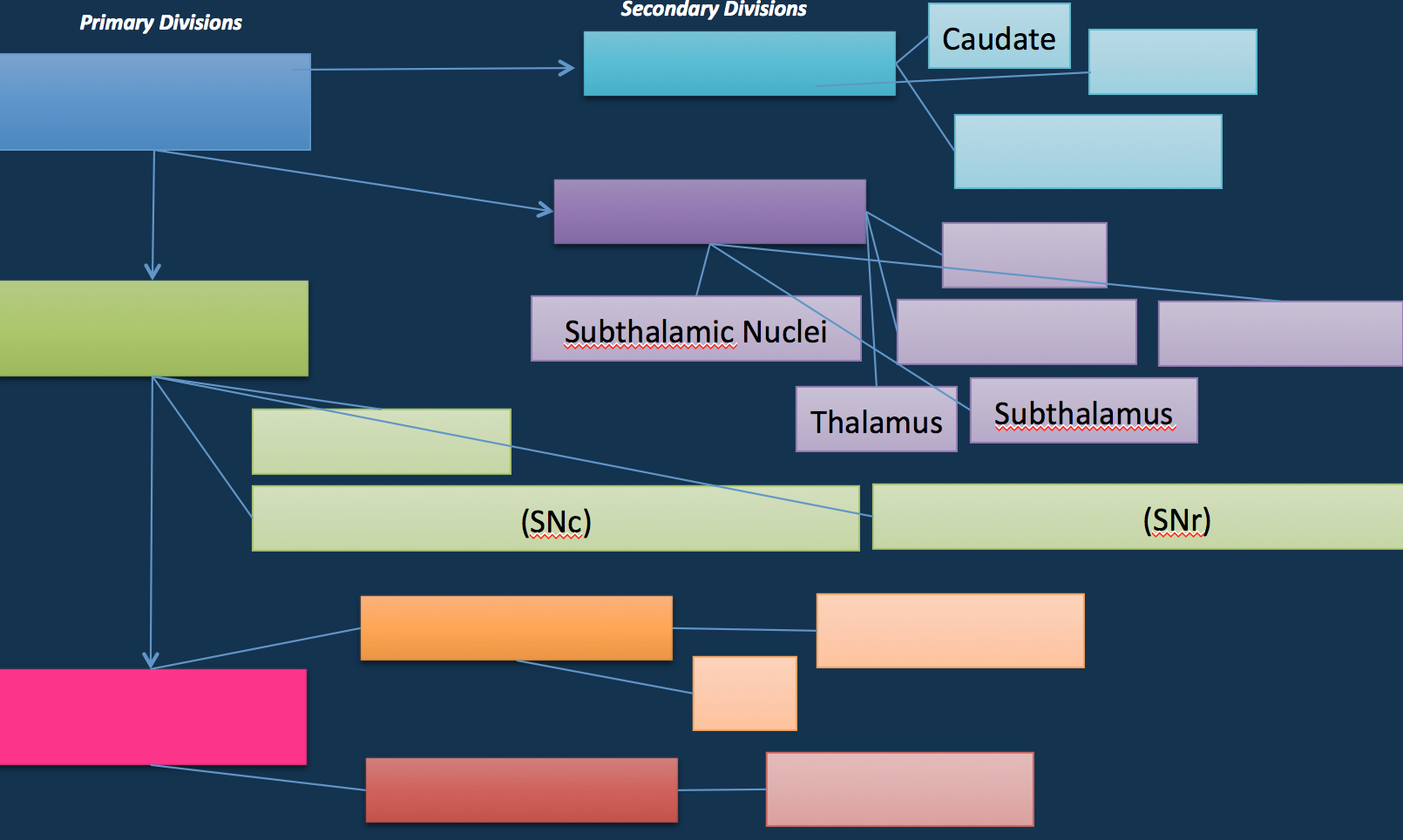
- AProsencephalon
- BMesencephalon
- CRhombencephalon
- DTelencephalon
- EDiencephalon
- FPutamen
- GCerebral cortices
- HPallidum
- IEpithalamus
- JHypothalamus
- KSubstancia Nigra Pars Compacta
- LSubstancia Nigra Pars Reticulata
- MCerebellum
- NPons
- OMetencephalon
- PMyelencephalon
- QMedulla
10[blank_start]Holoprosencephaly[blank_end] is a cephalic disorder in which the [blank_start]prosencephalon[blank_end] fails to give rise to two hemispheres. The child could be born with [blank_start]cyclopia[blank_end] (one eye-- like a cyclops.)
Mutations in the gene encoding for the [blank_start]SHH[blank_end] protein can cause this condition.- AHoloprosencephaly
- Bprosencephalon
- Ccyclopia
- DSHH
11[blank_start]Cerebellar[blank_end] signs are ipsilateral but [blank_start]cerebral[blank_end] signs are contralateral.
- ACerebellar
- Bcerebral
12What are cerebellar signs?
- ADysdiadokinesia
- BDysmetria
- CAtaxia
- DNystagmus
- EIntention tremor
- FSlurred speech
- GHypotonia
- HBroad based gait
- IParesthesia on opposing limb
- JKerniq's sign
13The post central gyrus is the sensory cortex.
- AVerdadeiro
- BFalso
14What is this known as? Which 3D model is for what?
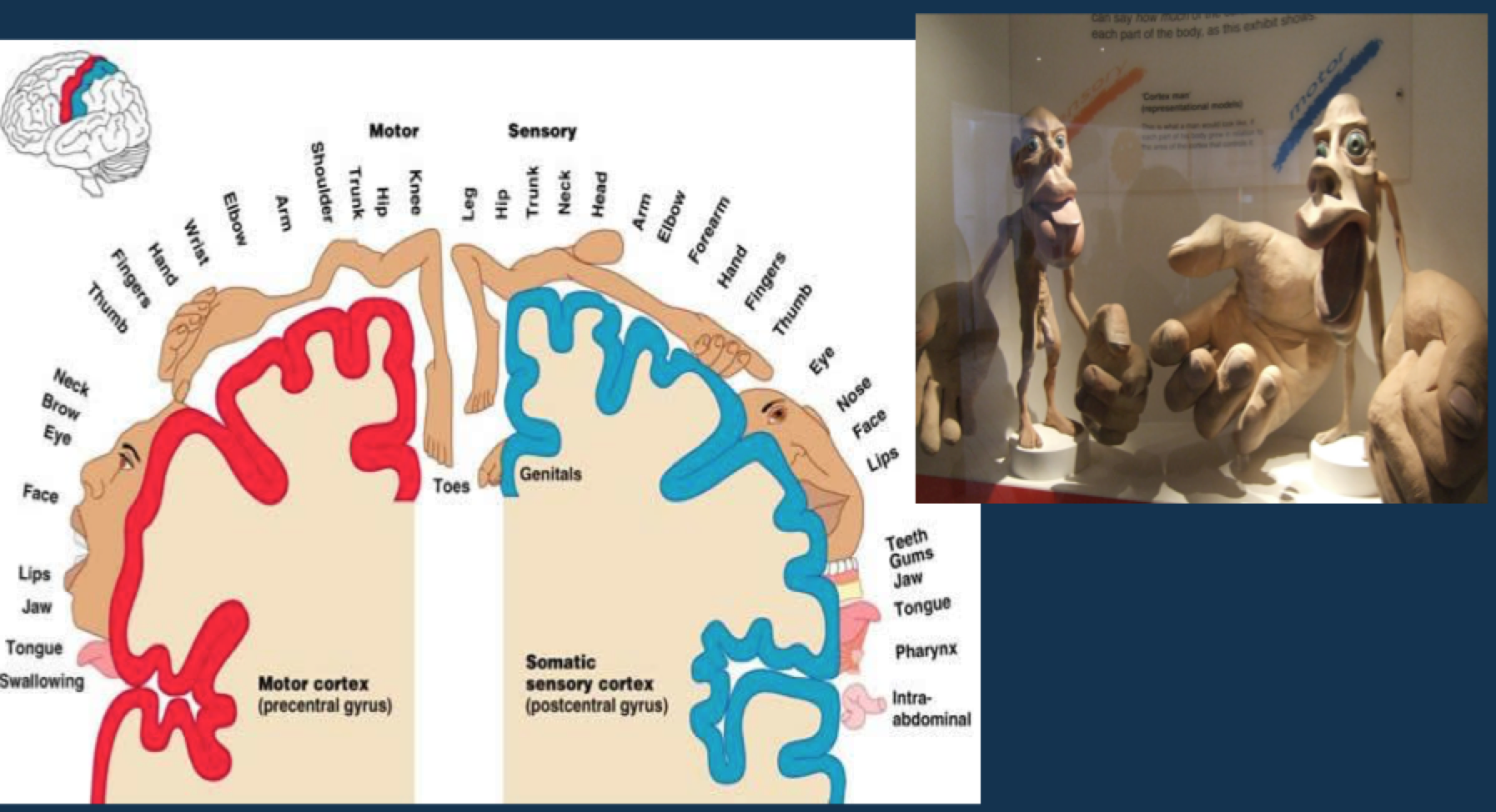
- Asensory
- Bmotor
- Chomunculus
15Vasculature:
[blank_start]Internal[blank_end] [blank_start]carotids[blank_end] give rise to [blank_start]anterior[blank_end] and [blank_start]middle[blank_end] cerebral arteries
[blank_start]Vertebral[blank_end] arteries give rise to two [blank_start]posterior[blank_end] arteries, the [blank_start]cerebellar[blank_end] artery, and the [blank_start]basilar[blank_end] artery (trunk for the Circle of Willis.)- AInternal
- Bcarotids
- CVertebral
- Danterior
- Emiddle
- Fposterior
- Gcerebellar
- Hbasilar
16Fill in the vessels supplying each of the shaded parts.
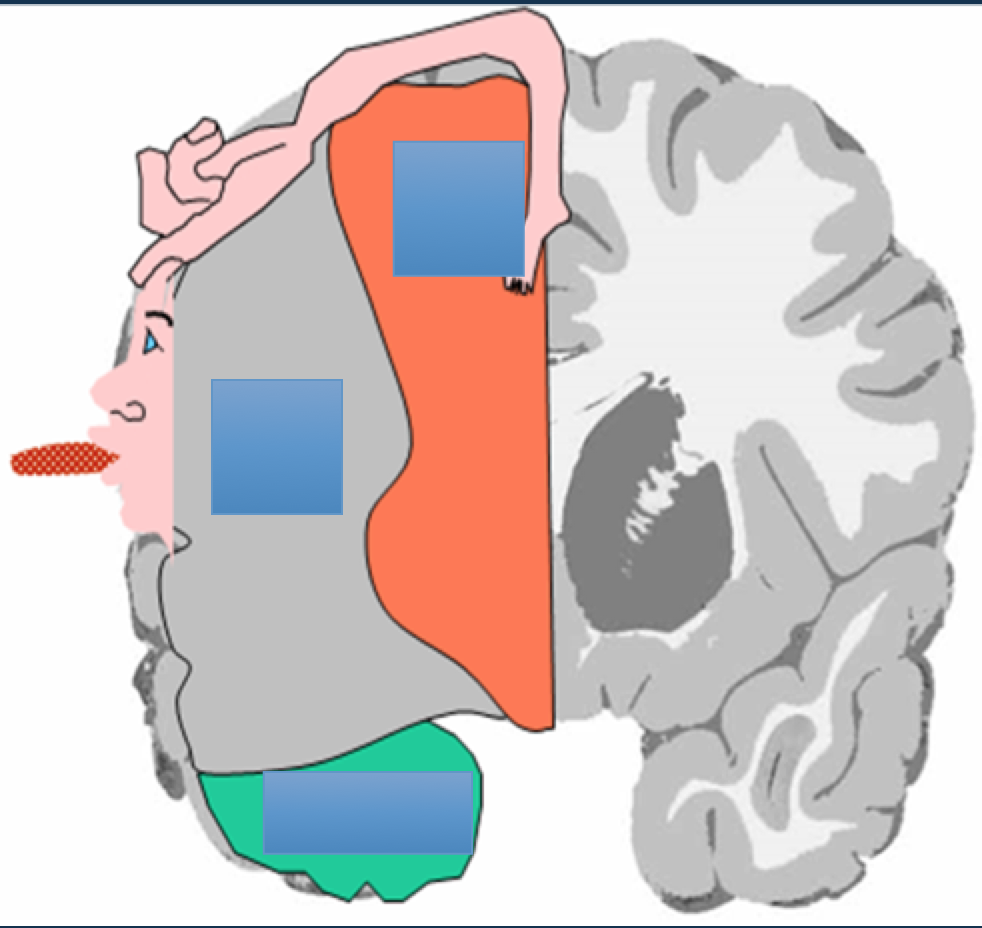
- Aanterior cerebral artery
- Bposterior cerebral artery
- Cmiddle cerebral artery
17Blood vessel occlusions in the brain can present differently:
If the anterior cerebral artery becomes blocked, there will be a loss of strength and sensation in the [blank_start]lower[blank_end] part of the body.
If the middle cerebral artery becomes blocked, there will be a loss of strength and sensation in the [blank_start]upper[blank_end] parts of the body.
If the posterior Cerebral Artery becomes blocked, there will be [blank_start]visual[blank_end]/sensory defects with little to no motor loss. Most notably, there will be [blank_start]homonymous[blank_end] [blank_start]Hemianopia[blank_end].- Alower
- Bupper
- Chomonymous
- DHemianopia
- Evisual
18Parkinsonism involved impaired functionality of the basal ganglia.
- AVerdadeiro
- BFalso
19What is true regarding the basal ganglia?
- Ahelp regulate sleep patterns
- Bthe same as basal nuclei
- Cconnects to the thalamus
- Dconnects to substancia nigra of the midbrain
- Econtrol over appropriate and inappropriate movements
20Cranial Nerves 2 and 3:
Optic nerve:
Visual [blank_start]acuity[blank_end]
Visual fields
and Pupillary [blank_start]afferent[blank_end] reflux
Oculomotor nerve is an [blank_start]efferent[blank_end] pupillary reflex.- Aefferent
- Bafferent
- Cacuity
21In the optic chiasm, both temporal and nasal fibers cross over.
- AVerdadeiro
- BFalso
22Label the types of optic lesions:
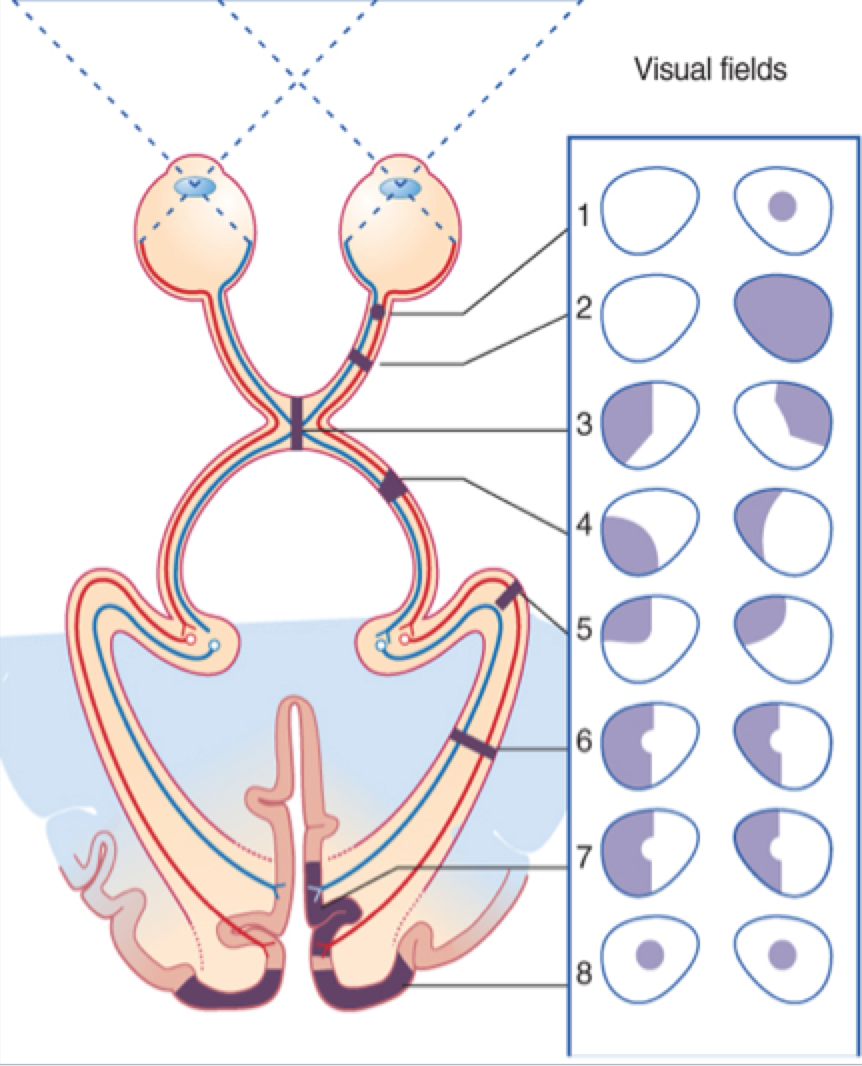
- APartial optic nerve lesion
- BComplete optic nerve lesion
- COptic chiasm lesion
- DOptic tract lesion
- EMeyer’s loop lesion
- FOptic radiation lesion
- GVisual cortex lesion
- HBilateral macula cortex lesion
23Partial optic nerve lesion (lesion within the [blank_start]optic[blank_end] nerve): Causes [blank_start]ipsilateral[blank_end] [blank_start]scotoma[blank_end].
2. Complete optic nerve lesion: [blank_start]Blindness[blank_end] in that eye.
3. Optic chiasm lesion: [blank_start]Bitemporal[blank_end] [blank_start]hemianopia[blank_end]
4. Optic tract lesion: [blank_start]Homonymous[blank_end] [blank_start]hemianopia[blank_end]
5. Meyer’s loop: PITS ([blank_start]Parietal[blank_end] [blank_start]Inferior[blank_end], [blank_start]Temporal[blank_end] [blank_start]superior[blank_end])
(temporal pathway) lesion: [blank_start]Homonymous[blank_end] upper [blank_start]quadrantanopia[blank_end].
6. Optic radiation lesion: [blank_start]Homonymous[blank_end] [blank_start]hemianopia[blank_end]
7. Visual cortex lesion: [blank_start]Homonymous[blank_end] [blank_start]hemianopia[blank_end]
8. Bilateral macula cortex lesion: [blank_start]Bilateral[blank_end] [blank_start]central[blank_end] scotomas- Aoptic
- Bipsilateral
- Cscotoma
- DBlindness
- EBitemporal
- Fhemianopia
- GHomonymous
- Hhemianopia
- IParietal
- JInferior
- KTemporal
- Lsuperior
- MHomonymous
- Nquadrantanopia
- OHomonymous
- Phemianopia
- QHomonymous
- Rhemianopia
- SBilateral
- Tcentral
24Which cranial nerve does not control eye movement?
- Aocculomotor
- Boptic
- Ctrochlear
- Dabducens
25Eye Movement pneumonic:
(SO4LR6)3:
[blank_start]Superior[blank_end] [blank_start]oblique[blank_end] is by trochlear (4)
[blank_start]lateral[blank_end] [blank_start]rectus[blank_end] is by abducens (6)
Everything else is [blank_start]oculomotor[blank_end] (3)- Aoculomotor
- Blateral
- Crectus
- DSuperior
- Eoblique
26Label the parts of the trigeminal cranial nerve (5)
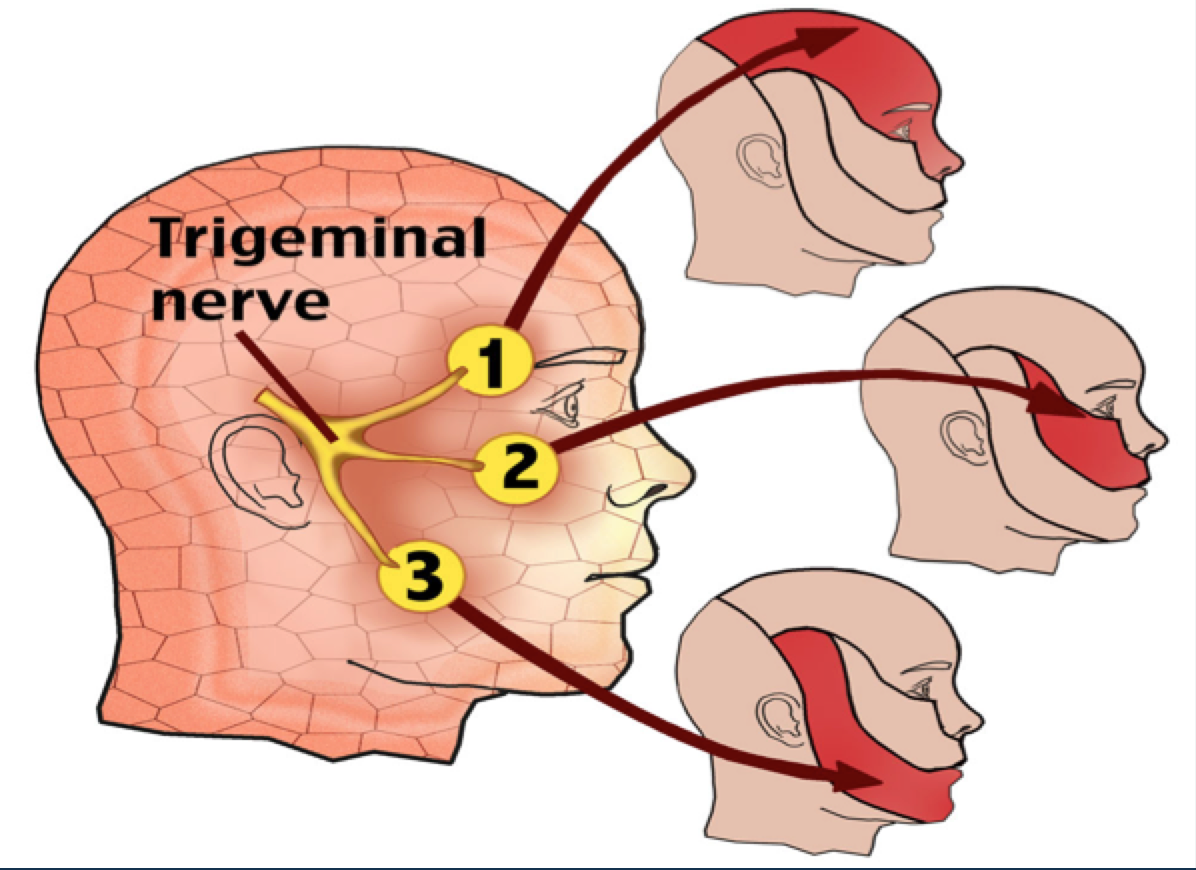
- Aopthalmic
- Bmaxillary
- Cmandibular
27The trigeminal's ONLY motor function is mastication.
- AVerdadeiro
- BFalso
28Which condition, which has a rash that never crosses the midline, is shown below? (center button) What is is most often caused by? (top left button)
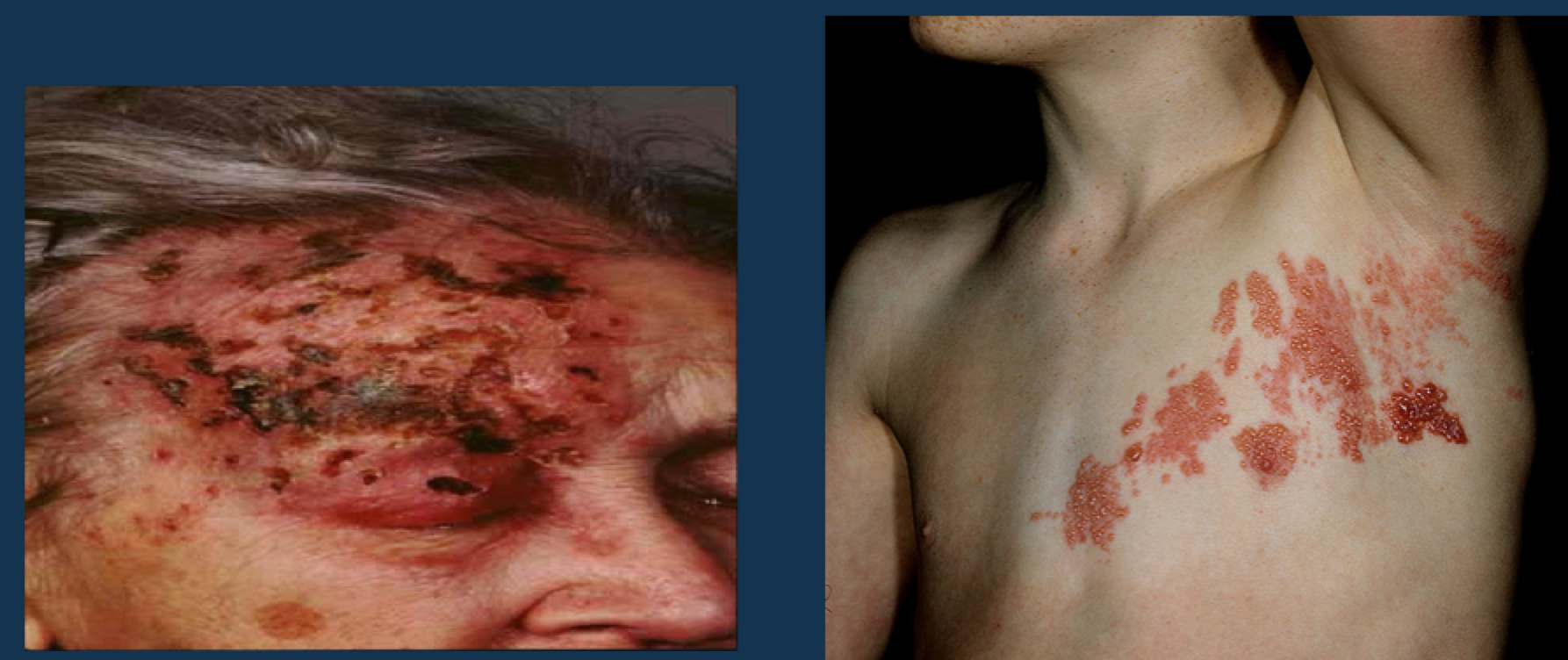
- Ashingles
- Bherpes zoster
29[blank_start]Decussation[blank_end] is the crossing from one side of the central nervous system to the other
- ADecussation
30Major sensory pathways:
[blank_start]Dorsal[blank_end] [blank_start]columnar[blank_end] (Medial Lemniscus)
and
[blank_start]Spinothalamic[blank_end] Tract.- ADorsal
- Bcolumnar
- CSpinothalamic
31Major motor pathways
The upper motor neurones:
[blank_start]Corticospinal[blank_end] (pyramidal)
and
[blank_start]Corticobulbar[blank_end] tracts.- ACorticospinal
- BCorticobulbar
32Based on the location of decussation, which diagram is for which spinal tract?
NOTE: 1st diagram: majority decussates at medulla, but not always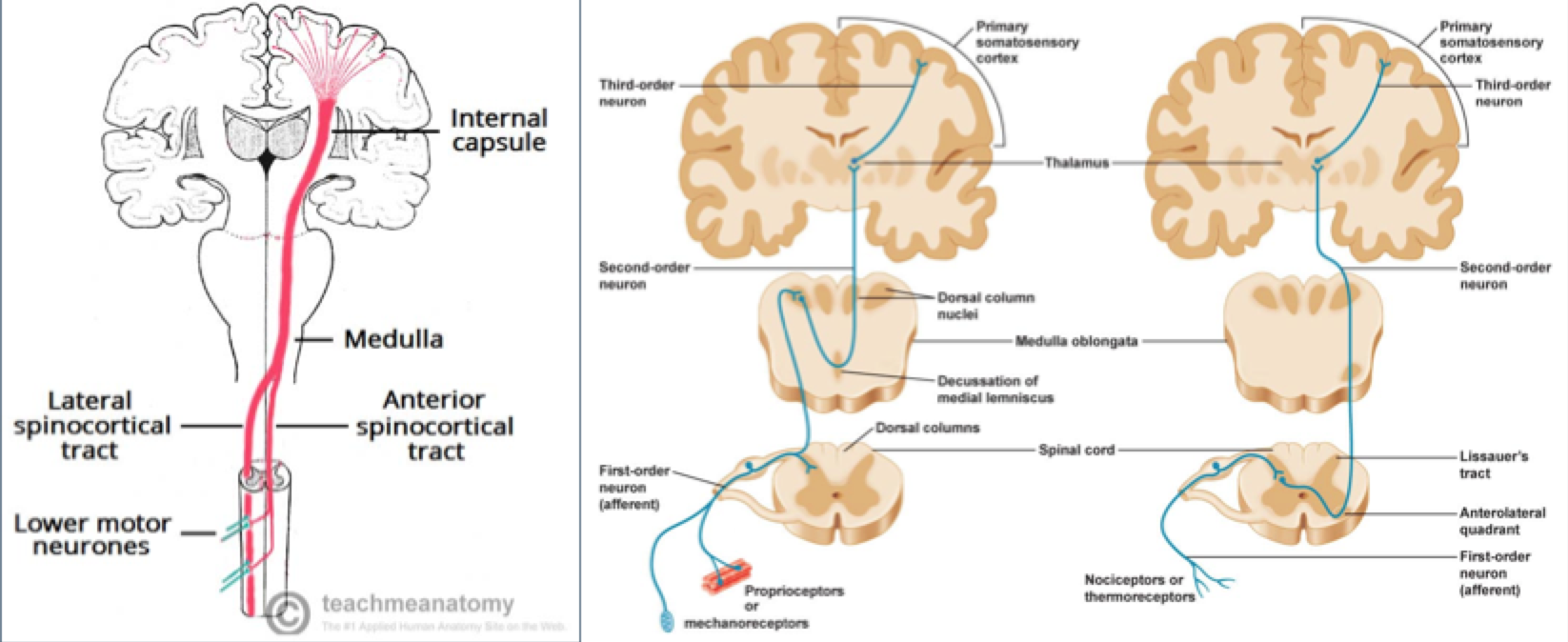
- Acorticospinal
- Bdorsal column
- Cspinothalamic
33Finish the diagram regarding different types of sensory perception
(answers in alphabetical order)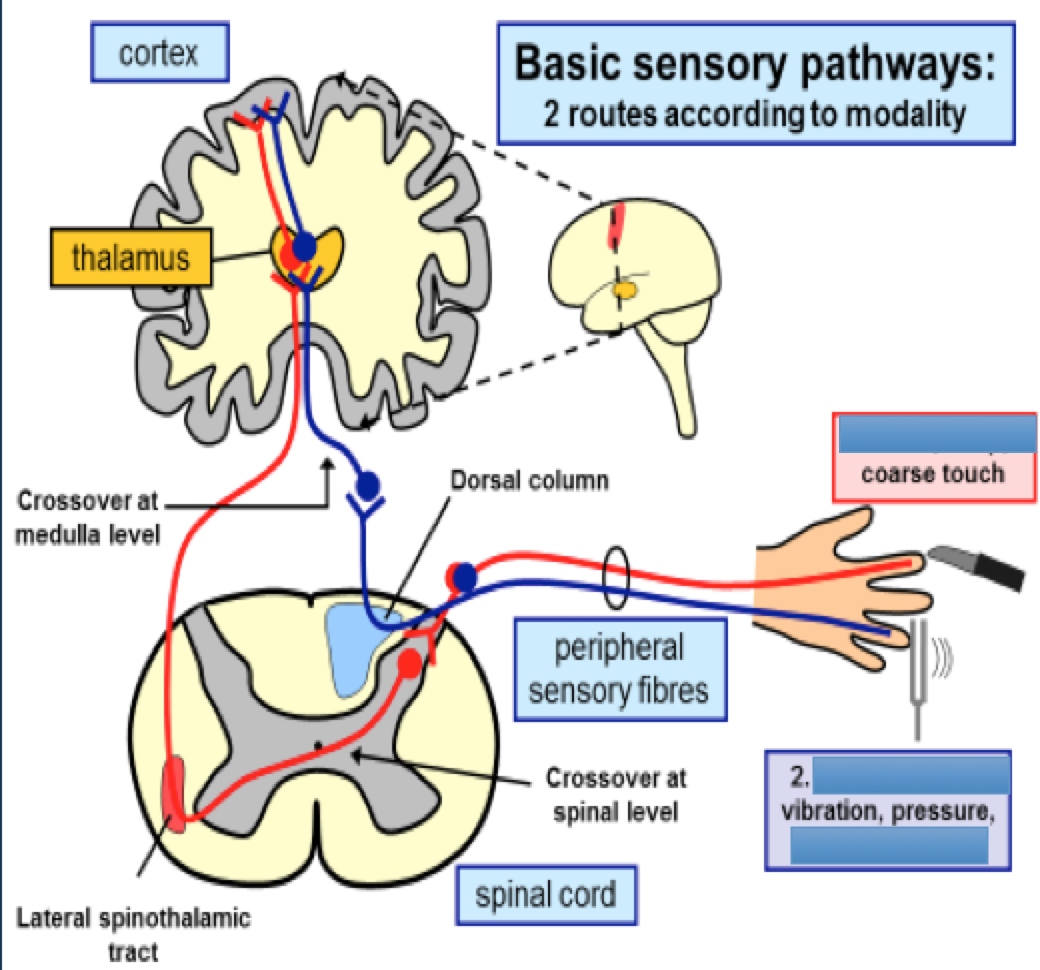
- Apain
- Btemperature
- Cproprioception
- Dfine touch
34
The spinal cord ends at level [blank_start]L1[blank_end]/[blank_start]2[blank_end]. The lower [blank_start]lumbar[blank_end] and [blank_start]sacral[blank_end] nerves travel down to exit at their corresponding level, forming the [blank_start]cauda[blank_end] [blank_start]equina[blank_end].
While an [blank_start]epidural[blank_end] can be done at any level, spinal anesthesia should be done below this level.- AL1
- B2, L2
- Clumbar
- Dsacral
- Ecauda
- Fequina
- Gepidural
35How CSF flows:
1. Arachnoid [blank_start]granulations[blank_end] --> 2. [blank_start]Lateral[blank_end] ventricles--> 3. Foramen of [blank_start]Monroe[blank_end]--> 4. [blank_start]Third[blank_end] ventricle--> 5. [blank_start]Cerebral[blank_end] [blank_start]Aqueduct[blank_end]--> 6. [blank_start]Fourth[blank_end] Ventricle--> 7. [blank_start]Median[blank_end] and lateral [blank_start]apertures[blank_end]--> 8. [blank_start]Subarachnoid[blank_end] space- Agranulations
- BLateral
- CMonroe
- DThird
- ECerebral
- FAqueduct
- GFourth
- HMedian
- Iapertures
- JSubarachnoid
36What is of clinical significance regarding spinal tracts?
- ABrown – Sequard Syndrome
- BMultiple sclerosis
- CSyringomyelia
- DAmyotrophic Lateral Sclerosis
- ESpironemegalia
37In Multiple sclerosis, there is damage to the [blank_start]posterior[blank_end] [blank_start]column[blank_end] which leads to a loss of [blank_start]proprioception[blank_end] in the hands and fingers.
- Aposterior
- Bcolumn
- Cproprioception
38
[blank_start]Syringomyelia[blank_end] is the expansion of the [blank_start]central[blank_end] [blank_start]canal[blank_end] which leads to [blank_start]spinothalamic[blank_end] tract damage as the [blank_start]crossing[blank_end] axons are damaged.
The presentation is: loss of [blank_start]pain[blank_end] and [blank_start]temperature[blank_end] detection in the upper limbs.- ASyringomyelia
- Bcentral
- Ccanal
- Dspinothalamic
- Ecrossing
- Fpain
- Gtemperature
39In Amyotrophic [blank_start]Lateral[blank_end] Sclerosis, the [blank_start]Corticospinal[blank_end] tracts are damaged (upper motor neuron lesions) as well as [blank_start]Ventral[blank_end] [blank_start]Motor[blank_end] neurons (lower motor neuron lesions.)
- ALateral
- BCorticospinal
- CVentral
- DMotor
40[blank_start]Brown[blank_end] – [blank_start]Sequard[blank_end] Syndrome is the hemisection of the spinal cord.
Ipsilateral to the lesion, the presentation is:
[blank_start]Upper[blank_end] [blank_start]motor[blank_end] neuron signs due to damage to the corticospinal tract
Loss of [blank_start]proprioception[blank_end] due to damage to the dorsal column-medial lemniscus tract
Contralateral to the lesion, the presentation is:
Loss of [blank_start]pain[blank_end] and [blank_start]temperature[blank_end] due to damage to the spinothalamic tract- ABrown
- BSequard
- CUpper
- Dmotor
- Eproprioception
- Fpain
- Gtemperature
41If there is cord transection, there is bilateral motor and sensory loss below the affected level
- AVerdadeiro
- BFalso
42What does not play a role in balanced, upright posture?
- Avestibular function
- Bvision
- Cproprioception
- Ddystrophin
43The [blank_start]Romberg[blank_end] test is a test of the body's sense of positioning ([blank_start]proprioception[blank_end]), which requires functioning of the [blank_start]dorsal[blank_end] [blank_start]columns[blank_end] of the spinal cord. A patient who has a problem with proprioception can still maintain balance by using [blank_start]vestibular[blank_end] [blank_start]function[blank_end] and [blank_start]vision[blank_end].
The standing patient is asked to close his or her eyes. A [blank_start]loss[blank_end] of [blank_start]balance[blank_end] is interpreted as a positive finding.- ARomberg
- Bproprioception
- Cdorsal
- Dcolumns
- Evestibular
- Ffunction
- Gvision
- Hbalance
- Iloss
44What is true regarding the meninges?
- AThe meninges are the three membranes that envelop the brain specifically
- BDura Mater
- CPia Mater
- DArachnoid Mater
- Eprimarily protect the central nervous system
- FCSF is found in the sub-arachnoid space
- Gthe cerebral arteries are found in the arachnoid mater
- HThe pia is the only layer which invaginates the sulci
- ICentral Gyrus
45The [blank_start]anterior[blank_end] branch of the middle meningeal artery runs under the [blank_start]pterion[blank_end], which is the region where the frontal, parietal, temporal, and [blank_start]sphenoid[blank_end] bones fuse. It is located on the side of the skull, just [blank_start]behind[blank_end] the temple. This artery runs through the [blank_start]foramen[blank_end] [blank_start]spinosum[blank_end].
Trauma to this vessel is the easiest and most common way for one to get a [blank_start]epidural[blank_end] hematoma.- Aanterior
- Bpterion
- Csphenoid
- Dbehind
- Eforamen
- Fspinosum
- Gepidural
46Usually, Epidural hemorrhages are arterial but subdural hemorrhages are venous.
- AVerdadeiro
- BFalso
47Which of these do not cause subdural hematomas?
- Atauma to elderly
- Btrauma to long-term alcoholic
- Cthose with cerebral atrophy
- Dshaken baby syndrome
- Eanticoagulant medications
- Fintensive athletics
48Violent shaking of a baby will lead to bridging arteries to tear and a subdural hemorrhage may happen.
- AVerdadeiro
- BFalso
49WHAT TYPE OF HEMORRHAGE IS EACH CT SCAN DEPICTING?
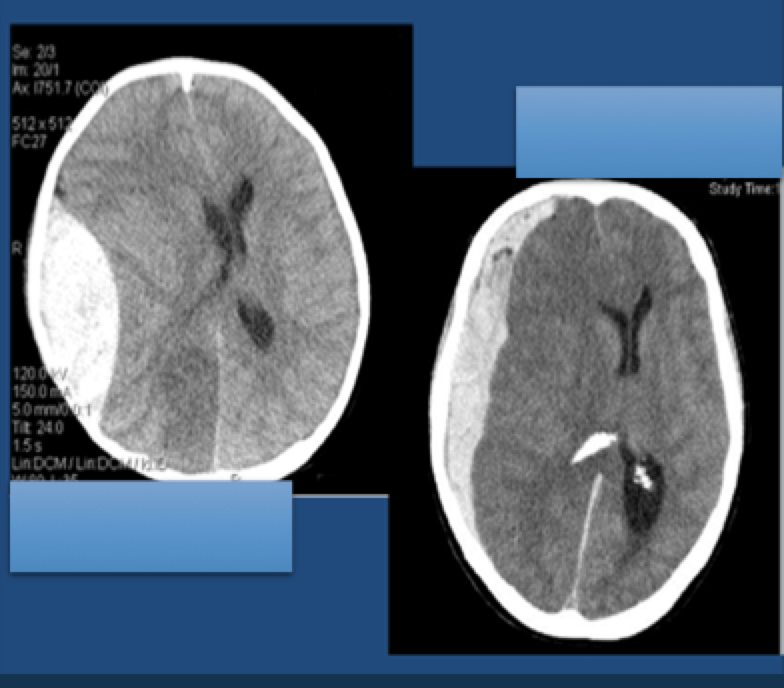
- Aepidural, extradural
- Bsubdural
50What is this CT showing? What is the arrow specifically pointing to?
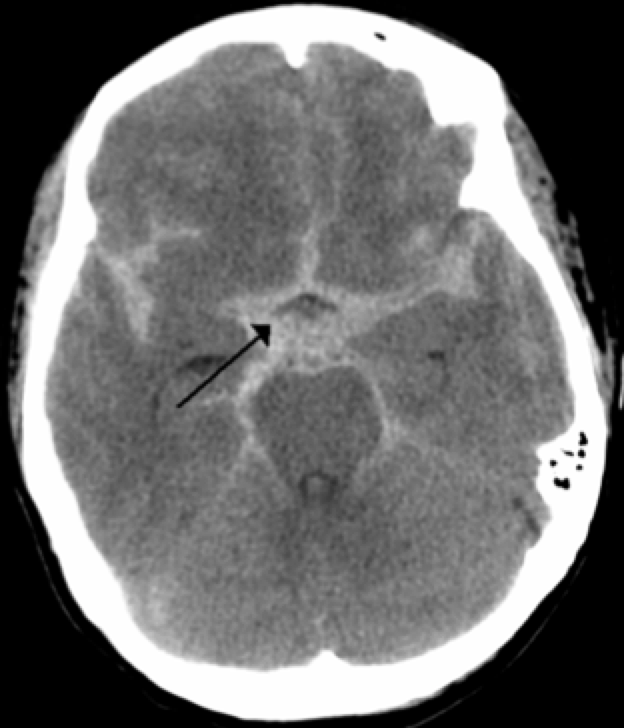
- Ablood
- Bsubarachnoid
51What is the CT showing? What causes this?
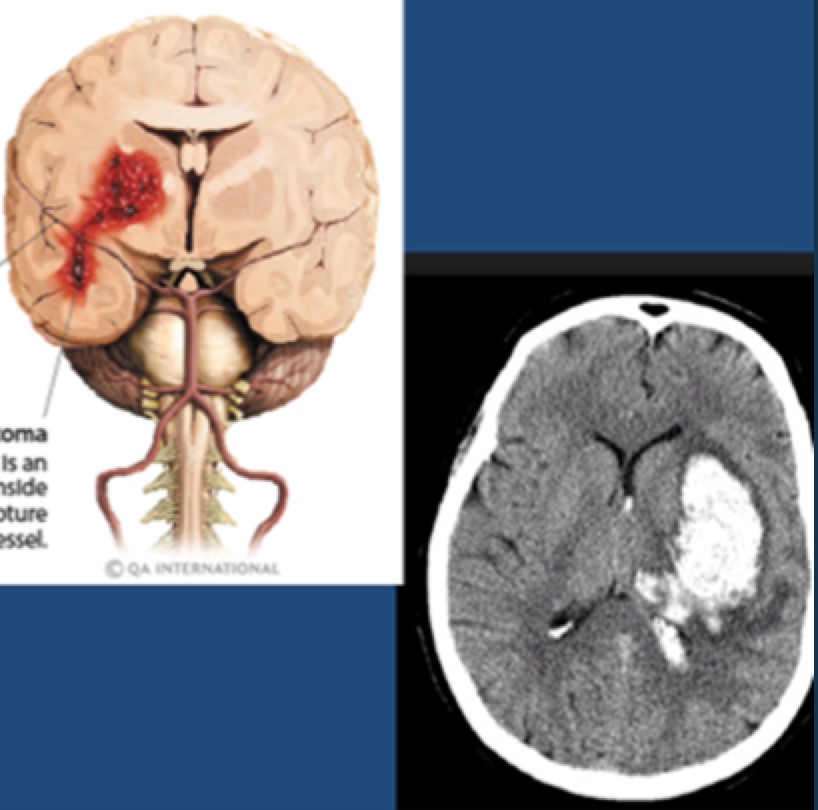
- Aintracerebral hemorrhage
- Brupture of a blood vessel
52The [blank_start]Monro[blank_end]-[blank_start]Kellie[blank_end] doctrine states that three things exist within the fixed dimensions of the skull: [blank_start]blood[blank_end], cerebrospinal fluid, and the brain. An increase in any one component must lead to a [blank_start]decrease[blank_end] in one (or both) of the other components, otherwise the [blank_start]intracranial[blank_end] pressure will increase.
If the pressure is severe enough, this can lead to [blank_start]herniation[blank_end] of brain tissue out of the skull. If this occurs at the brainstem, it can lead to [blank_start]coma[blank_end] or even brain [blank_start]death[blank_end].- AMonro
- BKellie
- Cintracranial
- Ddecrease
- Eblood
- Fherniation
- Gcoma
- Hdeath
53[blank_start]Cerebellar[blank_end] [blank_start]tentorium[blank_end]: is an extension of the [blank_start]dura[blank_end] mater that separates the cerebellum from the inferior portion of the [blank_start]occipital[blank_end] lobes.
- ACerebellar
- Btentorium
- Cdura
- Doccipital
54[blank_start]Falx[blank_end] [blank_start]cerebri[blank_end] is a strong, arched fold of [blank_start]dura[blank_end] mater that descends vertically in the [blank_start]longitudinal[blank_end] [blank_start]fissure[blank_end] between the cerebral hemispheres. It is narrow in front, where it is attached to the [blank_start]crista[blank_end] galli of the ethmoid; and broad behind, where it is connected with the upper surface of the [blank_start]tentorium[blank_end] cerebelli.
- AFalx
- Bcerebri
- Clongitudinal
- Dfissure
- Edura
- Fcrista
- Gtentorium
55Falx cerebelli projects downward from the tentorium cerebelli to separate the two cerebellar hemispheres.
- AVerdadeiro
- BFalso
56Increased stretching or tension of the dura of tentorium cerebelli and above will be detected as pain by which cranial nerve?
- ATrigeminal
- BFacial
- CVestibulocochlear
- DVagus
- EAbducens
- FOcculomotor
57Ventricles are hollow.
- AVerdadeiro
- BFalso
58CSF is acts as a cushion for the brain's [blank_start]cortex[blank_end], providing basic mechanical and [blank_start]immunological[blank_end] protection to the brain inside the skull. It also impacts cerebral autoregulation of cerebral [blank_start]blood[blank_end] [blank_start]flow[blank_end].
- Acortex
- Bimmunological
- Cblood
- Dflow
59What is true?
- Achoroid plexus ( differentiated ependymal cells) makes it
- BEpendyma lines the ventricular system of the brain
- CEpendyma is a type of neuroglia
- DEpendyma lines the central canal of the spinal cord
- EMajority of CSF is made by the lining surrounding the subarachnoid space
- FMajority of CSF is made by the ventricles' surfaces
60[blank_start]Wernicke's[blank_end] dysphasia (AKA [blank_start]receptive[blank_end] [blank_start]aphasia[blank_end]) is when one can speak fluently but cannot comprehend nor speak comprehensively. Because the patient is [blank_start]unaware[blank_end] of this, the prognosis is poor.
[blank_start]Broca's[blank_end] dysphasia (AKA [blank_start]expressive[blank_end] [blank_start]aphasia[blank_end]) is when one can fully comprehend but has difficulty replying/speaking. They are often very frustrated and recovery is [blank_start]not[blank_end] fully capable. [blank_start]Writing[blank_end] is also affected.- AWernicke's
- BBroca's
- Creceptive
- Daphasia
- Eexpressive
- Faphasia
- Gunaware
- HWriting
- Inot
Informações
- Descrição
- Content courtesy of Dayo's Old Age 2 teach. Credits to him.
- Autor
- Usuário eliminado
- Idioma
- English
- Visualizações
- 17
- Histórico
- Criado em 10 mar 2018 · atualizado em 13 mar 2018
- Etiquetas
- Avaliação
- Ainda sem avaliações Avalie este quiz