
Flashcards
Year 10 - Topic 1: Cells and movement across cell membranes
Flashcards do conjunto (24)
- 1What is the function of the nucleus?Carries genetic information and controls what happens inside the cell
- 2What is the function of the cell membrane?Controls the movement of substances into and out of the cell
- 3What is the function of the cytoplasm?Jelly-like substance, where chemical reactions happen
- 4What is the function of the mitochondria?Where respiration takes place, releasing energy for the cell
- 5What is the function of the vacuole?Contains a liquid called cell sap, which keeps the cell firm
- 6What is the function of the cell wall?Made of a tough substance called cellulose, which supports the cell
- 7What is the function of chloroplasts?Contain the green pigment chlorophyll, which absorbs light energy. This is where photosynthesis occurs.
- 8Why do you need to use a stain, such as iodine, to view cells under a microscope?Biological stains allow greater detail of cells to be seen
- 9In what way is an electron microscope better than a light microscope?There is greater magnification in an electron microscope than a light microscope so more detail can be seen
- 10Definition of a tissue.Groups of similar cells with a similar function
- 11Definition of organ.Several different tissues performing specific functions.
- 12What is meant by the term specialised cells?Cells that are adapted for specific functions
- 13What is diffusion?Movement of particles from a high concentration to a low concentration
- 14What is osmosis?Movement of water particles from a high concentration to a low concentration across a selectively permeable membrane
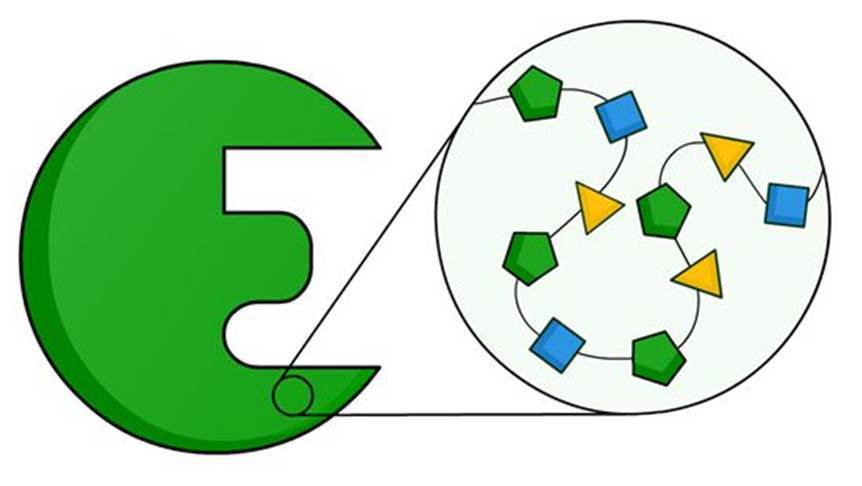
- 15HIGHER What is active transport?Movement of particles from a low concentration to a high concentration using energy in the form of ATP
- 16What is an enzyme?Biological catalyst - speeds up the rate of a chemical reaction
- 17HIGHER What are enzymes made up of?Amino acids - amino acids join together in a long chain which fold to form a specific shape
- 18Describe the function of enzymes' action (lock and key hypothesis).
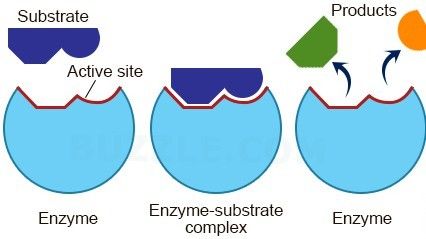
- 19What 3 factors affect enzyme activity?Temperature
pH
Substrate concentration - 20Temperature - explain what is happening in the graph.37°C is the optimum temperature for this enzyme.
Below 37°C, the enzyme and its substrate don't have enough energy to make successful collisions.
Above 37°C, it is too hot and the enzyme denatures so the rate of reaction goes down.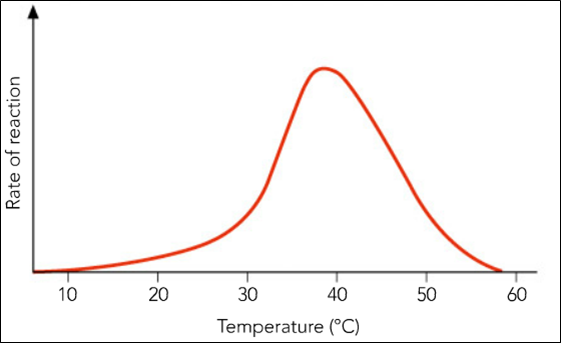
- 21pH - explain what is happening in the graph.The peak of the line is the optimum pH.
Above and below the optimum, the enzyme denatures so the reaction rate decreases.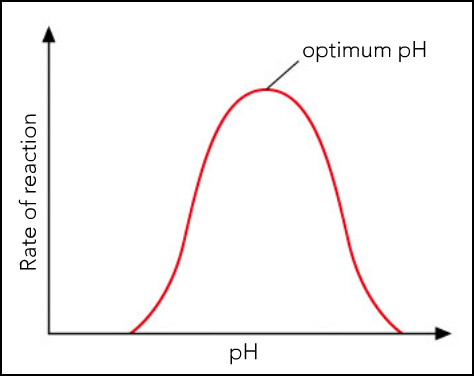
- 22Substrate concentration - explain what is happening in the graph.As the substrate concentration increases, the rate of reaction increases up until a point.
At this point, the rate of reaction levels off as all of the active sites are full.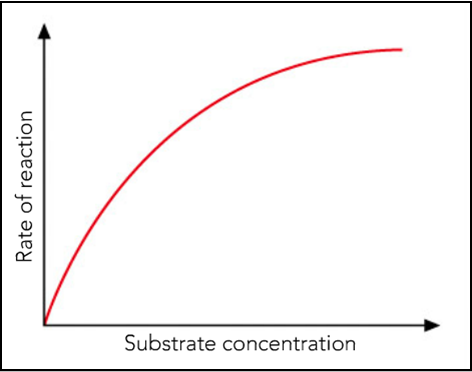
- 23What does optimum temperature mean?The temperature an enzyme works best at.
- 24What does optimum pH mean?The pH an enzyme works best at.
Informações
- Descrição
- O usuário eliminou as informações de disciplina FlashCards sobre Year 10 - Topic 1: Cells and movement across cell membranes, criado por Usuário eliminado em 26-03-2018.
- Criado por
- Usuário eliminado · mar 2018
- Atualizado
- 26 mar 2018
- Visualizações
- 37
- Histórico
-
- Criado por Mrs Z Rourke · 5 fev 2018
- Copiado por Mrs Z Rourke · 7 fev 2018
- Copiado por Mrs Z Rourke · 26 mar 2018
- Avaliação