
Flashcards
Environmental Science Midterm 2 - Ecosystem Ecology and Biochemistry
Flashcards do conjunto (52)
- 1What is the Watershed?The largest water system in North America, any processes taking place in the drainage and watershed of the st. Lawrence will affect the Great Lakes
- 2Systema network of relationships among parts of elements of components that interact with and influence one another
change of energy, matter, or info
receives inputs, processes, then produces outputs - 3Feedback Loopa system's output serves as input to that same system
- 4Negative Feedback Loopoutput that results from a system moving in one direction acts as the input that moves the system in the other direction
= dynamic equilibrium
eg: inc. prey --> inc predators --> dec. prey --> decrease predators --> increase prey etc - 5Positive Feedback Loopinstead of stabilizing a system, it drives it further toward one extreme (increase changes in system)
eg. albedo affect global warming - 6Dynamic Equilibrium (steady state)system processes moce in opposing directions at equivalent rates, balancing their effects
- 7Equilibriumno work or change in free energy
- 8homeostasisa system maintains constant or stable internal conditions
- 9emergent propertiessystem characteristics not evident in the components alone
a property which a collection or complex system has, but which the individual members do not have - 10LithosphereRock and sediment
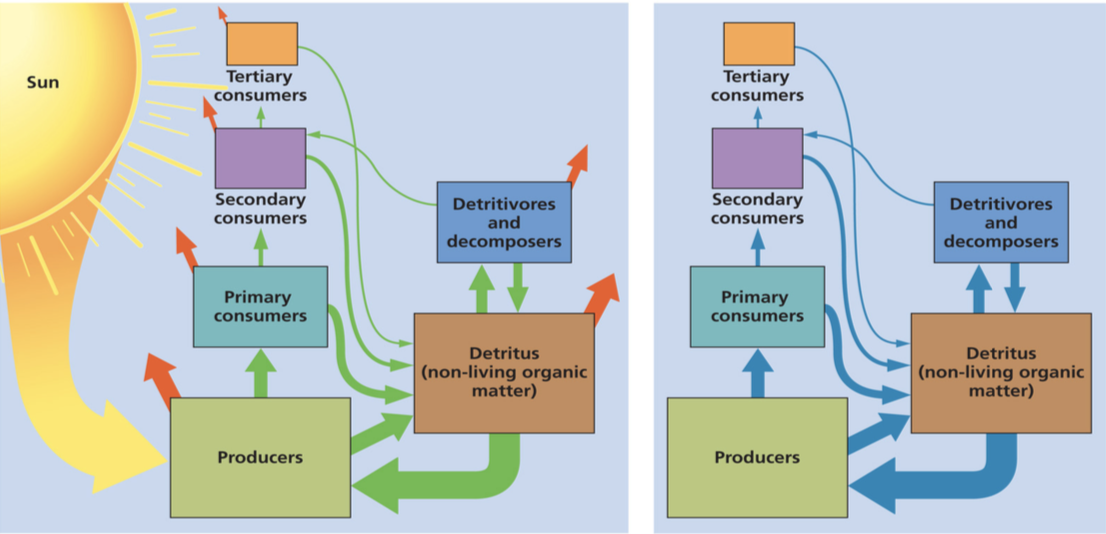
- 11Atmospherethe air
- 12HyrosphereLiquid, or water vapour
- 13Biosphereall the planet's living organisms and the abiotic portions of the environment
- 14Ecosystemsall organisms and non living entities that occur and interact in a particular area at the same time
includes abiotic and biotic components - 15Ecosystems: Interactive Living and Non-Living Entitiesenergy entering the system is processed and transformed
matter is recycled within ecosystem, resulting in outputs such as heat, water flow, and waste products - 16—light energy --> chemical energy stored in bonds of organic matter by primary producers using CO2 which is an inorganic molecule
primary consumers break down these bonds to harness energy
part of the light energy is lost at each trophic level is lost as heat - 17Primary productionconversion of solar energy --> chemical energy by autotrophs
- 18Gross Primary Production (GPP)the absorption/digestion of energy by autotrophs
- 19Net Primary Production (NPP)Energy remaining after respiration, and is used to generate biomass
available for heterotrophs (begins secondary production) - 20Secondary Productionbiomass generated by heterotrophs
- 21Where does most production of biomass on land occur?most production on land occurs in tropical forests, due to the high heat and high light
- 22Where does most production of biomass in water occur?in Northern water, because there is less stratification and the water mixes, nutrients are brought back up where light is present and this stimulates primary production
- 23Net Primary Productivityhigh net primary productivity = ecosystems whose plants rapidly convert solar energy to biomass
variation in net primary productivity among ecosystems & biomes result in geographic patterns of variation across the globe - 24Nutrientselements and compounds required for survival that are consumed by organisms
- 25Macronutrientsnutrients required in relative large amounts
nitrogen, carbon, phosphorus - 26Micronutrientsnutrients needed in smaller amounts
- 27Nutrient (biogeochemical) Cyclethe movement of nutrients through ecosystems
atmosphere, hydrosphere, lithosphere, and biosphere - 28Pools (reservoirs)where nutrients reside for varying amounts of time
- 29Fluxmovement of nutrients among pools, which change over time and are influenced by human activities
- 30Sources VS SinksSources : pools that release more nutrients than they accept
Sinks: accept more nutrients than they release - 31EvaporationWater moves from aquatic and land systems to air
- 32TranspirationRelease of water vapour by plants
- 33Precipitationcondensation of water vapour as rain or snow
- 34Aquifersunderground reservoirs of sponge-like regions of rock and soil that hold groundwater
- 35water tablethe upper limit of groundwater held in an aquifer
- 36Human Impacts on the Hydrological CycleDamming rivers increases evaporation and infiltration
Altering the surface & vegetation increases runoff and erosion
Removing forests and vegetation reduces transpiration and lowers water tables
most threatening : overdrawing groundwater for drinking, industrial etc. - 37The Carbon Cyclecarbon is found in carbohydrates, fats, proteins, bones
photosynthesis moves carbon from the air to organisms
respiration returns carbon to the air and oceans
decomposition returns carbon to the sediment (largest reservoirs)
oceans second largest - 38Humans affect on the carbon cycleburning fossil fuels moves carbon from the ground to the air
cutting Forrests and burning fields moves carbon from organisms to air
atmosphere carbon dioxide is highest its been in a long time, driving force for climate change
the missing carbon sink: 1-2 billion tons of carbon unaccounted for - may be in plants/soils of Northern temperate and boreal forests - 39Methanogenasisonly occurs in the absence of oxygen
process where dissolved organic matter (DOM) is converted to methane - 40Biological Pumpthe ocean's biologically driven sequestration of carbon from the atmosphere to deep sea water and sediment
driven by photosynthesis - 41Microbial Carbon Pumpthe transformation of bioavailable carbon (which could be transformed to CO2 and leave ocean) into a pool of refractory organic carbon that will remain in the deeper part of the ocean
- 42Microbial Loopthe transformation of dissolved organic carbon into particulate organic carbon by heterotrophic bacteria
this mechanism enables the recycling of organic carbon back to food webs - 43The Nitrogen Cyclenitrogen is 78% of our atmosphere
N2 gas is inert (not usable form)
Nitrogen Fixation: N2 gas is fixed (made into ammonia) by bacteria. this makes a usable form - 44Nitrificationbacteria that convert ammonium ions --> nitrite ions --> nitrate ions
plants can take up these ions
animals obtain nitrogen by eating plants or other animals - 45Denitrifying Bacteriaconvert nitrates in soil or water to N2, releasing it back into the atmosphere
only occurs when oxygen is present - 46How Humans Affect the Nitrogen Cyclehumans are fixing as much nitrogen as nature does
(haber-bosch process = production of fertilizers, fixes nitrogen)
increased emissions of nitrogen greenhouse gases - 47Consequences of Humans Affecting the Nitrogen CycleCa & K in soil washed out by fertilizers
acidified water & soils
reduced biodiversity of plants adapted to low nitrogen soils
changes estuaries and coastal ecosystems - 48Eutrophicationprocess of nutrient over-enrichment, blooms of algae, increased production of organic matter, ecosystem degradation
- 49Steps of Eutrophication1) nitrogen input
2) phytoplankton flourish at the surface
3) dead phytoplankton and their waste move to the bottom, providing more food to decomposers
4) decomposer pop. grows and consumes more O2
5) too low O2 kills fish, makes dead zone - 50Phosphorus Cycleinvolves no organisms
most phosphorus is within rocks and is released with weathering
with naturally low [environment], phosphorus is a limiting factor for plant growth
plants take up phosphorus when it is dissolved in water - 51How we Affect the Phosphorus Cyclemining rocks for fertilizer moves phosphorus from the soil to water systems
wastewater discharge also releases phosphorus
runoff containing phosphorus causes eutrophication of aquatic systems
household detergents have phosphorus - 52—
Informações
- Descrição
- O usuário eliminou as informações de disciplina FlashCards sobre Environmental Science Midterm 2 - Ecosystem Ecology and Biochemistry , criado por Usuário eliminado em 01-04-2018.
- Criado por
- Usuário eliminado · abr 2018
- Atualizado
- 1 abr 2018
- Visualizações
- 20
- Histórico
-
- Criado por abby Radske · 17 mar 2018
- Copiado por abby Radske · 1 abr 2018
- Avaliação