
Notas
Thomas Malthus Theory
Conteúdo das notas (1)
Página 1
Thomas Malthus theory on population
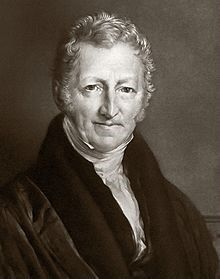
Thomas Robert Malthus was born in 1766. In
1788, he became a member of the clergy and earned his master’s degree in 1791.
When he was 32, he published his first paper on how agricultural production
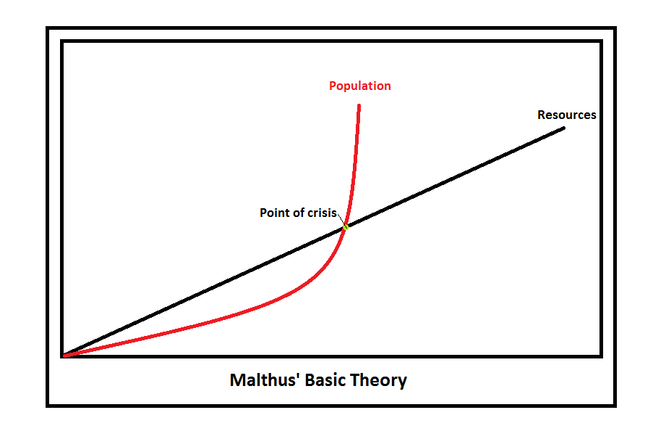
will not support population growth. Malthus thought that human population
increases exponentially (1, 2, 4, 8, 16, 32, 64, etc.) because it is natural
human urge to reproduce and food supply would only increase arithmetically (1,
2, 3, 4, 5, 6, 7, etc.). Therefore eventually humans would starve.
However Malthus argued the population growth would be slowed
and would be kept from rising exponentially for too long by preventative checks
and positive checks. Malthus described preventative checks as those that affect
birth rate: marrying at a later age, moral restraint, abstaining from
procreation, birth control and homosexuality. A modern day preventative check
would be women having a career so not having children at all or not having
children until a later age. Malthus defined positive checks as those that
affect the death rate: disease, war, natural disaster and eventually famine.
Malthus also thought that fear of famine would decrease the birth rate as
potential parents are less likely to have children if they think their child
might starve. However this is not always the case as in Africa, parents have
lots of children because they know some will die so they will have some left.
Malthus used the new United States of America as an example of high birth.
Malthus’ theory was developed before the industrial
revolution and focuses on plants, animals and grains as key components of the
diet. For Malthus available productive farmland was a limiting factor in
population growth. Due to an increase agricultural production (new farm machinery)
it has become a less important factor.
Another factor is poverty, which can be caused by a large
population because it would increase the number of people in a work force,
lowering labouring costs. In the 1800 an example of poor people and low labouring
costs would have been factories in Britain. Now it would be material factories
in Asia. Malthus disagrees with the newly introduced welfare system which gave
poor people more money for having more children. He realised this would just
increase the number of poor workers, further lowering their wages.
Thomas Malthus Printed further editions of his Principle of
Population from 1803 to 1826. Malthus was awarded the first professorship in
Political Economy at Halebury College. He is often known as the patron saint of
demography and he caused it to become a proper academic study. Thomas Malthus
died in 1834.
New Page
Informações
- Descrição
- Notas sobre Thomas Malthus Theory, criado por Jonathan Greenwood em 25-09-2014.
- Criado por
- Jonathan Greenwood · set 2014
- Atualizado
- 13 jun 2016
- Visualizações
- 560
- Avaliação