
71. People Can Tell When a Smile is Real or Fake More Accurately with Video
Slides do conjunto (6)
-
People Can Tell When a Smile is Real or Fake More Accurately with Video

- Legenda: Figure 1. Carpenter, K. (n.d.). Laughing woman photo [Digital image on free site]. Retrieved January 21, 2019, from https://unsplash.com/search/photos/smile
-
- Guillaume Duchenne, a French doctor, conducted research for smiles on subjects using electrical currents. His study attempted to stimulate specific facial muscles and photograph the people’s expressions. The subjects experienced pain, which can be detected in the faces of the people.
- Weinschenk, S., PH.D. (2011). 100 Things Every Designer Needs to Know About People [Kindle]. pg. 161
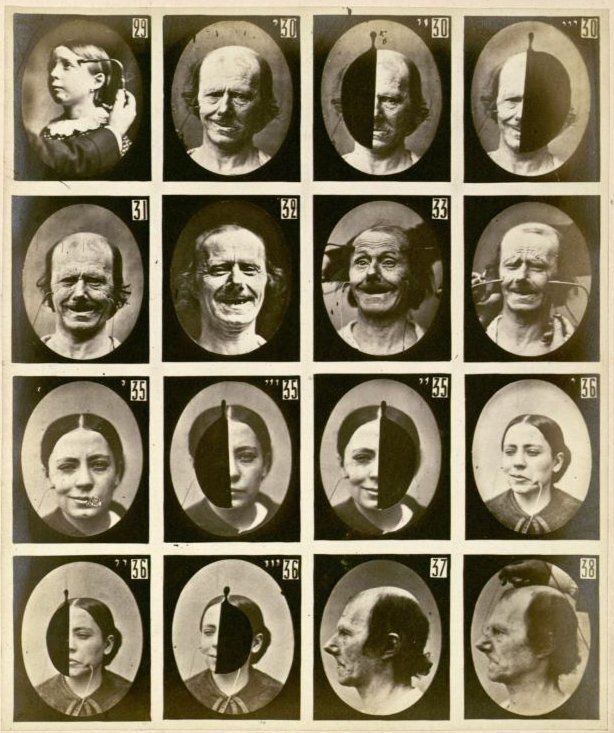
- Legenda: Figure 2. Duchenne-FacialExpressions.jpg [Image from wikipedia]. (n.d.). Retrieved January 21, 2019, from https://commons.wikimedia.org/wiki/File:Duchenne-FacialExpressions.jpg
-
Duchenne Smile and Non Duchenne Smile
- Duchenne Smile
- Contracting the zygomatic major muscles (the muscles raise the corners of the mouth) along with the orbicularis oculi muscles (the muscles raise the cheeks and make the eyes crinkle) created a Duchenne smile. This was determined to be a genuine smile.
- Weinschenk, S., PH.D. (2011). 100 Things Every Designer Needs to Know About People [Kindle]. pg.161
- Non-Duchenne Smile
- Contracting the zygomatic major muscle; the mouth turns up, but the eyes don’t crinkle. This is called a non-Duchenne smile and was considered to be a fake smile.
-
- People found it quicker to trust and like other people who were showing what are believed to be genuine emotions rather than fake ones.

-
- A research study emerged from Eva Krumhuber and Antony Manstead that sought to prove the truth that people couldn’t fake a smile. Their studies showed that 83% of the people could produce fake smiles that seemed real, however, those smiles were in photographs. They decided to extend the study to video and found that it was harder to fake a smile while in a video. It had nothing to do with the crinkly eyes but by details of what the video showed. For example, how long they held the smile, lack of other emotions besides happiness, and flickers of impatience. It was concluded that video footage lasted longer and was easier to detect a fake smile opposed to a static snapshot.
- Weinschenk, S., PH.D. (2011). 100 Things Every Designer Needs to Know About People [Kindle]. pg.161
-
- "Pay attention to smiles in videos. People will be able to determine a fake smile versus a real one better in a video than in a photo. If they don’t think the smile is real, they’re less likely to trust you."
- "It is possible to fake a smile and to fake a crinkly-eyed smile, but it is easier to fake a smile in a static picture than on a video."
- "People can tell whether a smile is real or not by looking for conflicting emotions. They are looking at many parts of the face, not just the eyes."
- "If a smile looks real, it will engage the viewer and build trust."
- Weinschenk, S., PH.D. (2011). 100 Things Every Designer Needs to Know About People [Kindle]. pg.162

Informações
- Descrição
- O usuário eliminou as informações de disciplina Slides sobre 71. People Can Tell When a Smile is Real or Fake More Accurately with Video, criado por Usuário eliminado em 29-01-2019.
- Criado por
- Usuário eliminado · jan 2019
- Atualizado
- 29 jan 2019
- Visualizações
- 14
- Histórico
-
- Criado por Heather Martin · 21 jan 2019
- Copiado por Heather Martin · 29 jan 2019
- Avaliação