
Notas
Management of Patient with Nonmalignant Hematologic Disorders
Conteúdo das notas (1)
Página 1
Bleeding Disorders
Failure of normal hemostatic mechanisms results in bleeding
Can occur anywhere in the body
Trauma
Platelet factor abnormality
Liver & spleen
Coagulation factor abnormality
Tiny vessels usually affected
Deeper bleed
Vascular abnormality
Skin surface
General clinical manifestations
Vary according to the type of defect
Careful H & P
Bleeding may be superficial or deeper within the body
Petechiae
With platelet factor abnormality
Risk factors for bleeding (Chart 33-6)
Severity/duration of thrombocytopenia
Sepsis ( high platelet consumption)
Increased intracranial pressure (rupture vessels; causes bleeding)
Liver (coagulation factors) /renal dysfunction (erythropoietin)
Dysproteinemia – low platelet function
Alcohol abuse – low platelet production
Splenomegaly – high platelet destruction
Medications
Medical management
Treat underlying cause
Anemia, blood loss
Transfusions of blood products
Hemostatic agents if fibrinolysis excessive (aminocaproic acid)
Nursing Management
Patient education
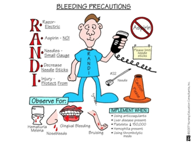
Bleeding precautions, if Pt knows they are on bleeding precautions (keep body away from risk of falls, hurting, brushing teeth, if they bleed what will happen? It will not stop)
Avoiding activities that increase the risk of bleeding
Examination for bleeding
Testing of all drainage and excreta
Thrombocytopenia
Low platelet level
low production of platelets within bone marrow
high destruction of platelets
high consumption of platelets
See table 33-3 for causes and treatments
Clinical manifestations
< 50,000: possible bleeding
< 20,000: Petechiae, nasal/gingival bleeding, excessive menstrual bleeding, excessive bleeding after surgery/dental extractions
<5,000: spontaneous, fatal CNS bleeding or GI hemorrhage
Assessment & Diagnostic
Bone marrow biopsy
Genetic testing
CBC
Hepatitis screening
Medical Management
Treat underlying cause
Platelet transfusion
Splenectomy
Nursing Management
Education
Measures to minimize bleeding (see Chart 15-7 in Chapter 15)
Immune Thrombocytopenic Purpura (ITP)
Affects all ages but more common in children & young women
Primary ITP occurs in isolation
Secondary ITP occurs from autoimmune disease, viral infections, and medications
Pathophysiology
Destruction of platelet by unknown stimulus
Anti-platelet antibodies develop >>>
antibodies bind to platelets >>>
platelets ingested/destroyed >>>
bone marrow increases platelet production to compensate >>>
compensation becomes not as effective as thrombopoietin levels are not elevated in patients with ITP >>>>
platelet production becomes diminished
Clinical Manifestations
May have no symptoms
Easy bruising
Heavy menses
Petechiae
Dry purpura
Mucosal bleeding (wet purpura)
risk for intracranial bleeding
Assessment & Diagnostics
History & physical
HIV/Hepatitis C testing
Bone marrow biopsy
Helicobacter pylori
Medical Management
Goal: “safe” platelet level
Stop medication immediately if cause
Pharmacological measures
Immunosuppressive agents
Corticosteroids
Monoclonal antibodies
Chemotherapeutic agents
Thrombopoietin receptor agonist
IVIG
Splenectomy
Nursing Management
Determine risk of bleeding
Medication history
Sulfa-containing drugs
STOP medication is PT has sulfa allergy present
ASA based and NSAIDs
Chart 33-9
Neurological assessments
Avoid injections and rectal procedures
Patient education
Platelet Defects
Qualitative defects; number of platelets normal but the platelets do not function normally
Causes
Aspirin and NSAIDs Use
ESRD
MDS
Multiple myeloma
Cardiopulmonary bypass
Herbal therapy (Chart 33-9)
Acquired Coagulation Disorders
Liver Disease
Diminished coagulation factors produced
Prolonged PT
Risk for bleeding
Transfusion with FFP (in severe cases PRBCs and platelets)
Vitamin K Deficiency
Synthesis of many coagulation factors depends on vitamin K
Common in malnourished patients
Prolonged use of antibiotics decreases intestinal flora that produce vitamin K à depleting vitamin K stores
Vitamin k administration (PO or SQ)
Adequate synthesis of coagulation factors is reflected by normalization of the PT
Vitamin K is the antidote for warfarin toxicity
Monitor INR
Anticoagulant Therapy Complications
Most common in those taking warfarin
INR monitoring
Vitamin K antidote for warfarin toxicity
Transfusion with fresh frozen plasma
Informações
- Descrição
- Chapter 33
- Criado por
- Usuário eliminado · jun 2019
- Atualizado
- 2 jun 2019
- Visualizações
- 9
- Histórico
-
- Criado por Brittnee Gonzalez · 2 jun 2019
- Copiado por Brittnee Gonzalez · 2 jun 2019
- Avaliação