
Flashcards
Lecture 3 - Endocrine: Growth
Flashcards do conjunto (10)
- 1Endocrine: Growth Objectives•Define the periods of growth and their characteristics
•Understand the actions and the mechanisms of action for GH on bone and soft tissues
•Role of IGF-1 (and IGF-II)
•Describe the factors that control GH secretion
•Examine the role of sex steroids
•Define and understand the clinical symptoms associated with abnormalities in GH secretion - 2Endocrine Control of Growth GROWTH –Under influence of growth hormone: •Net synthesis of ___ •↑___ of the long bones •↑ size and number of ___ in soft tissues -Factors other than GH affect growth: •Genetics ->Inheritance ->Abnormalities can cause various developmental defects •Diet ->Malnourishment -> ↓ growth potential (__% brain development in first 2 years) ->Excess = ____, not growth •Freedom from disease and stressful environment ->Prolonged stress-induced secretion of ___ -> stunted growth (through protein break-down, ↓ __ ___ growth, inhibiting __ secretion) –Normal levels of growth-influencing hormones: •Thyroid hormone •Insulin •Sex hormonesproteins
Length
cells
70%
OBESITY
cortisol
long bone
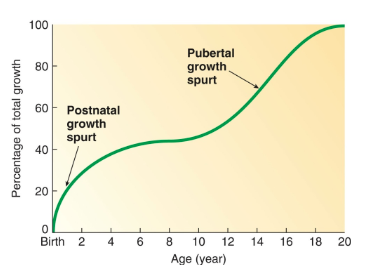
GH - 3Growth Not continuous: –FETAL growth •___ hormones •Genetic/environmental factors determine ___ at birth •GH ___ involved –CHILDREN •Postnatal growth spurt: –1st _ years –After -> rate linearly ___ until puberty •Pubertal growth spurt (11 yrs for females, 13 yrs for males): –Marked ____ in linear growth –Cause not well-understood –Genetic/hormonal factors » _ androgens -> protein synthesis and bone growth »T from testes, adrenal androgens in ___ *BOTH _ & __ -> halt bone growth at end of pubertyPlacental
size
NOT
2
declines
acceleration
↑
females
T (testosterone) & E2 (estradiol) - 4Metabolic Effects of GH NOT Related to Growth -GH is the MOST abundant ___ hormone secreted, even in adults, suggesting actions in ___ to growth -Exerts actions by binding ____ to target tissues -During prolonged FASTING or if energy requirements EXCEED available glucose stores: ->Adipose »Breakdown triglycerides -> ↑ [fatty acid]blood ->Skeletal muscles »↑ use of __ __ for fuel (glucose sparing) »_ glucose uptake [↑ [glucose]blood = conserved for glucose-dependent tissues (__ , __)] –>Liver » _ glucose output [↑ [glucose]blood = conserved for glucose-dependent tissues (__ , __)] ->Also stimulates ___ synthesis -> _ [amino acid]blood »May or may not be a direct actionanterior pituitary (AP)
addition
DIRECTLY
↑
fatty acids
↓
heart, brain
↑
protein
↓ - 5Growth Hormone Does NOT act ___ to exert effects on growth –Actions mediated by insulin-like growth factors (__ & __) •Structurally and functionally similar to insulin •Produced by many tissues •Have endocrine, paracrine, and autocrine actions •Act via __ ___ pathwaydirectly
IGF-I & IGF-II
tyrosine kinase - 6IGF-I –70 a.a. protein, synthesis stimulated by __ –Mediates GH’s growth-___ actions –Major source = ___ (released into blood) •Also produced locally by most other tissues (___) –> NOT released to blood –Is paracrine secretion a major factor during postnatal growth (first _ years) period? »Circulating [GH] and [IGF-I] are __ during this time –Control of PRODUCTION (other than by GH): •Nutrition: [↓ intake -> _ IGF-I (but _ GH)] •Age-related factors: ( _IGF-I accompanies _ GH at puberty -> pubertal growth spurt) •Tissue-specific stimulatory factors: –FSH/LH & sex steroids -> ↑ IGF-I within reproductive organsGH
promoting
Liver
paracrine
2
low
↓
↑
↑
↑ - 7Growth Hormone IGF-II –Production NOT influenced by __ –Major source = ___ PRIMARY ROLE: •During FETAL development: –Receptors expressed very __ in development (in contrast, IGF-I receptors not expressed until later in fetal life) »Found in _____ cells (develops into the fetal portion of placenta) –Stimulates ___ growth –Stimulates both pre- and post-implantation embryonic growth In NEWBORNS: –IGF-II _, while IGF-I _ •Secreted during adulthood, but UNKNOWN role –Patients with tumors that secrete IGF-II develop ____ »Binds to insulin receptors @ ___ -67 a.a. -62% homology with IGF-1 -Immunologically ___ than IGF-1GH
liver
early
trophoblast
placental
↓
↑
hypoglycemia (low blood sugar)
liver
different - 8Growth Hormone -GH (acting through __) stimulates growth in soft tissues and skeleton SOFT TISSUE –Hyperplasia (_ # cells) •↑ cell division •↓ apoptosis –Hypertrophy (↑ __ of cells) • _ protein synthesis –↑ amino acid uptake by cell –↑ activity of synthesis machinery »↑ DNA & RNA synthesis »↑ incorporation of amino acids into protein @ ribosome •↓ protein ____IGF-I
↑
size
↑
degradation - 9Growth Hormone Effects on Skeletal Growth Effects on bone growth BONE STRUCTURE: ~____~ –Extracellular matrix composed of collagen fibers and semisolid gel »Responsible for tensile ___ of bone –CaPO4 precipitation -> bone ____ »Responsible for resistance to ____ ~____~ –Form bone by secreting osteoid ~_____~ –Dissolve bone tissues »Release minerals to blood •Relevant ANATOMY: –Periosteum »____ tissue surrounding bone –Diaphysis »___ of a long bone »Hollow, central cavity •Contains __ ___ –Epiphysis »“___” at either end of long bone •Where articulations are formed –___ ___ »Cartilaginous growth region b/w diaphysis and epiphysisOsteoid
strength
hardening
compression
Osteoblasts
("Blasts Build Bone")
Osteoclasts
("Clasts Cut bone")
Connective
Shaft
bone marrow
"knob"
Epiphyseal plate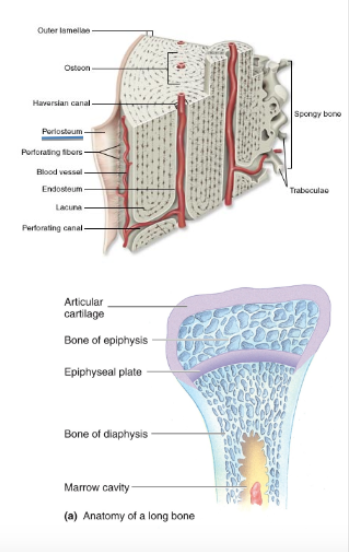
- 10Bone Growth
Informações
- Descrição
- O usuário eliminou as informações de disciplina FlashCards sobre Lecture 3 - Endocrine: Growth, criado por Usuário eliminado em 07-11-2019.
- Criado por
- Usuário eliminado · nov 2019
- Atualizado
- 7 nov 2019
- Visualizações
- 10
- Histórico
-
- Criado por Marissa Alvarez · 30 out 2019
- Copiado por Marissa Alvarez · 7 nov 2019
- Avaliação