
Notas
7.2 - Transcription and gene expression
Conteúdo das notas (6)
Página 1
Regulation of gene expression by proteins
Some proteins are always necessary for the survival of the organism and are expression is unregulated fashion.
Other proteins need to be produced at certain times in certain amounts, hence their expression needs to be regulated
Example: Prokaryotes and Eukaryotes
Gene expression is regulated in prokaryotes:
Is due to the consequence of variations in environmental factors
The E.coli gene that is responsible for the absorption and metabolism of lactose.
Gene expression in Eukaryotic genes:
Are regulated in response to variations in environmental conditions
Each cell only expresses a fraction of its genes.
The regulation of gene expression is a key part of cell differentiation and cell development.
Numbers of portions whose binding to DNA regulates transcription:
They include enhancers, silencers, and promoter-proximal elements.
Enhancers are regulatory sequences on the DNA which increases the rate of transcription when proteins bind to them.
Silencers are sequences on the DNA which decreases the rate of transcription when proteins bind.
Promoter-proximal elements are nearer to the promoter and binding of proteins compared to an enhancer and a silencer, and important initiate transcription.
The sequence linking to regulatory transcriptor factors are unique to the gene.
Página 2
The impact of the environment on gene expression
"Nature-nurture" debate is a debate centered on the extent to which particular human behavior or phenotype should be attributed to the environment or to heredity.
Studies usually done on twins
The influence of the environment on gene expression fr some traits cna be unequivocal.
Such as the gene expression in the production of skin pigmentation due to exposure to sunlight.
The concentration of morphogens affect gene expression contributing to d/f patterns of gene expression, hence different embryonic cell (depending on the position)
Morhogens the uneven distribution of chemicals in an embryo.
Página 3
Nucleosomes regulate transcription
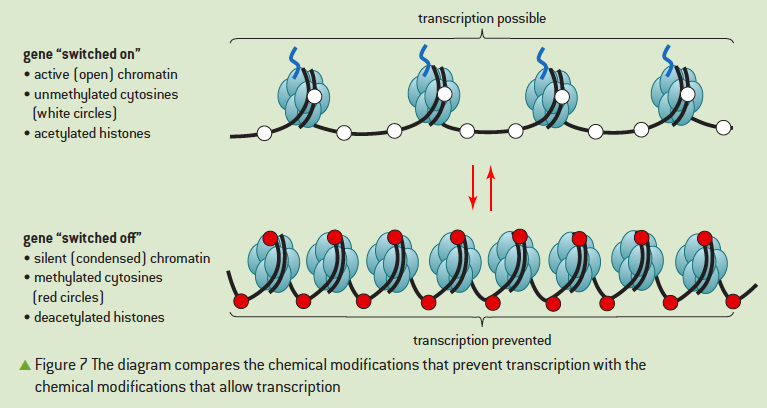
Nucleosomes help regulate transcription in eukaryotes
Eukaryotes are associated with proteins called Histones.
chemical modifications of the tail of the protein are essential in determining whether the gene will be expressed or not.
A number of modifications can happen to the tail such as:
Addition of an acetyl group
Neutralizes the positive charge allowing a less condensed structure with higher levels of transcription.
Addition of a methyl group
Tends to decrease gene expression
Addition of a phosphate group
the chemical modification of histone tails can either activate or deactivate genes by decreasing or increasing the accessibility of the gene to transcription factors.
Epigenetics
Chemical modifications that have an impact on gene expression are known as epigenetic tags.
The sum of all the epigenetic tags constitutes the epigenome
Different cells have their own methylation patterns so that a unique set of proteins can be produced, hence the cell performs its function
During cell division, the methylation pattern is passed to the daughter cell.
The sperm and egg develop from cells with epigenetic tags
When the sex cells bind /meet the epigenome is erased through the process known as "reprogramming".
About 1% of the epigenome survives and yields a result called "imprinting".
Página 4
The direction of transcription
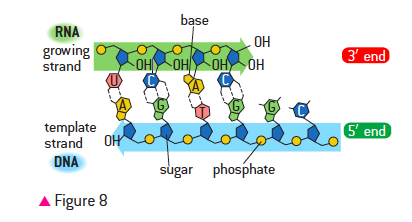
Transcription occurs in the 5' to 3' direction
The synthesis of RNA occurs in 3 stages:
Initiation
Elongation
Termination
Transcription begins at a site known as a promoter, where the RNA polymerase attaches.
this unwound the DNA forming an open complex
It slides along the DNA synthesizing a single strand of RNA
Página 5
Post-transcriptional modification
Transcription, translation, and post-translation regulation happens in both prokaryotes and eukaryotes
Most regulations in terms of prokaryotic gene expression occur at transcription.
post-transcriptional modification of RNA is a method of gene expression and doesn't happen in prokaryotes.
the most significant d/f between eukaryotes and prokaryotes is:
The absence of a nuclear membrane surrounding the genetic material in prokaryotes.
This means that transcription and translation can be coupled
The presence of nuclear membrane surrounding the genetic material in eukaryotes
This separates the location of transcription and translation into d/f compartments which allow significant post-transcriptional modification to occur before the mature transcript exits the nucleus.
Examples; removing introns for RNA transcript
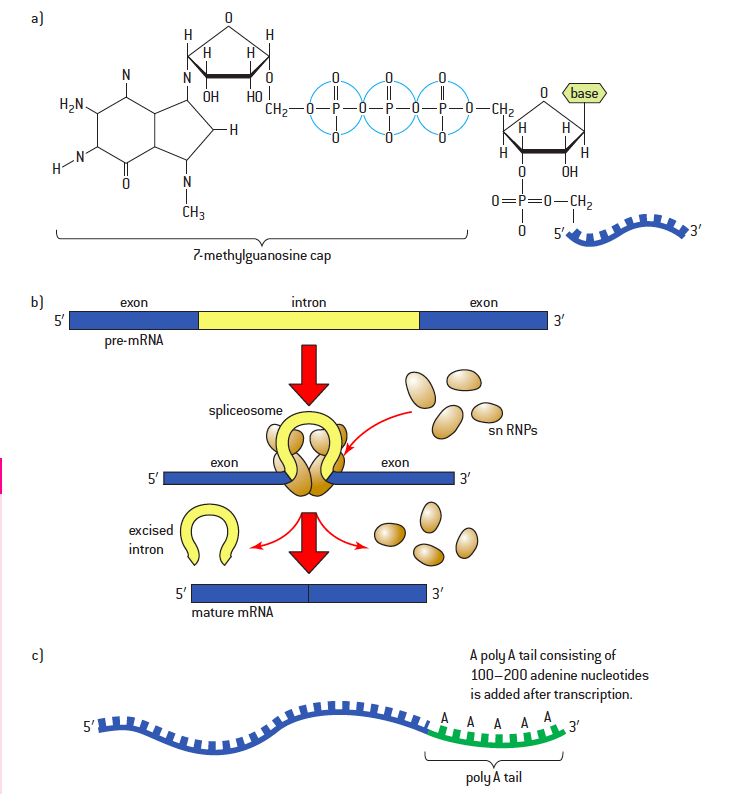
The immediate product of mRNA transcription is referred to as pre-mRNA.
It must go through several stages of post-transcriptional modification to become mature mRNA
One of the stages is called RNA splicing
Introns ( Intervening sequences) Is a sequence interspersed throughout the mRNA that will not contribute to the formation of polypeptides.
They must be removed
Exons are the remaining coding portions after the removal of introns.
Will be spliced together to form the mature mRNA.
The post-transcriptional modification also includes:
An addition of a 5' cap; usually occurs before transcription s been completed.
A poly-A tail os added after transcription has been made.
Página 6
mRNA splicing
The splicing of mRNA increases the number of different proteins an organism can produce.
Alternative splicing is a process during gene expression whereby a single gene codes for multiple proteins.
Occurs in genes with multiple exons
A particular exon may or may not increase in the final mRNA
due to this a protein translated from alternatively spliced mRNA will have different amino acid sequences and possibly in its biological function as well.
Informações
- Descrição
- O usuário eliminou as informações de disciplina Notas sobre 7.2 - Transcription and gene expression, criado por Usuário eliminado em 20-02-2020.
- Criado por
- Usuário eliminado · fev 2020
- Atualizado
- 20 fev 2020
- Visualizações
- 38
- Histórico
-
- Criado por Blen Abate · 16 fev 2020
- Copiado por Eliana Zerga · 17 fev 2020
- Copiado por Blen Abate · 20 fev 2020
- Avaliação