
Flashcards
BISC 100 - Lecture 35: Biodiversity
Flashcards do conjunto (31)
- 1Why Biodiversity Matters• The expanding human population threatens
• biodiversity and
• the disappearance of natural ecosystems.
• Only about a quarter of Earth’s land surfaces
remain untouched by human alterations - 2• Healthy ecosystems provide resources, such as water, wood, and fish, and services such asrecycling nutrients,
• preventing erosion and mudslides,
• controlling agricultural pests, and
• pollinating crops. - 3Coastal wetlands...act as a buffer against hurricanes,
• reduce the impact of flooding,
• filter pollutants, and
• furnish nesting sites and breeding areas for birds
and marine turtles and nurseries for a wide variety
of fish and shellfish. - 4• Biological diversity, or biodiversity, includes• genetic diversity,
• species diversity, and
• ecosystem diversity.
• Thus, the loss of biodiversity encompasses more
than just the fate of individual species. - 5Genetic Diversityraw material that makes microevolution and
adaptation to the environment possible.
• If local populations are lost, then
• the number of individuals in the species declines,
and
• the genetic resources for that species decline. - 6Species DiversityEcologists believe that we are pushing species
toward extinction at an alarming rate.
• The present rate of species loss may be 100
times higher than at any time in the past
100,000 years.
• Some researchers estimate that at the current rate
of destruction, over half of all currently living
plant and animal species will be gone by the end
of this century - 7Two recent victims of human-caused extinctions are the• Chinese river dolphins and
• Formosan clouded leopard - 8Ecosystem DiversityAn ecosystem includes the organisms and the
abiotic factors in a particular area.
• Because of the network of interactions among
populations of different species within an
ecosystem, the loss of one species can have a
negative effect on the entire ecosystem.
• The disappearance of natural ecosystems results
in the loss of ecosystem services, functions
performed by an ecosystem that directly or
indirectly benefit people, including
• air and water purification,
• climate regulation, and
• erosion control. - 9Causes of Declining BiodiversityEcologists have identified four main factors
responsible for the loss of biodiversity:
1. habitat destruction and fragmentation,
2. invasive species,
3. overexploitation, and
4. pollution.
• The ever-expanding size and dominance of the
human population are at the root of all four
factors. - 10Habitat Destruction• Biodiversity is threatened by the massive
destruction and fragmentation of habitats by
• agriculture,
• urban development,
• forestry, and
• mining.
• According to the IUCN, habitat destruction affects more
than 85% of all birds, mammals, and amphibians that
are threatened with extinction. - 11Invasive Species• Invasive species have
• competed with native species,
• preyed upon native species, and
• parasitized native species. - 12OverexploitationPeople can overexploit wildlife by harvesting at
rates that exceed the ability of populations to
rebound.
• Excessive commercial harvesting, poaching, and
sport hunting have greatly affected populations of
• tigers,
• the American bison, and
• Galápagos tortoises.
• Overharvesting also threatens rare trees such as
mahogany and rosewood that produce valuable
wood. - 13PollutionAir and water pollution is a contributing factor in
declining populations of hundreds of species.
• The global water cycle can transport pollutants from
terrestrial to aquatic ecosystems hundreds of miles
away.
• Pollutants that are emitted into the atmosphere may
be carried aloft for thousands of miles before falling
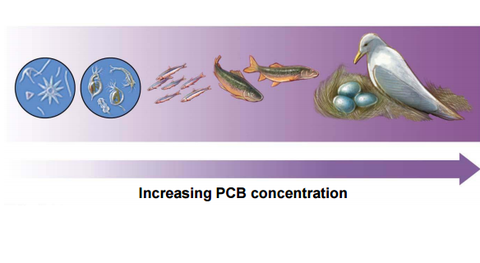
to earth in the form of acid precipitation. - 14BIOMAGNIFICATION
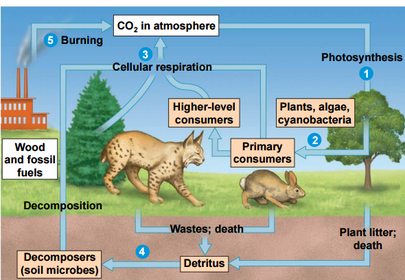
- 15The Carbon Cycle
- 16The Phosphorus CycleOrganisms require phosphorus as an ingredient of
nucleic acids, phospholipids, and ATP and as a
mineral component of vertebrate bones and teeth.
• The phosphorus cycle does not have an
atmospheric component.
• Rocks are the only source of phosphorus for
terrestrial ecosystems
• Phosphates move from land to aquatic ecosystems
much more rapidly than they are replaced.
• Soil characteristics may also decrease the amount
of phosphate available to plants. As a result,
• phosphate is a limiting factor in many terrestrial
ecosystems and
• farmers and gardeners often use phosphate
fertilizer, such as crushed phosphate rock or bone
meal, to boost plant growth.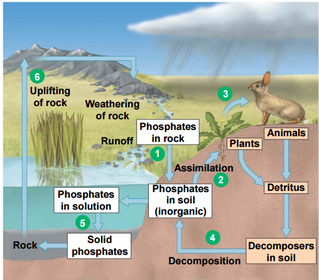
- 17The Nitrogen CycleNitrogen is
• an ingredient of proteins and nucleic acids and
• essential to the structure and functioning of all
organisms.
• The atmospheric reservoir is huge; almost 80% of
the atmosphere is nitrogen gas (N2
).
• However, plants cannot use nitrogen gas.
• The process of nitrogen fixation converts gaseous
N2
to ammonia (NH3
).
• Ammonia then picks up another H+
to become
ammonium (NH4
+
), which plants can assimilate. - 18Nitrogen has two abiotic reservoirs:1. the atmosphere and
2. the soil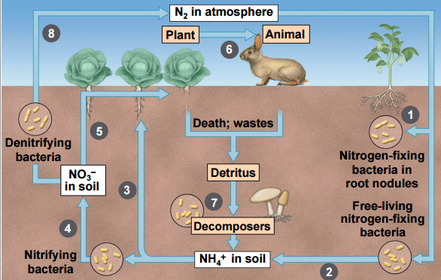
- 19• Two major sources of nitrogen are1. combustion of fossil fuels and
2. modern agricultural practices.
• Some nitrogen escapes to the atmosphere, where
it forms nitrous oxide (N2O), a gas that contributes
to global warming.
Human activities are disrupting the nitrogen cycle
by adding more nitrogen to the biosphere each
year than natural processes do. - 20Nutrient PollutionThe growth of algae and cyanobacteria in aquatic
ecosystems is often limited by low nutrient levels,
especially
• phosphorus and
• nitrogen.
• Nutrient pollution occurs when human activities
add excess amounts of these chemicals to aquatic
ecosystems - 21Conservation and Restoration BiologyMany of the environmental problems facing us
today have been caused by human enterprises.
• Ecological research is the foundation for
• finding solutions to these problems and
• reversing the negative consequences of ecosystem
alteration. - 22Conservation biologygoal-oriented science
that seeks to understand and counter the loss of
biodiversity - 23Restoration ecologyuses ecological principles to
develop methods of returning degraded areas to
their natural state. - 24Biodiversity “Hot Spots”Conservation efforts are often focused on
biodiversity hot spots, relatively small areas
that have
• a large number of endangered and threatened
species and
• an exceptional concentration of endemic species,
those that are found nowhere else.
• The “hottest” of Earth’s biodiversity hot spots are
shown in Figure 20.37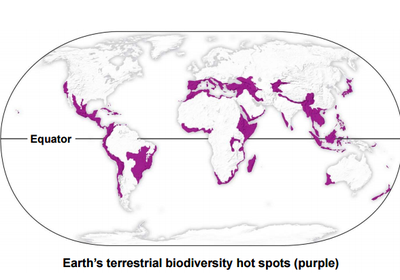
- 25Conservation at the Ecosystem LevelConservation biology increasingly aims at
sustaining the biodiversity of entire
• communities,
• ecosystems, and
• landscapes, regional assemblages of interacting
ecosystems, such as an area with forest, adjacent
fields, wetlands, streams, and streamside habitats - 26Landscape ecologyis the application of
ecological principles to the study of land-use
patterns.
• Its goal is to make ecosystem conservation a
functional part of the planning for land use. - 27Edges between ecosystems
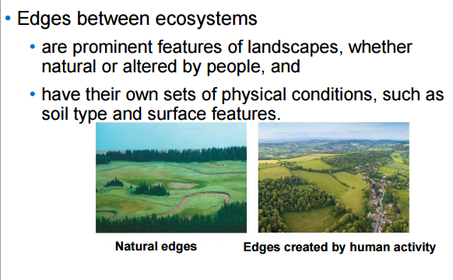
- 28movement corridora narrow strip or series
of small clumps of suitable habitat connecting
otherwise isolated patches.
can promote dispersal,
• help sustain populations, and
• are especially important to species that migrate
between different habitats seasonally.
• But a corridor can also spread disease, especially
among small subpopulations in closely situated
habitat patches. - 29Restoring EcosystemsBioremediation uses living organisms to detoxify
polluted ecosystems.
Some restoration projects have the broader goal of
returning ecosystems to their natural state. - 30The Goal of Sustainable DevelopmentAs the world population grows and becomes more
affluent, the demand increases for the provisioning
services of ecosystems, such as
• food,
• wood, and
• water.
The goal of sustainable development is to meet
the needs of people today without limiting the
ability of future generations to meet their needs.
• Sustainable development depends on
• continued research,
• the application of ecological knowledge, and
• the connection of the life sciences with
• social sciences,
• economics, and
• humanities. - 31Evolution Connection: Can Biophilia Save Biodiversity?Edward O. Wilson uses the term biophilia to
describe the human desire to affiliate with other
life in its many forms.
• Many biologists have embraced the concept
of biophilia and turned their passion for nature
into careers.
• If biophilia is evolutionarily embedded in our
genomes, then there is hope that we can
become better custodians of the biosphere.
Informações
- Descrição
- O usuário eliminou as informações de disciplina FlashCards sobre BISC 100 - Lecture 35: Biodiversity, criado por Usuário eliminado em 10-08-2016.
- Criado por
- Usuário eliminado · ago 2016
- Atualizado
- 10 jan 2017
- Visualizações
- 40
- Histórico
-
- Criado por Chelsi Souch · 10 ago 2016
- Copiado por Chelsi Souch · 10 ago 2016
- Avaliação