
Mapa mental
Th1L03 Amino acids
Conteúdo do mapa
Th1L03 Amino acids
Building block of proteins
Structure
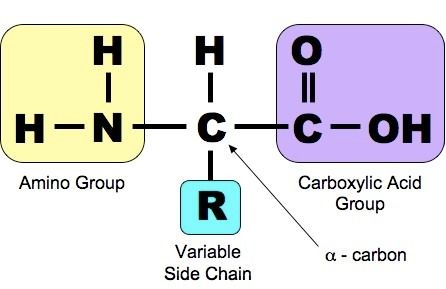
- Central carbon atom (alpha-carbon) linked to an amino group, a carboxylic group, a hydrogen atom and a R group (variable group)
- Chiral
- Can exist in two mirror-image forms
- L and D isomers
- L isomer has amino group on left side
- Only L amino groups are constituents of proteins probably because are more soluble
- D isomer has amino group on right side
- L isomer has amino group on left side
- L and D isomers
- Can exist in two mirror-image forms
Dipolar ions or zwitterions
- Amino acids at neutral pH
- Amino group is protonated (-NH3+)
- Carboxyl group (-COO-) is deprotonated
- Ionisation sates of an amino acid depends on pH
In acidic solution
- amino acid group(-NH3+)
- carboxyl group (-COO-) is deprotonated
In basic solution
- carboxyl group tends to be the first group to give up its proton as it has a low pKa (approx . 2)
- The dipolar form persists until pH = 9 where the protonated amino group loses a proton
Functional groups
- include alcohols, thios, thioesters, carboxylic acids, carboxamides and various basic groups
- Most are chemically reactive and account for protein function
- Size, shape, charge, hydrogen bonding capacity, hydrophobic character, chemical reactivity
- Reactive properties of functional groups are essential to enzymes
- Proteins can interact with one another and with their biological macromolecules which have more complex functions
- Proteins differ in their rigidity/ flexibility and this plays a role into function (think cytoskeleton vs. connective tissue)
Imagens e arquivos do mapa
Informações
- Descrição
- O usuário eliminou as informações de disciplina Mapa Mental sobre Th1L03 Amino acids, criado por Usuário eliminado em 26-08-2016.
- Criado por
- Usuário eliminado · ago 2016
- Atualizado
- 27 ago 2016
- Visualizações
- 31
- Histórico
-
- Criado por Emma Allde · 15 ago 2016
- Copiado por Emma Allde · 26 ago 2016
- Avaliação