
Mapa mental
Th1L04: Peptide, Covalent and Non-Covalent Bonds
Conteúdo do mapa
Th1L04: Peptide, Covalent and Non-Covalent Bonds
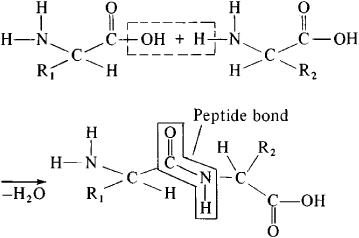
Peptide bonds
- Also called amide bonds
- Formed via dehydration synthesis
- Requires energy making it kinetically stable but slow
- Bonds are rigid due to short length
- Also remain unbranched
- Do not rotate
- Trans arrangment possible
- Planar
- Six atoms aligned
- Dipeptides
- A few naturally occurring examples
- Aspartame (asp-phe): artificial sweetener
- Tripeptide
- Glutathione (glu-cys-gly): natural antioxidant
- Polypeptide
- Each amino acid unit is called a residue
- Amino acid end at the beginning of the chain is called the amino-terminal residue (N-terminal)
- Amino acid at the end of the chain carboxyl-terminal (C-terminal) residue
- Rich in hydrogen bonding potential
- Each residue contains a carbonyl group (hydrogen-bond acceptor)
- except for proline, and an NH group, which a good hydrogen-bond donor
- Short (10-40 aa)
- Hormones, NTs
- Large (<44 aa)
- Proteins
- Large protein (50 - 2,000 aa)
- Dystrophin (3684 AAs)
- Titin which is 27,000 amino acids, a muscle protein
- Each amino acid unit is called a residue
- Uncharged, allowing polymers of amino acids to form tightly packed globular structures
- Proteins fold in such a way that to minimise contact with an aqueous environment
- These are hydrophobic regions of the protein
- Unable to form hydrogen bonds
- These are hydrophobic regions of the protein
Covalent bonds
- Partial dipoles
- Nuclei of the hydrogen atoms naturally repel when close together because they are both positively charged at certain distance away from each other there is a slight dipole attraction that strengthens the bond that requires very low energy
- Disulphide bridges
- join cysteines together forming a subunit
- e.g. insulin
- join cysteines together forming a subunit
- Partial dipoles
Non-covalent bonds
- Hydrogen bonds
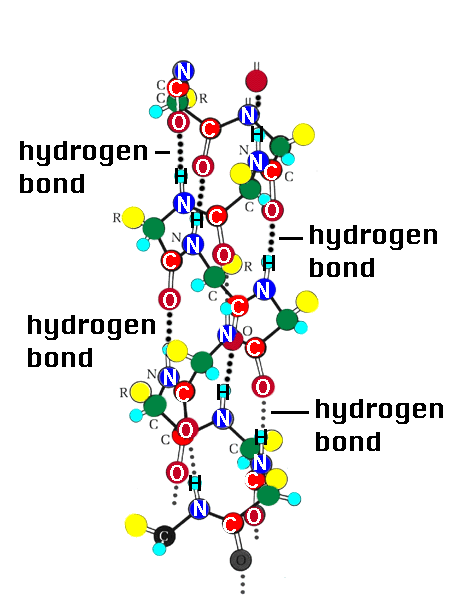
- Peptides can from hydrogen bonds with other polar groups (including peptide bonds) in a polypeptide chain
- e.g. alpha helix
- Responsible for specific base-pairs
- Hydrogen-bond donor
- Hydrogen-bond acceptor
- Atom less tightly linked to hydrogen atom
- Will have a partial negative charge
- e.g. Trp, His
- Longer and straighter than covalent bonds
- Low energy
- Peptides can from hydrogen bonds with other polar groups (including peptide bonds) in a polypeptide chain
- Weaker than covalent bonds
- Roles
- Responsible for maintaining the tertiary structures of proteins
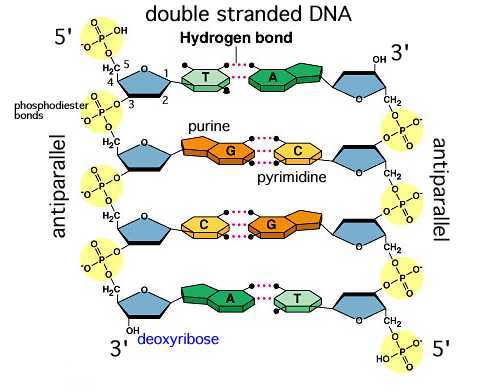
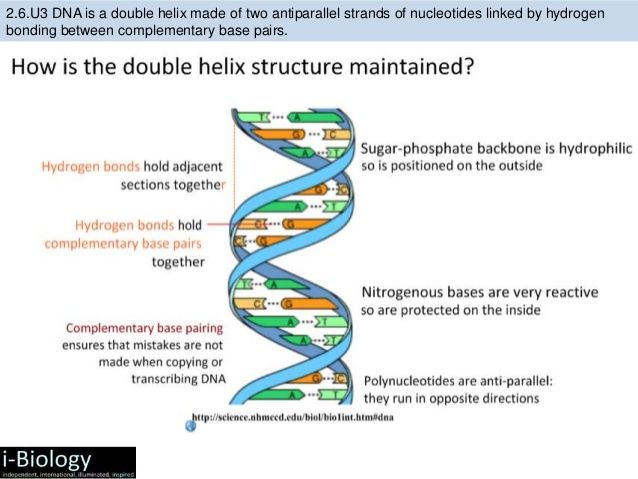
- Crucial for biochemical processes such as the formation of the double helix
- Electrostatic interactions
- A charged group on one molecule can attract an oppositely charged group on another molecule
- Polarity and solvent have a major effect of dielectric constant and thus on the strength of the interaction
- Usually more attractive interactions have more negative energy
- Energy given by Coulomb's law
- Energy = proportions(charges of the two atoms)/distance(dielectric constant
- A charged group on one molecule can attract an oppositely charged group on another molecule
- van der Waals
- The distribution of electronic charge around an atom fluctuates with time
- Charge distribution is never perfectly symmetric resulting in a complementary asymmetry in the electron distribution within its neighbouring atoms so they attract one another
- Result is that atoms come closer to one another until they are separated by van der Waals constant distance where stronger repulsive forces become dominant (outer electron clouds overlap)
- A large number of VDW forces can become substantial
- Base stacking and associated van der Waals interactions are nearly optimal in double-helical structure
- Hydrogen bonds
Imagens e arquivos do mapa
Informações
- Descrição
- O usuário eliminou as informações de disciplina Mapa Mental sobre Th1L04: Peptide, Covalent and Non-Covalent Bonds, criado por Usuário eliminado em 26-08-2016.
- Criado por
- Usuário eliminado · ago 2016
- Atualizado
- 27 ago 2016
- Visualizações
- 40
- Histórico
-
- Criado por Emma Allde · 15 ago 2016
- Copiado por Emma Allde · 26 ago 2016
- Avaliação