
Flashcards
Th2L02 DNA damage and mutations
Flashcards do conjunto (42)
- 1What are the 3 forms of induced mutation and what are their main mechanisms of actionPhysical (ionising radiation) ( single or double strand breaks), UV light (causes thymine dimers) and chemical (agents that react with nuclear bases)
- 2What is UV-C (180-290 nm)Light found in daylight as it is absorbed by the ozone layer; the most energetic and lethal
- 3What is UV-B (290-320 nm)The major mutagenic fraction of sunlight
- 4What is damage causes by UV irradiationchemical bonds between adjacent thymines distorting DNA and causing problems during DNA replication, often resulting in point mutations
- 5What is Nitrous acid an example ofChemical agent that results in (CG > TA) point mutation
- 6What is Alkylating agents an example ofChemical agent that results in guanine modification, GC > AT
- 7What are Free radicals examples of (strand breaks and base modification)Chemical agent
- 8What are free radicals○ Unstable, highly-reactive molecules created during normal metabolism and in response to environmental factors
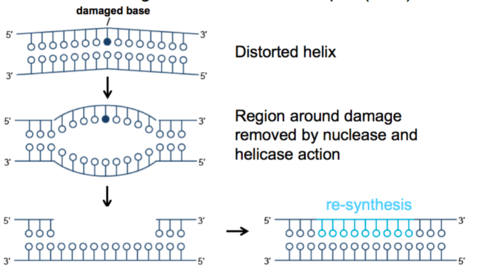
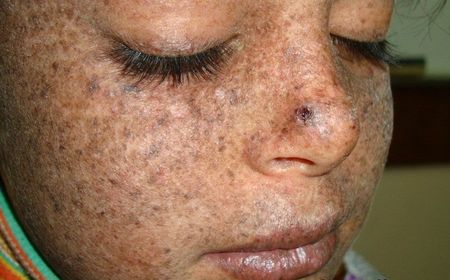
○ May play a role in the development of cancer, cardiovascular disease, and other diseases of aging by reacting with and damaging DNA and other parts of cells. - 9What is Xeroderma pigmentosum (XP)a mutation that results in defects in a single strand nucleotide excision repair (NER) gene (XP-D), which prevents repair of thymidine dimers as it encodes for helicase required for NER
- 10What are the symptoms of Xeroderma pigmentosum (XP)Dry skin w/ melanoma and other cancers by about 1000x ("children of the night")
- 11What are the general characteristics of cancer cellsDo not grow old and die
No reproductive limit - 12How many mutations are sufficient to turn healthy somatic cell to a cancerous cell To the point where DNA polymerase will not recognise mutated strand5-6 mutations
- 13How many (%) of human primary tumours test positive for telomerase activity85%
- 14What kind of point mutations are there (4)• Silent (synonymous)
• Missense (non-synonymous)
• Nonsense
• Indels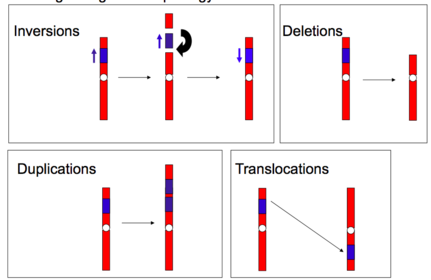
- 15What is a silent mutationa single point mutation that doesn't change the coded amino acid
e.g. CGA (Arg) -> CGG (Arg) - 16What is a missense (non-synonymous)a single point mutation that DOES change the coded amino acid
e.g. Sickle cell anaemia (GAG (Glu) > GTG (Val))
N-Ras (CAA (Gln) > CAC (His)) - 17What is a nonsense mutationa single point mutation that does not coded for an amino acid e.g. a STOP or START codon instead where there shouldn't be one
TGC (amino acid codon) > TGA (stop codon) resulting in trunkated polypeptides - 18What are indels (mutations)small scale insertions and deletions
- 19What kind of indels exist (2)Insertions/deletions with multiple of 3 that maintain of reading frame
Insertions/deletions NOT with multiple of 3 - 20loss of 508th codon in CFTR > cystic fibrosis when homozygous is an example of what kind of mutationInsertions/deletions with multiple of 3 that maintain of reading frame
- 21Which mutation results in frame shifts resulting in non-native polypeptides which can be catastrophicInsertions/deletions NOT with multiple of 3
- 22What is Huntington's disease an example ofSerious consequences of small scale insertion/deletion
namely:
Trinucleotide CAG (glutamine) repeat on huntingtin gene (from 10-34) to (36-121) > neuronal decay - 23What happens as a result of loss of 32bp in CCR5Individuals homozygous for change in 32 CCR5 allele are resistant to HIV-1
- 24What is CCR5The binding receptor HIV goes for on macrophage
- 25What is cri du chatA chromosomal deletion in chromosome 5p that results in children who are mentally retarded, have small heads, and have a cry that sounds like a loud cat
The children die at a young age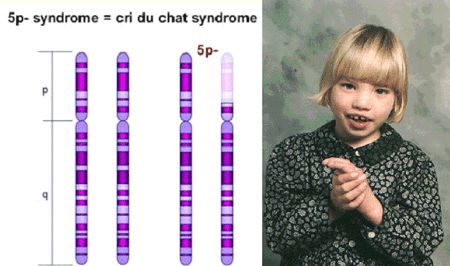
- 26What is Chronic myelogenous leukaemia (CML)A genetic disease due to translocation where a portion of chromosome 22 gets swapped with a piece of chromosome 9 resulting in a Philadelphia Chromosome
Its a cancer affecting white blood cells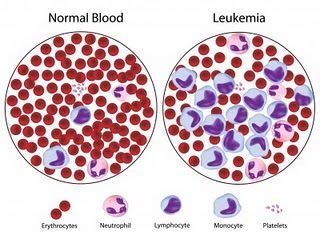
- 27What are the 3 examples of spontaneous mutation- errors in DNA replication which escape proofreading and repair mechanisms
- replication slippage
- deamination - 28What is replication slippageGain of repeats - reverse slippage
Loss of repeats - forward slippage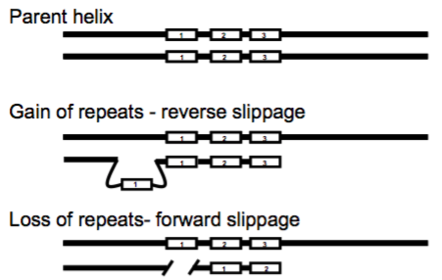
- 29What is deamination○ The removal of an amino group from an organism, particularly from an amino acid
○ C will then pair with A and A will then pair with C, e.g.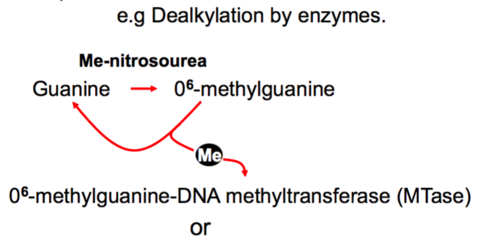
- 30What causes human immunodeficiency virus (HIV)an
enveloped RNA retrovirus infects CD4 T cells and uses the enzyme reverse transcriptase to mediate synthesis of proviral DNA which integrates into the host cell genome - 31What do CD4 T cells doRecognises and binds to MHC II antigens and helps stabilise the binding of antigenic determinants to T cell receptor
- 32What do the high mutations rate of HIV genome result indrug resistant viruses
- 33What do early HIV symptoms resembleInfluenza:
Fever
Chills
Rash
Night sweats
Muscle aches
Sore throat
Fatigue
Swollen lymph nodes
Mouth ulcers - 34What does Azidothymidine (AZT) doInhibits multiplication of HIV and other retroviruses by blocking reverse transcription and production of virally encoded DNA
- 35What is the main issue with Azidothymidine (AZT)Eventually patients stopped responding to treatment
- 36What is the HIV mutation rate10^-3 per base
One of the highest of any virus (or anything else) observed to date
1 x 10^6 faster than human genome - 37What is the typical mutation rate of a eukaryotic genome10^-9 per base
- 38What is reverse transcriptaseAn DNA polymerase enzyme encoded by some certain viruses (retroviruses) that uses RNA as a template for DNA synthesis
- 39What features of reverse transcriptase make it so lethal (2)• More error prone their other nucleic acid polymerases
• Does not possess an exonuclease 3' to 5' so does not have any proofreading capacity - 40What is Acute myeloid leukaemia• A cancer of the blood in which a person produces faulty white blood cells
• Immature white blood cells are overproduced and they crowd the bone marrow and cause it not to make normal blood cells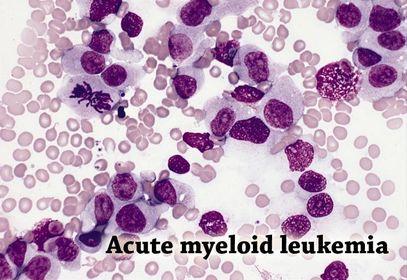
- 41What do all forms of AML have in commonthe same 9 mutations
- 42Which genes are mutated in AML (3)oncogenes, tumour suppressors and novel genes
Informações
- Descrição
- O usuário eliminou as informações de disciplina FlashCards sobre Th2L02 DNA damage and mutations, criado por Usuário eliminado em 26-08-2016.
- Criado por
- Usuário eliminado · ago 2016
- Atualizado
- 27 ago 2016
- Visualizações
- 23
- Histórico
-
- Criado por Emma Allde · 21 ago 2016
- Copiado por Emma Allde · 26 ago 2016
- Avaliação