
Quiz
Biology Chapter 10 Review - ABeka
Este quiz tem tipos de pergunta que abrem no player de sempre.
Perguntas do quiz (23)
1The 3 primary organs of the cardiovascular system are: (think about what the word means.... cardio + vascular)
- Aheart
- Blungs
- Cblood vessels
- Dblood
2What are the three categories of blood proteins and their functions?
1.) [blank_start]albumin[blank_end] – regulates the amount of water in the blood.
2.) [blank_start]globulins[blank_end] – help transport fats throughout the body and helps fight infections.
3.) [blank_start]fibrinogen[blank_end] - involved in blood clotting- Aalbumin
- Bglobulins
- Cfibrinogen
- Daluminium
- Efiber
3Describe the functions of the different types of blood cells:
1.) [blank_start]Red blood cells[blank_end] carry oxygen.
2.) [blank_start]White blood cells[blank_end] produce antibodies and help fight infections.
3.) [blank_start]Platelets[blank_end] initiate blood clotting. They start the blood-clotting process.- ARed blood cells
- BWhite blood cells
- CPlatelets
4What are the four basic types of blood in the ABO group?
- AA
- BB
- CC
- DAB
- EO
5The plural of atrium is [blank_start]atria[blank_end].
The function of the atria is to ensure that the thick-walled ventricles are fully inflated with blood.
The atria send blood [blank_start]to the ventricles[blank_end].
The function of the ventricles is to force blood out of the heart and through the blood vessels to the rest of the body.
The ventricles send blood [blank_start]out of the heart[blank_end] to the body.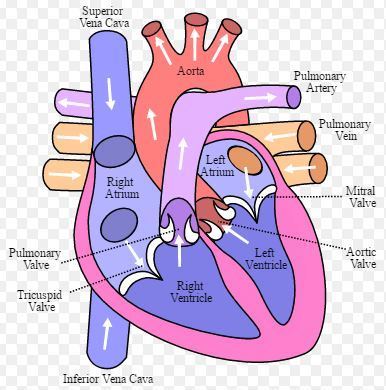
- Aatria
- Bto the ventricles
- Cout of the heart
6There are four valves of the heart.
The [blank_start]bicuspid (mitral) valve[blank_end] connects the left atrium and left ventricle.
The [blank_start]tricuspid valve[blank_end] connects the right atrium and the right ventricle.
The [blank_start]aortic semilunar valve[blank_end] allows blood to exit the left ventricle and enter the aorta.
The [blank_start]pulmonary semilunar valve[blank_end] allows blood to exit the right ventricle and enter the pulmonary artery.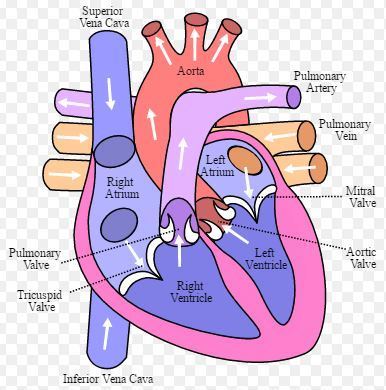
- Abicuspid (mitral) valve
- Btricuspid valve
- Caortic semilunar valve
- Dpulmonary semilunar valve
7These are the functions of the liver.
It [blank_start]cleanses[blank_end] the blood...
It [blank_start]destroys[blank_end] bacteria...
It [blank_start]stores[blank_end] carbohydrates as glycogen...
It [blank_start]produces[blank_end] several blood proteins...
It [blank_start]supplies[blank_end] the body cells with food when food supplies run low...- Acleanses
- Bdestroys
- Cstores
- Dproduces
- Esupplies
8Hypertension means high blood pressure.
- AVerdadeiro
- BFalso
9The leading cause of [blank_start]death[blank_end] in the US is [blank_start]cardiovascular disease[blank_end].
- Adeath
- Bcardiovascular disease
- Cautomobile accidents
10Five habits that can lead to heart disease later in life.
- Aobesity
- Black of exercise
- Cregular exercise
- Demotional stress
- Eeating a high fiber diet
- Fsmoking (nicotine)
- Galcohol abuse
11The structure that prevents food from entering the lungs is the [blank_start]epiglottis[blank_end].
- Aepidermis
- Bepiglottis
- Cuvula
12Common respiratory diseases and their causes:
1.) [blank_start]pneumonia[blank_end] - caused by bacterial or viral infections of the lining of the lungs
2.) tuberculosis - caused by a slow-growing bacteria that infects the lungs
3.) bronchitis - caused by an infection or from smoking.
4.) [blank_start]pleurisy[blank_end] - an inflammation of the pleura - can result from smoking
5.) bronchial asthma - caused bby allergies
6.) influenza- caused by viruses that infect the respiratory system
7.) [blank_start]common cold[blank_end] - caused by more than a hundred different types of viruses- Apneumonia
- Bpleurisy
- Ccommon cold
13[blank_start]Excessive blood loss[blank_end] can cause a person's blood pressure to fall to a [blank_start]critical low[blank_end] (a condition known as shock). The reduced blood flow deprives the heart of needed [blank_start]fuel and oxygen[blank_end].
- AExcessive blood loss
- Bcritical low
- Cfuel and oxygen
14[blank_start]Mismatched[blank_end] blood transfusions are dangerous because a person's [blank_start]immune system[blank_end] will attack blood cells it recognizes as foreign, with potentially [blank_start]fatal[blank_end] results.
- AMismatched
- Bimmune system
- Cfatal
15Describe the path of blood through the circulation process - beginning with the vena cava and ending with the aorta.
1.) Oxygen-depleted Blood enters the heart via the [blank_start]Vena Cava[blank_end]
2.) into the Right Atrium
3.) through the [blank_start]Tricuspid Valve[blank_end]
4.) into the Right Ventricle
5.) through the [blank_start]Pulmonary Valve[blank_end]
6.) Oxygen-depleted Blood exits the heart through the Pulmonary Arteries
7.) into the Lungs
8.) Oxygen-rich Blood enters the heart via the Pulmonary Veins
9.) into the Left Atrium
10.) through the [blank_start]Mitral Valve[blank_end]
11.) into the Left Ventricle
12.) through the [blank_start]Aortic Valve[blank_end]
13.) Oxygen-rich Blood exits the heart via the [blank_start]Aorta[blank_end]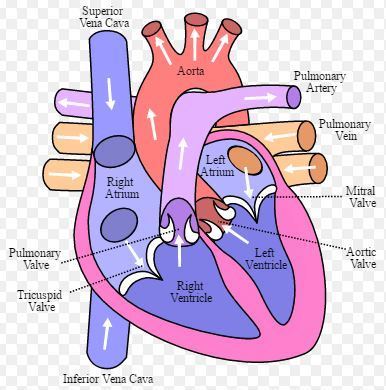
- AVena Cava
- BTricuspid Valve
- CPulmonary Valve
- DMitral Valve
- EAortic Valve
- FAorta
16Cardiac muscle vs. Skeletal muscle
Cardiac muscle cells are connected by intercalated disks, allowing them to [blank_start]contract as a unit.[blank_end]
Cardiac muscle cells lack the fuel and oxygen storage systems of skeletal muscle cells to make [blank_start]room for more mitochondria[blank_end] "power plants".
This feature allows cardiac muscle cells to [blank_start]generate large amounts of power[blank_end] for long periods [blank_start]without becoming tired[blank_end].
Cardiac muscle cells are [blank_start]self-stimulating[blank_end], allowing the heart to continue beating even if it is [blank_start]disconnected[blank_end] from the nervous system.- Acontract as a unit.
- Broom for more mitochondria
- Cgenerate large amounts of power
- Dwithout becoming tired
- Eself-stimulating
- Fdisconnected
17External vs. Internal vs. Cellular respiration
[blank_start]External[blank_end] respiration is breathing (inhaling and exhaling).
[blank_start]Internal[blank_end] respiration is the exchange of oxygen and carbon dioxide between the blood cells and the tissue cells.
[blank_start]Cellular[blank_end] respiration is the process of releasing energy by combining oxygen and food molecules within the cells.- AExternal
- BInternal
- CCellular
18Describe the structure and function of the lungs.
The lungs consist of bronchial tubes that end in small saclike structures called [blank_start]alveoli[blank_end].
Each alveolus is a microscopic, thin-walled structure surrounded by a network of [blank_start]capilaries[blank_end].
The design of the alveoli allows molecules of gases to pass freely through the membranes by [blank_start]diffusion[blank_end].
[blank_start]Oxygen[blank_end] molecules diffuse easily into the bloodstream through the thin walls of both the alveoli and the capillaries.
[blank_start]Carbon dioxide[blank_end] and water vapor diffuse just as easily from the bloodstream into the air sacs.- Aalveoli
- Bcapilaries
- Cdiffusion
- DOxygen
- ECarbon dioxide
19How is spech produced?
Speech is produced when [blank_start]air[blank_end] is forced out of the lungs and passes over the [blank_start]vocal cords[blank_end], producing steady sounds.
These tones are modified into articulate speech by the mouth, throat, [blank_start]nasal cavity, and tongue[blank_end].- Aair
- Bvocal cords
- Cnasal cavity, and tongue
20The brain regulates your heart rate and breathing rate.
Heart and breathing rates are regulated by the [blank_start]autonomic nervous system[blank_end] and controlled by the [blank_start]medulla oblongata[blank_end] of the brain stem.
Heart rate is regulated by signals that are transmitted rom the brain to the [blank_start]sino-atrial (S-A) node[blank_end], via the accelerator nerves and the vagus nerves.
The S-A node is the heart's [blank_start]pacemaker[blank_end].
Breathing rate is controlled by impulses sent from the [blank_start]brain[blank_end] to the diaphragm and chest muscles when it is time to inhale and exhale.
The breathing rate is sped up when the brain detects a high concentration of [blank_start]carbon dioxide[blank_end].- Aautonomic nervous system
- Bmedulla oblongata
- Csino-atrial (S-A) node
- Dpacemaker
- Ecarbon dioxide
- Fbrain
21Why are red blood cells [blank_start]dismantled[blank_end] by the spleen and liver instead of continually [blank_start]repairing[blank_end] themselves as most other cells do?
Red blood cells [blank_start]cannot[blank_end] repair themselves because they do not have [blank_start]nuclei[blank_end].- Anuclei
- Bdismantled
- Crepairing
- Dcannot
22During a heart transplant procedure, the nerves to the heart are not always reattached.
How can the donated heart beat without being connected to the brain?
The sinoatrial node and the [blank_start]self-stimulating property[blank_end] of cardiac muscle allow the heart to continue beating [blank_start]without[blank_end] being connected to the [blank_start]nervous system[blank_end].- Aself-stimulating property
- Bwithout
- Cnervous system
23Normal inhalation at rest is considered an [blank_start]active[blank_end] process, but normal exhalation at rest is considered a [blank_start]passive[blank_end] process.
Why?
Expanding the thoracic cavity to inhale requres [blank_start]actively contracting[blank_end] the intercostal muscles and diaphragm.
Shrinking the thoracic cavity to exhale occurs when these muscles [blank_start]relax[blank_end]; there are no muscles that pull the chest back to a smaller position.
Although not mentioned in the text, muscle contraction is involved in [blank_start]forced[blank_end] exhalation, such as [blank_start]coughing[blank_end], sneezing, and exhalation during strenuous exercise.- Aactive
- Bpassive
- Cactively contracting
- Drelax
- Eforced
- Fcoughing
Informações
- Descrição
- Questions at the end of the Chapter, ABeka
- Autor
- Kelda Brenny
- Idioma
- English
- Visualizações
- 376
- Histórico
- Criado em 5 nov 2016 · atualizado em 18 jan 2017
- Etiquetas
- Avaliação
- Ainda sem avaliações Avalie este quiz