
Mapa mental
AS Chemistry Bonding and Structure
Conteúdo do mapa
AS Chemistry Bonding and Structure
Ionic Bonding
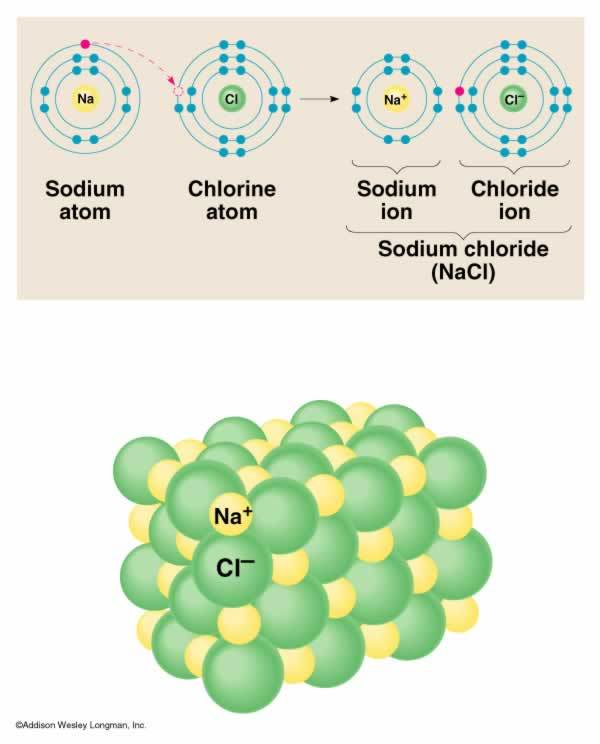
- Electrostatic attraction between two oppositely charged ions.
- Giant Ionic Lattice
- High melting and boiling point due to strong ionic bonds.
- In solid state, it does not conduct electricity because the ions are in a fixed position.
- In melted or molten state, it conducts electricity because the lattice breaks down and the ions are free to move.
- Dissolves in polar solvents.
- When NaCl is dissolved in water, the water molecules attract Na+ and Cl- ions. The water molecules surround the ions. Na+ attracts delta negative charges on the Oxygen atoms and Cl- attracts the delta positive charges on the Hydrogen atoms.
- A three dimensional structure held together by electrostatic attraction between oppositely charged ions.
Covalent Bonding
- Simple Molecular Structure
- In a solid, molecules are held together by weak Van Der Waals' forces between molecules, the atoms within each molecule are bonded together strongly by covalent bonds.
- Low melting and boiling point because there are weak Van Der Waals' forces and you only need a small amount of energy to break them.
- They do not conduct electricity because there are no free moving charged particles.
- Soluble in non polar molecules such as Hexane.
- A three dimensional structure of molecules, bonded together by weak intermolecular forces.
- Giant Covalent Lattice
- Held together by strong covalent bonds, no forces as no defined molecule.
- Diamond, Graphite and Silicon Dioxide are examples.
- High melting and boiling points because high temperatures are needed to break the strong covalent bonds in the lattice.
- It does not conduct electricity because there are no free moving, charged particles.
- They are completely insoluble as the bonds are too strong to be broken by polar and non polar solvents.
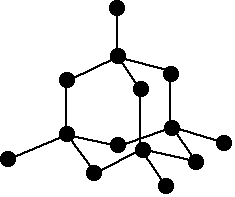
- Diamond
- Tetrahedral structure held together by strong covalent bonds throughout the lattice
- No conductivity as there are no delocalised electrons.
- Hard because the tetrahedral shape allows the external forces to be spread throughout the lattice.
- No conductivity as there are no delocalised electrons.
- Tetrahedral structure held together by strong covalent bonds throughout the lattice
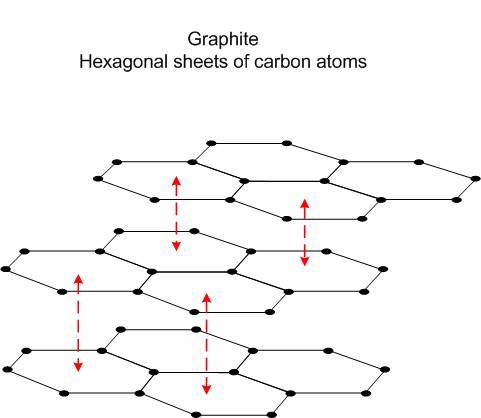
- Graphite
- Strong hexagonal layered structure with Van der Waals forces between the layers
- Because there are delocalised electrons between layers, there is good conductivity.
- Bonding within each layer is strong but weak forces between the layers allow the layers to slide easily.
- Because there are delocalised electrons between layers, there is good conductivity.
- Strong hexagonal layered structure with Van der Waals forces between the layers
- A shared pair of electrons
- Simple Molecular Structure
Metallic Bonding
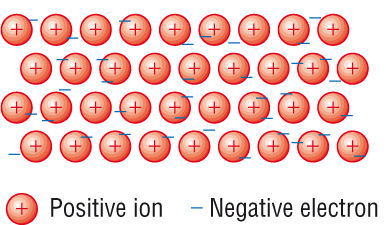
- Electrostatic attraction between positive metal ions and delocalised electrons.
- Delocalised electrons are shared between more than two atoms.
- Giant Metallic Lattice
- High melting and boiling points, the electrons are free to move throughout the structure by the postiive ions remain in place. They are needed to break the bond and dislodge the ion from its rigid position.
- The delocalised electrons can move freely so the metal can conduct electricity even in solid state.
- Ductile means stretchy, and this allows the metal to be drawn into wires.
- Malleable means hammered into shape, metals can be pressed into shapes or hammered into thin sheets.
- They are soft because the delocalised electrons can move, this allows layers to slide past each other
- Alloys
- Mixture of metals; they press freely together by do not become a compound because they can mix in different proportions.
Imagens e arquivos do mapa
Informações
- Descrição
- O usuário eliminou as informações de disciplina Mapa Mental sobre AS Chemistry Bonding and Structure, criado por Usuário eliminado em 30-11-2016.
- Criado por
- Usuário eliminado · nov 2016
- Atualizado
- 1 dez 2016
- Visualizações
- 27
- Histórico
-
- Criado por awesome.lois · 13 nov 2014
- Copiado por Tariq hudda · 30 nov 2016
- Avaliação