
Notas
Longitudinal and Transverse Waves
Conteúdo das notas (2)
Página 1
Transverse Waves Vibrate at Right Angles to the direction of Energy Transfer

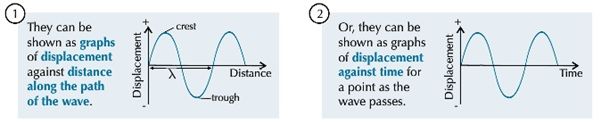
All electromagnetic waves are transverse. They travel as vibrations through magnetic and electric fields - with vibrations perpendicular to the direction of energy transfer. Ripples on water are a type of transverse wave.
Transverse waves may be expressed in two common ways:
Longitudinal Waves Vibrate Along the Direction of Energy Transfer
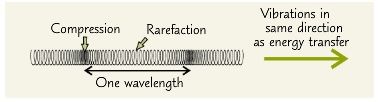
The most common example of a longitudinal wave is sound waves. A sound wave consists of alternate compressions and rarefactions of the medium it's travelling through. Seismic shocks are also a type of longitudinal wave. When represented graphically, the motion and displacement of a longitudinal wave will resemble that of a transverse wave.
A Polarised Wave Only Oscillates in One Direction
Polarisation is the filtering of waves resulting in oscillation only in one direction. Polarisation may only occur for transverse waves.
Página 2
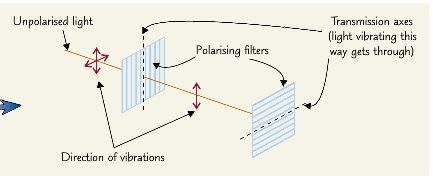
Polarising Filter Only Transmit Vibrations in One Direction
Ordinary light waves are a mixture of different directions of vibration (such as electric and magnetic fields). They are able to be polarised using a polarising filter.
If the two polarising filters are perpendicular to eachother, no light gets through
Light becomes partially polarised when reflected from some surfaces - some of it vibrates in the same direction
If partially polarized light is observed at the correct angle, unwanted glare can be blocked out. Polaroid glasses especially make
Television and Radio Signals are Polarised
TV signals are polarised by the orientation of the rods on the broadcasting aerial. To receive a strong signal, the rods on the receiving aerial must be aligned with those on the transmitting aerial. The same principle can be applied to radio antennae.
Polarisation is Evidence that Electromagnetic waves are Transverse
In 1808, Etienne-Louis Malus discovered that light was polarised by reflection. Physicists at the time thought that light spread like sound, as a longitudinal wave, and so struggled to explain polarisation. In 1817, Young suggested light was a transverse wave consisting of vibrating electric and magnetic fields at right angles to the transfer of energy.
Informações
- Descrição
- A2 Physics (Waves) Notas sobre Longitudinal and Transverse Waves, criado por Leonie Jenkins em 06-01-2017.
- Criado por
- Leonie Jenkins · jan 2017
- Atualizado
- 7 jan 2017
- Visualizações
- 14
- Avaliação