
Flashcards
268 & 269 - Heart Embryology & Morphogenesis
Flashcards do conjunto (46)
- 1What does the following embryonic structure give rise to? Truncus arteriosusAscending aorta and pulmonary trunk
- 2What does the following embryonic structure give rise to? Bulbus cordisSmooth parts (outflow tract) of left and right
ventricles - 3What does the following embryonic structure give rise to? Endocardial cushionAtrial septum, membranous interventricular
septum; AV and semilunar valves - 4What does the following embryonic structure give rise to? Primitive atriumTrabeculated part of left and right atria
- 5What does the following embryonic structure give rise to? Primitive ventricleTrabeculated part of left and right ventricles
- 6What does the following embryonic structure give rise to? Primitive pulmonary veinSmooth part of left atrium
- 7What does the following embryonic structure give rise to? Left horn of sinus venosusCoronary sinus
- 8What does the following embryonic structure give rise to? Right horn of sinus venosusSmooth part of right atrium (sinus venarum)
- 9What does the following embryonic structure give rise to? Right common cardinal vein and right anterior cardinal veinSuperior vena cava (SVC)
- 10What embryonic structure gives rise to the following? Ascending aorta and pulmonary trunkTruncus arteriosus
- 11What embryonic structure gives rise to the following? Smooth parts (outflow tract) of left and right ventriclesBulbus cordis
- 12What embryonic structure gives rise to the following? Atrial septum, membranous interventricular septum; AV and semilunar valvesEndocardial cushion
- 13What embryonic structure gives rise to the following? Trabeculated part of left and right atriaPrimitive atrium
- 14What embryonic structure gives rise to the following? Trabeculated part of left and right ventriclesPrimitive ventricle
- 15What embryonic structure gives rise to the following? Smooth part of left atriumPrimitive pulmonary vein
- 16What embryonic structure gives rise to the following? Coronary sinusLeft horn of sinus venosus
- 17What embryonic structure gives rise to the following? Smooth part of right atrium (sinus venarum)Right horn of sinus venosus
- 18What embryonic structure gives rise to the following? Superior vena cava (SVC)Right common cardinal vein and right anterior cardinal vein
- 19What is the first functional organ in vertebrate embryos?Heart
- 20When does the heart first begin beating?First functional organ in vertebrate embryos; beats spontaneously by week 4 of development
- 21Heart Morphogenesis What is Cardiac looping?Primary heart tube loops to establish left-right polarity
- 22Heart Morphogenesis When does Cardiac looping begin?Begins in week 4 of gestation.
- 23Heart Morphogenesis Defect in left-right dynein (involved in L/R asymmetry) can lead to what?Defect in left-right dynein (involved in L/R
asymmetry) can lead to dextrocardia, as seen in Kartagener syndrome (primary ciliary dyskinesia). - 24Heart Morphogenesis What defect can lead to dextrocardia, as seen in Kartagener syndrome (primary ciliary dyskinesia).Defect in left-right dynein (involved in L/R
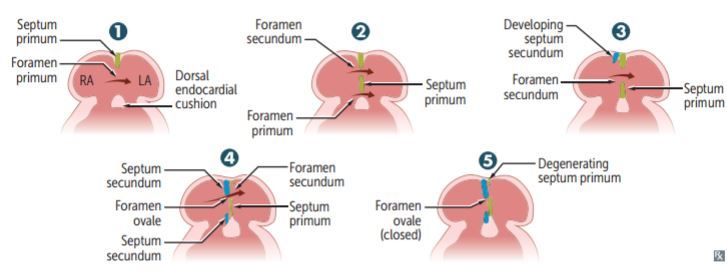
asymmetry) can lead to dextrocardia, as seen in Kartagener syndrome (primary ciliary dyskinesia). - 25Explain 1Atria
Septum primum grows toward endocardial
cushions, narrowing foramen primum. - 26Explain 2Atria
Foramen secundum forms in septum
primum (foramen primum disappears) - 27Explain 3Atria
Septum secundum develops as foramen
secundum maintains right-to-left shunt. - 28Explain 4Atria
Septum secundum expands and covers most of the foramen secundum. The residual foramen is the foramen ovale. - 29Explain 5Atria
Remaining portion of septum primum forms valve of foramen ovale. - 30Explain 6 and 7 (Not shown)6. (Not shown) Septum secundum and septum primum fuse to form the atrial septum.
7. (Not shown) Foramen ovale usually closes soon after birth because of q LA pressure. - 31What is Patent foramen ovale caused by?Caused by failure of septum primum and septum secundum to fuse after birth; most are left untreated.
- 32What is caused by caused by failure of septum primum and septum secundum to fuse after birth?Patent foramen ovale
(most are left untreated) - 33What can lead to paradoxical emboli (venous thromboemboli that enter systemic arterial circulation), similar to those resulting from an ASD?Patent foramen ovale
- 34What can Patent foramen ovale lead to?Can lead to paradoxical emboli (venous
thromboemboli that enter systemic arterial
circulation), similar to those resulting from
an ASD. - 35Explain 1Ventricles
Muscular interventricular septum forms.
Opening is called interventricular foramen.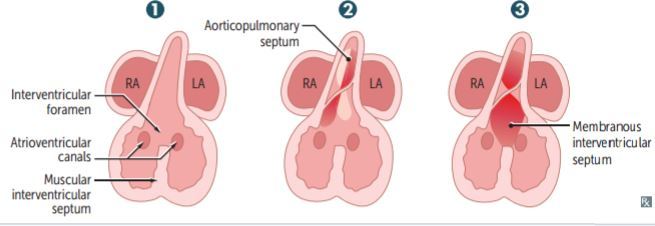
- 36Explain 2Ventricles
Aorticopulmonary septum rotates and fuses with muscular ventricular septum to form membranous interventricular septum, closing interventricular foramen - 37Explain 3Ventricles
Growth of endocardial cushions separates atria from ventricles and contributes to both atrial septation and membranous portion of the interventricular septum. - 38What is a ventricular septal defect?Most common congenital cardiac anomaly, usually occurs in membranous septum.
- 39What is the most common congenital cardiac anomaly?Ventricular septal defect
- 40Where does a Ventricular septal defect usually occur?Usually occurs in membranous septum.
- 41How is the Outflow Tract formed?Neural crest and endocardial cell migrations leads to truncal and bulbar ridges that spiral and fuse to form aorticopulmonary septum leading to ascending aorta and pulmonary trunk.
- 42What Conotruncal abnormalities are associated with failure of neural crest cells to migrate? Transposition of great vessels.
Tetralogy of Fallot.
Persistent truncus arteriosus. - 43The following are associated with what? Transposition of great vessels. Tetralogy of Fallot. Persistent truncus arteriosus.Conotruncal abnormalities associated with
failure of neural crest cells to migrate. - 44How does the Aortic/Pulmonary Valve develop?Derived from endocardial cushions of outflow tract
- 45How does the Mitral/tricuspid valve develop?Derived from fused endocardial cushions of the AV canal.
- 46Valvular anomalies may be what? (4 possibilities)Valvular anomalies may be stenotic, regurgitant, atretic (eg, tricuspid atresia), or displaced (eg, Ebstein anomaly)
Informações
- Descrição
- O usuário eliminou as informações de disciplina FlashCards sobre 268 & 269 - Heart Embryology & Morphogenesis, criado por Usuário eliminado em 30-05-2017.
- Criado por
- Usuário eliminado · mai 2017
- Atualizado
- 30 mai 2017
- Visualizações
- 19
- Histórico
-
- Criado por Victoria Wright · 15 mai 2017
- Copiado por Victoria Wright · 30 mai 2017
- Avaliação