
Notas
What is Offsite Construction?
Conteúdo das notas (1)
Página 1
What is Offsite Construction?
The manufacture & pre-assembly before installation on site.
Work is moved from the construction site to the factory.
Offsite is a process which utilises as much of the manufacturing process as possible within the context of the project.
The concept has been around for a long time (1850s: pre-fabricated hospitals in Crime War; The Crystal Palace; Post WWII Prefabs)
The nature and scope of the work will dictate whether offsite construction is suitable.
Prefabrication require more time and effort at the early stages of a project.
The success of prefabricated bathroom pods in the UK has gathered momentum for it's use to meet the growing requirements of the education, health and housing sector in the UK.
It is vital to choose a competent, experienced specialist with appropriate management and quality control procedures in place.
Government is encouraging Modern Methods of Construction and says it can achieve 'a step change in the construction industry to produce the quantity and quality of housing we need'.
The growing interest in MMC has been driven by the increased requirement for more households in the UK.
Currently, 175,000 houses are supplied per year but this will need to rise to 230,000 per year to meet growing demand.
Currently 30 house building factories in the UK capable of producing 30,000 homes per year.
It costs over £10 million to build an MMC factory and train staff.
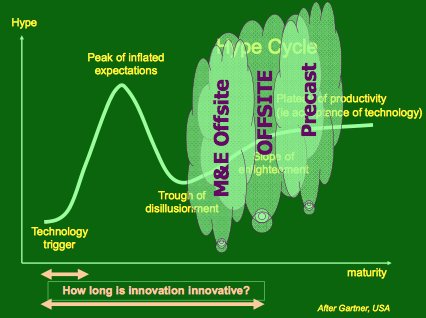
What are the Levels of Offsite?
Level 1: Sub-Assemblies: small-scale elements that are always constructed offsite (i.e. subassemblies)
Level 2: Non-Volumetric: pre-assembled units that do not create useable space. (i.e. pre-assemblies)
Level 3: Volumetric: pre-assembled factory finished units which create useable space & are installed within or onto a building. (i.e. pre-assemblies)
Level 4: Whole Buildings: volumetric units that make up the actual building. (i.e. whole-buildings)
Examples of Level 2 Non-Volumetric Offsite
Timber systems (e.g. SIPS - structural insulated panels) - Case Study: Hackney, London - tallest residential timber building in the world of 9 storeys.
Concrete Systems
Steel Systems
Hybrid Systems
M&E Systems
Brickwork examples
Offsite Level 2 Techniques
Timber structural insulated panels (SIPS) - no onsite carpentry skills required, weatherproof in 1 day & improves safe working conditions.
Concrete PC Frame - pre-engineered panels erected on site to form the box-like structure for finishing.
Flat Pack Whole Buildings - prefabricated 2D elements transported to site rather than in 3D volumetric form, used where volumetric options are not feasible.
Multi-Materials Systems (Glued Masonry Panel) - rarely used with panels of lightweight concrete blocks with glued joints that are fabricated offsite & lifted into position.
Multi-Functional Systems - roof cassettes.
M&E Distribution - ceiling void modules or complete units (e.g. domestic energy centre or integrated plumbing systems - IPS)
Examples of Level 3 Volumetric Offsite
Pods (e.g. bathroom & kitchen)
Plantrooms
Service Risers
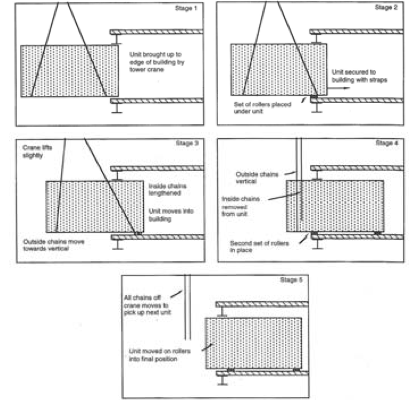
Case Study - Radisson Hotel, Stansted Airport - complete sealed bathroom units delivered to site by low-loader lorry (4 per lorry) and once in position were connected to the power & water to complete the bathrooms before snagging & handover was undertaken.
Examples of Level 4 Whole Buildings
Whole-pre-cast concrete buildings
Steel-based volumetric units that enclose useable space.
Fully finishes either internally, externally or both.
Case Study - Lime Tree School, Manchester - offsite volumetric whole building enabled the school to be constructed in a 20 week programme (400m2 per day).
Examples of Whole Building Offsite Construction
Case Study - Southend Pier Cultural Centre - entire building was preassembled & delivered & installed by barge.
Examples of Infrastructure Offsite
Case Study - Heathrow Control Tower & Stratford High Speed Bridge
Examples of Offsite Engineering Construction
Petro-chemical plants
Power
Oil & gas
Pharma
Process
Extreme Example of Offsite Construction - International Space Station
Transportation Requirements for Offsite Modules
Length Over 30m & Width over 6.1m - must provide 8 weeks notice to Highways Authority, road & bridge authorities & Police
Length 18.75m - 30m - must provide 2 days notice to Police.
Width 5-6.1m - must provide Highways Authority with 10 days notice & the Police with 2 days notice.
Width 3-5m - must provide Police with 2 days notice.
Relocatable Whole-Buildings
Not really considered offsite when the whole building is moveable/portable/transportable.
Multi-Storey Offsite Construction
Concrete volumetric system for multi-storey buildings up to 20 storeys in height.
Concrete is the most viable material for strength and fire safety reasons.
Modules are constructed from lightweight concrete panels.
Maximum width is 4.8m and length of 12m.
A fitted out pod weights approximately 30 tonnes.
Time on site is reduced by up to 80% compared with traditional techniques.
Company is waiting to find a manufacture to license the technology to build a prototype to prove it works in reality.
Biggest barrier is convincing a company to take it on board and bring the product to market.
The Benefits of Prefabrication
Time
Less time on site
Up to 60% faster.
Less time spend on commissioning.
Reduced management time.
Programme certainty with guaranteed deliver dates.
Quality
Higher quality achieved
Better thermal and sound performance.
Products tried and tested in the factory.
Greater consistency and more reproducible
Greater quality control with 80% less snagging and defects.
Ease of maintenance and replacement.
Cost
Lower preliminary and overhead costs.
Improved cash flow.
Increased certainty and less risk.
Reduced abortive work and defects.
Reduced maintenance and whole-life costs.
Added value.
Less on-site damage and wastage.
Productivity
Less snagging.
More success at interfaces.
Less site disruption.
Reduced use of wet trades.
Better control of site activities.
Removes difficult operations onsite.
Products work first time.
No
Work continues independent of local labour issues.
Environmental
Improved energy efficiency.
Up to 80% less energy used on site and 25% less energy in-use.
Up to 90% less waste.
Improved waste and recycling management.
People
Fewer people and up to 60% less traffic movements.
Increased and stable long term employment for local communities.
People know how to use products.
80% improvement in health & safety with fewer site based accidents.
Process
Programme is driven centrally.
Simplifies construction process.
Allows systems to be measured.
Can cope with restricted sites.
Reduces congested work areas and multi-trade interfaces.
Disadvantages of Offsite Construction
Higher initial capital costs.
Poor public acceptability and perceived negative image of it's quality.
Inflexibility in factories in responding to fluctuating demands.
Reasons for Not Using Offsite Construction
Complexity of operation
Quality
Cost
Availability
Design
Safety
Requirements to Realise Benefits of Offsite Construction
Team with good previous experience in offsite.
Adequate site access and available plant.
Sufficient lead in times.
Willingness and ability to freeze design when required.
Willingness and ability to inspect offsite works.
Available manufacturing facility with economical transport distance.
Available time for offsite prototype testing.
Available early construction/manufacturing expertise.
Procurement
Lead in times can be significant for offsite production work.
Lead in times of 20 weeks are not uncommon for toilet pods.
Achieving a design freeze is paramount to success.
Minimum manufacturing time off-site is always required to deliver a product with sufficient quality and build ability.
Future of Offsite
Government is continuing to push the merits of offsite construction.
The intense use of labour in offsite production is creating strong competition from offsite manufacturers in low-wage economies such as Easter Europe.
The larger the order the greater the commercial advantage that can be realised from a low-cost supplier.
Offsite will continue to increase and improve construction efficiency.
Page 1
Page 2
Informações
- Descrição
- Undergraduate Advanced Construction Notas sobre What is Offsite Construction?, criado por d.moran-10 em 22-05-2014.
- Criado por
- d.moran-10 · mai 2014
- Atualizado
- 3 set 2016
- Visualizações
- 84
- Avaliação