
Notas
Nanoscience - Eduqas Comb

Conteúdo das notas (4)
Página 1
Fullerenes
Fullerenes: A group of allotropes of carbon, made up of balls, 'cages' or tubes of carbon atoms
This is a type of fullerene known as a Buckminsterfullerene or 'buckyball'. They can be made with 60, 70,76 or 80 carbon atoms.
Because they have a closed structure, they can be used to entrap other molecules.
This can be useful for:
Carrying drugs for delivery to specific sites in the body
In cosmetics, where they can absorb harmful radicals
Página 2
Carbon Nanotubes
Carbon nanotubes are another type of fullerene.
Molecular-scale tubes of graphite-like carbon.
Among the stiffest and strongest fibres known - due to covalently bonded carbon hexagonal rings
Excellent conductivity - due to free electrons
Current uses:
Atomic force microscopes
Bone-tissue scaffolding
Cancer treatment
To make bulk materials for use in bicycle components and boat hulls
To make bulk materials for use in epoxy-resins for bonding high performance components in wind-turbines and sports equipment
Proposed further uses:
Connections inside miniature electronic circuits

Página 3
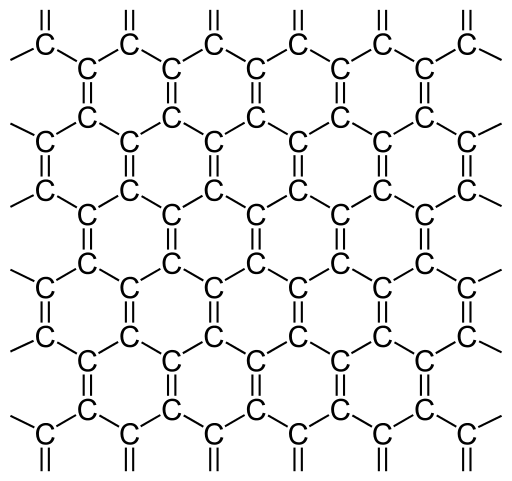
Graphene
Graphene: One layer of the graphite molecule, i.e. a single layer of carbon atoms covalently bonded in a hexagonal honeycomb lattice
Graphene has many extraordinary properties:
Thinnest material known to man - one atom thick
Lighest material known
Strongest material discovered- stronger than steel
Best conductor of heat at room temperature
Best conductor of electricity
Potential uses:
Thin - could be incorporated into printing inks, allowing circuits to be printed onto paper
Very unreactive - could be incorporated into metal paints to stop them rusting
Strong - could be used to replace Kevlar in bulletproof vests
Página 4
Nanoparticles
Nanoparticles: Particles between 1 and 100 nanometers in size. In nanotechnology, a particle is defined as a small object that behaves as a whole unit with respect to its transport and properties.
Nanoparticles sometimes have different properties from their bulk material, because they have a very large surface area for their size compared to normal particles.
Silver nanoparticles
1. Medical uses
Silver is commonly used for its antibacterial properties, particularly to treat external infections
Silver ions irreversibly damage key enzymes in the cell membranes of the microorganisms
Silver nano particles have a much greater anti-bacterial action than normal silver particles, because their tiny size means they can get to places normal particles cannot. They might even be able to enter living cells.
2. Clothes
Silver nanoparticles have been incorporated into the fabric of clothes in order to kill the bacterial build up that causes odours.
Dangers of silver nano particles:
We do not yet fully understand the consequences of using nano particles. There is no direct evidence that they are harmful, but we do not know for certain that they are harmless either. Some scientists are concerned especially by the effect they could have on the environment were they to find their way into delicate ecosystems or municipal waste water systems that depend on bacteria.
The Royal Comission of Environmental Pollution recommended against their use in clothes in 2008.
Informações
- Descrição
- O usuário eliminou as informações de disciplina Notas sobre Nanoscience - Eduqas Comb, criado por Usuário eliminado em 06-07-2017.
- Criado por
- Usuário eliminado · jul 2017
- Atualizado
- 6 jul 2017
- Visualizações
- 15
- Histórico
-
- Criado por Niamh Ryan · 5 jul 2017
- Copiado por Niamh Ryan · 6 jul 2017
- Copiado por Niamh Ryan · 6 jul 2017
- Avaliação