
The 'Golden Age' and Origins of the Nazi Party
Slides do conjunto (11)
-
The Stresemann Years 1924 -1929
- Gustav Stresemann was the German Chancellor from 1923-24 and Foreign Secretary after that. He helped Germany to get back on her feet following World War One leading to a period known as the 'Golden Age' :
- Economic measures: the Rentenmark, the Dawes Plan 1924, the Young Plan 1929
- International relations: the Locarno Treaties 1925 (Germany and France agreed their border), Germany join the League of Nations 1926, sign the Kellogg-Briand Pact 1928 (over 60 nations agreeing not to go to war)
- With more money and foreign goods in Germany, the standard of living rose amongst the population. People began to enjoy leisurely activities and material goods. On the surface, Germany was moving forward successfully. However, underneath Germany was dependent on foreign loans and not growing enough to achieve economic stability.

- Legenda: Gustav Stresemann (1878-1929)
-
- Dawes Plan 1924:
- April 1924, American banker, Charles G. Dawes, unveiled a plan to aid German economic recovery
- A regular schedule for German reparation payments from the Treaty of Versailles was established
- The total reparation payment was not reduced but Germany received more time to pay
- The Weimar government obtained 800,000,000 million mark loan from the US
- Young Plan 1929:
- Stresemann protested over the Allied stubbornness with reparations
- A committee was set up under Owen D. Young to investigate the problem
- The Young Plan was produced in 1929, declaring the reduction of reparations payments by 67% and that the payment period would end in 1988
- Hitler was against this plan, saying it would cause economic enslavement for future generations
-
Industry and Society 1920-1929
- 1920s - German industrial output regained pre-war level output e.g. 1927 - coal reached 79% pre-war level
- Large industries such as United Steel Works and IG Farben dominated business
- Wages rose above pre-war levels; social and health schemes were introduced
- Although things looked brighter, the government was over-reliant on American loans and unemployment was at 1.8 million in 1929
- Agriculture failed to recover
- Hitler and the Nazis would win major amounts of support from these areas

- Legenda: Stresemann, Chamberlain (UK PM) and Briand (French PM)
-
- Role of Women in Weimar Republic:
- The Weimar Constitution gave women a relatively progressive power in 1919, the right to vote and also to hold office
- Many women held government positions in the 1920s
- By 1925, 36% of the German workforce was made up of women, in areas such as industry, agricultural and clerical work
- Women were still forced into lower paid and lower skilled jobs then men, no matter what their education and training
- Women had to leave the workforce when they got married; take up their traditional role as wife and mother
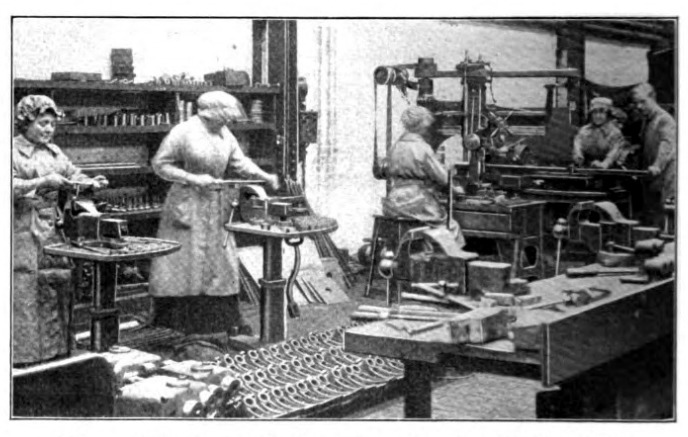
- Legenda: Women working in a factory
-
- The economic revival of the mid-1920s enabled the introduction of social reforms and better standards of living:
- Reintroduction of the welfare state; protecting the young, old, unemployed and disadvantaged
- The government created institutions and social workers to accommodate children who were illegitimate, homeless, abandoned or at risk
- In 1927, the Unemployment Insurance Law was introduced, it required workers and employees to make contributions to a national scheme for unemployment welfare
- Government investment, tax breaks, land grants and low-interest loans were used for the building of new houses and apartments
- 1924 -1931: more than two million new homes were built, while almost 200,000 more were renovated or expanded
- By 1928, homelessness has been reduced by more than 60 per cent
- In 1927, wages rose by 9%; rose again in 1928 by 12%
- Culture:
- The Weimar Republic was one of the most fertile grounds for modern arts and sciences
- Berlin became a new centre ground for art movements such as dadaism and expressionism
- The Bauhaus school near Weimar began to revolutionise modern architecture
- Much of the Weimar culture took from the American way of life; the assembly line technique, mass consumption and advertising
-

- Legenda: Nazi Party Symbol
- Began as the German Worker's Party led by Anton Drexler
- In 1919, Hitler joined after finishing in the army
- Drexler realised his talent and appointed him head of propaganda and the party's political ideas
- 1920 - the party announces its Twenty-Five Point Programme
- 1921 - Hitler becomes the new leader of the party
- Hitler renames the party the National Socialist German Worker's Party (NSDAP) - Nazi Party for short
- Set up a new private army called the Sturmabteiling (SA)
- The SA, also known as the Brownshirts, were to protect Hitler and disrupt other party meetings
- The party would meet in beer houses
- Hitler attracted attention with powerful speeches and rants about the Treaty of Versailles
-

- In 1923, the Nazi Party were a small minority party, yet Hitler thought highly of them. On November 8, he carried out his plan to topple the Weimar government by sending the SA to take over official buildings in Munich and announcing his planned revolution in a beer hall.
- Hitler interrupted a meeting of three Bavarian leaders in the beer hall
- He was backed up by 600 Brownshirts and held a gun to one of the leader's heads
- People were convinced to follow Hitler, after ex-war hero General Ludendroff showed his support for Hitler
- At the same time, Ernst Röhm was attempting to take control of government offices and arrest officials
- Government forces hit back and rebellion broke out the next day
- Hitler sent 2,000 troops to assist Röhm, but the Putsch failed
-
- Results of the Munich Putsch:
- Hitler and other leading Nazis were arrested for treason
- Hitler gained massive publicity from his trial
- Hitler impressed the judge and received five years in prison, when legally treason carried a life sentence
- In the end, Hitler only served nine months
- During his time in prison, Hitler wrote Mein Kampf (book outlining his beliefs)
-
- Hitler needed to reorganise the Nazi party after leaving prison. He realised that the party would have to win power via democratic means. Therefore, he created a network of local party branches and Hitler Youth (1926). While enlarging the SA, he also formed a new group in 1925 called the Schutzstaffel (SS). This organisation was similar to the SA, but its members were extremely loyal to Hitler personally.
- Hitler's efforts did not lead the Nazis to popular support in Germany, probably because at this time industry flourished from 1925-1929 and life was good for workers. In 1928, The Nazis gained 12 Reichstag seats and one quarter of the votes that communists won. The Nazi's failed to win over the majority of workers.
- The Nazis gained support from groups who did not benefit from the success of German growth. These included peasant farmers and small business owners

- Legenda: Nazi Party propaganda poster - the text on the bottom says 'The people's needs can be taken care of by your local community group.'
-
- Hitler called for a Nazi Party conference to be held in Bamberg in 1926
- He had concerns that the party was splitting in two ideologically
- Hitler wanted to stop any further challenges to his position within the party
- Gregor Strasser and Joseph Goebbels had been attempting to take over the party and steer it in a different direction
- Hitler used this occasion to deal with people's concerns and assure them he was the best leader for the party
- Hitler managed to get Goebbels on his side after this conference, who became one of his greatest supporters
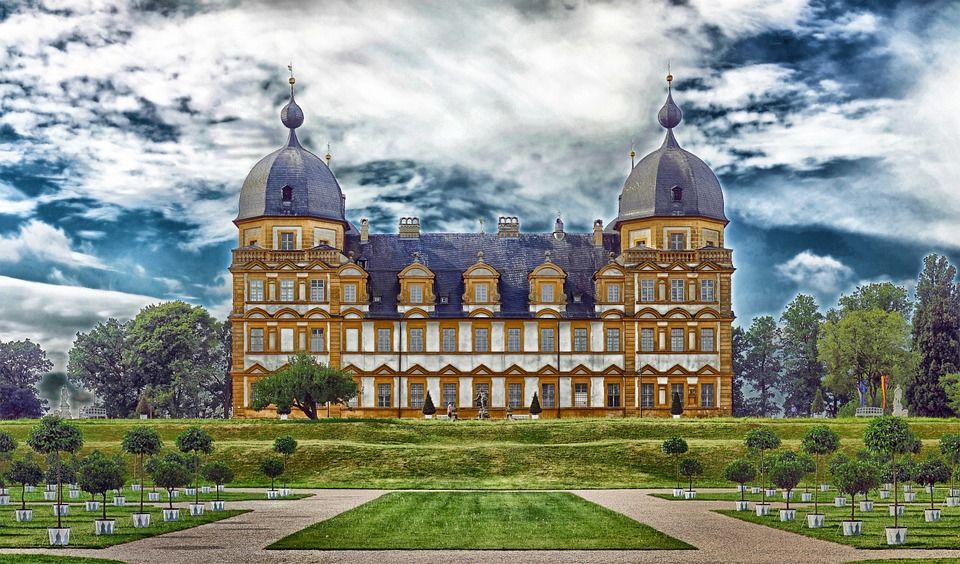
- Legenda: Bamberg
-
- The Nazis highlighted the role of peasants in their plans for Germany
- They praised the peasants of Germany as racially pure
- Nazis despised the culture of the Weimar Republic
- In order to gain respect, the Nazis began to collaborate closely with the right-wing Nationalist Party (DNVP)
- Membership for the party rose to over 100,000 by 1928
- Hitler appointed Josef Goebbels in charge of Nazi propaganda; Goebbels was highly efficient in spreading the Nazi message
- However, even with these advancements, the Nazis were still a minority party who had the support of less than 3% of the population
- The success of Stresemann in the economic and foreign policy meant that people did not look toward extreme politics for answers
Informações
- Descrição
- O usuário eliminou as informações de disciplina Slides sobre The 'Golden Age' and Origins of the Nazi Party, criado por Usuário eliminado em 11-07-2017.
- Criado por
- Usuário eliminado · jul 2017
- Atualizado
- 11 jul 2017
- Visualizações
- 26
- Histórico
-
- Criado por Andrew Burke · 4 jul 2017
- Copiado por Andrew Burke · 6 jul 2017
- Copiado por Andrew Burke · 6 jul 2017
- Copiado por Andrew Burke · 11 jul 2017
- Avaliação