
Notas
The Depression and Rise of the Nazis
Conteúdo das notas (3)
Página 1
The Great Depression
World trade boomed in the late 1920s, with the Unites States driving the global economy in trade and banking. With international trade, many nations grew richer and this reduced international tensions that existed post-WW1. This period of growth ended with the Wall Street Crash in October 1929. With the failure of the US stock market came the collapse of banks and businesses, while many saw their savings completed wiped out.
This period became known as the Great Depression; a long phase of economic decline that resulted in changes within and between countries.
Germany -
The First World War left Germany's Weimar Republic in a political and economic mess. It was by the end of the 1920s that prosperity and stability began to return to the German state, this was due largely in part to US loans. With the Wall Street Crash in 1929 the US recalled their loans from Germany; unemployment and economic collapse followed in Germany.
Weimar politicians were wither unwilling or incapable of working together to find policies to help the German population through the economic disaster. With many Germans dissatisfied with their government, people began to turn to extremist parties.
Unemployment peaked to 6 million
People lost their homes and had to live on the streets
The Weimar government refused to print more money but raised taxes and cut wages
Violence began to break out and people were desperate
Página 2
Enter the Nazis
The Great Depression played into the hands of the Nazis. Germany needed a strong leader. The Twenty-Five Point Programme of the Nazis seemed particularly attractive to the most vulnerable in society: the unemployed, the middle classes and the elderly.
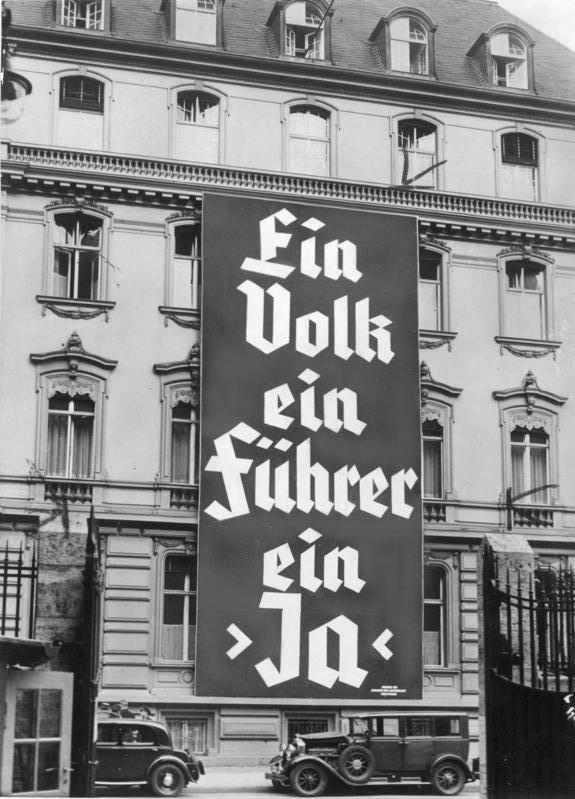
Hitler gave these groups a focus for their blame regarding Germany's troubles: the Versailles Treaty ('November Criminals'), communists and Jews. Hitler used his great rhetorical abilities to promote himself as the Saviour of Germany. Nazi propaganda was also used to advertise the ability of the party to solve all of Germany's problems. The Nazi Party's votes rose across Germany.
Election results:
1928 - 12 seats
1930 - 107 seats
July 1932 - 230 seats
November 1932 - 196 seats (SA attacks on opponents had negative effect on seat numbers)
Poster Slogan below - 'One people, One leader, One Yes'
Página 3
Why did the Nazis succeed in elections?
Hitler's rise:
Great communicator, who reached millions by using films, radio and rallies all over Germany (e.g. the Nuremberg Rallies)
Portrayed himself as a well capable; leader and at the same time a man of the people
Policies and slogans:
Relied on generalised slogans (e.g. 'uniting the people of Germany behind one leader')
Nazis took every opportunity to state that the Jews, communists and Weimar politicians were the causes of Germany's problems
Nazi actions:
At a local level the Nazi party demonstrated it was a party that could get things done
They organised soup kitchens and provided shelter in hostels for the unemployed
The uniformed SA and SS in the streets demonstrated to people values of order and discipline
Disillusionment with democracy:
There was deep dissatisfaction with the democracy of the Weimar Republic
Politicians seemed incapable of addresses the problems of the Depression
Chancellor Brüning relied on the emergency powers of Hindenburg, under Article 48, to bypass the democratic process altogether
Brüning did this in order to cut government spending and welfare
Decadence:
Nazis could count on those who felt traditional German values were under threat from the Weimar culture
Nazis mentioned restoring old-fashioned values for the good of society
These reasons for Nazi Party growth helped when dealing with the threat of the growing Communist Party. In dealing with the threat of the Communists, the Nazi Party received support from both business leaders and farmers.
Historian alternative view:
Not everyone was attracted to Hitler as a leader. The historian Gordon Craig argues the Nazi Party created a 'negative cohesion'. This means people supported the Nazi Party, not because they shared Nazi views, but because they shared Nazi fears i.e. 'If you despise what I despise, you have my support!'
Informações
- Descrição
- O usuário eliminou as informações de disciplina Notas sobre The Depression and Rise of the Nazis, criado por Usuário eliminado em 11-07-2017.
- Criado por
- Usuário eliminado · jul 2017
- Atualizado
- 11 jul 2017
- Visualizações
- 42
- Histórico
-
- Criado por Andrew Burke · 5 jul 2017
- Copiado por Andrew Burke · 11 jul 2017
- Avaliação