
Development of Surgical Methods and Medical Innovation
Slides do conjunto (6)
-
- The development of new types of weapons in World War One caused death and injury on a scale never seen before; new methods of treating soldiers that were wounded and injured were needed.
- Vaccination:
- Many soldiers in the trenches died from tetanus and typhus
- In the first year of the war, tetanus was the cause of 32 deaths per 1000 deaths on the Western Front
- The development of vaccinations in 1915 against typhus and tetanus reduced the death rate to 2 per 1,000 deaths
- Amputations and artificial limbs:
- Many soldiers had limbs amputated to stop the spread of gangrene
- The war years saw advances in the development of artificial limbs and moving joints
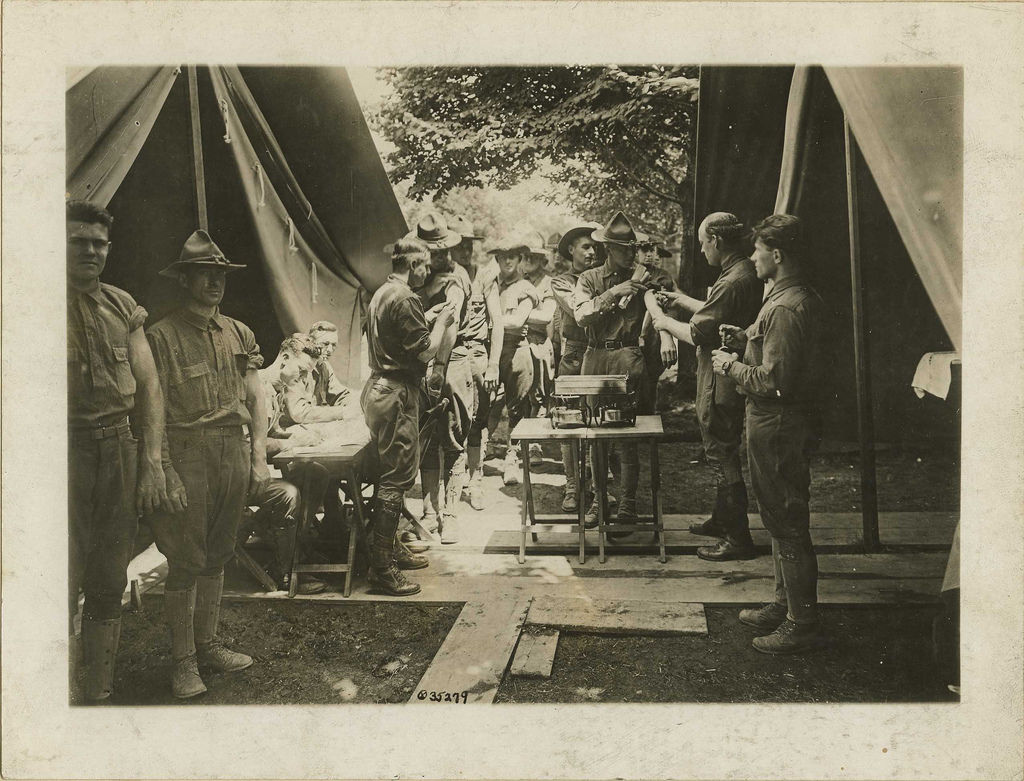
- Legenda: Soldiers receiving vaccinations
-
- Plastic surgery:
- This was a great advance for soldiers who suffered serious wounds from bullets and shell damage, especially to the face
- End of 1915 - seven hospitals in France had specialist areas for coping with wounds requiring plastic surgery
- One key figure was Harold Gillies, a British army surgeon, who developed a specialist department in Kent to treat facial injuries
- This department opened in 1917, providing 1,000 beds and treating over 2,000 soldiers injured in the Battle of the Somme
- Medical professionals discovered how to graft skin also
- Brain surgery:
- Huge numbers of head and brain injuries required surgeons to develop surgical methods, especially brain surgery
- Two developments helped this process:
- The ability to undertake blood transfusions
- Use of X-rays to locate metal fragments inside the head
- Harvey Cushing, an American surgeon, invented a magnet to extract bullets from head wounds
-
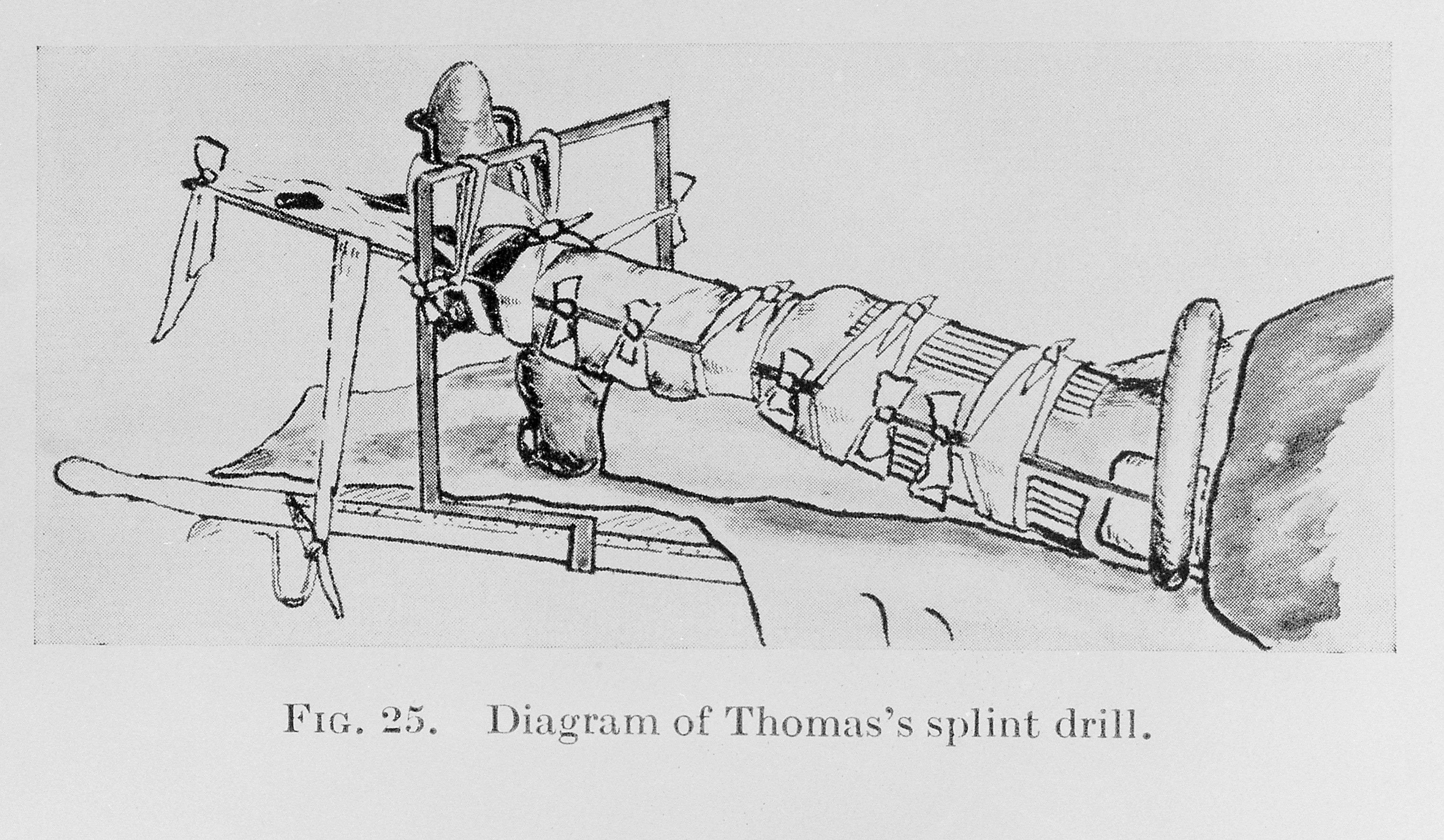
- The Thomas Splint:
- In the first few years of war, 80% of soldiers who had their femur broken by gunfire died from the injury
- Medical officers only had simple splints which did not stop the broken bones from moving, causing blood loss and infection
- In 1916, an invention by Welsh surgeon, Hugh Owen Thomas, caused the death rate to reduce from 80% to 20%
- This invention was the 'Thomas splint'
- It stabilised the fracture, putting the leg lengthways to prevent the bones from grinding against each other
- This reduced blood loss and infection and decreased the number of amputations required
- Robert Jones, Thomas' nephew, who worked as the British Army's Director of Military Orthopaedics in 1916, made sure the 'Thomas splint' was available for use at the front
-
- Development of aseptic surgery:
- One of the biggest causes of death was infection
- In the late-19th century, surgeon Joseph Lister pioneered aseptic surgery (performing surgery under sterile conditions reduced the onset of infection post-operation)
- On the battlefield, less hygienic conditions meant it was difficult to prevent infection of a wound
- It was through a trial and error process that surgeons attempted to overcome difficulties of infection
- Use of chemicals such as carbolic acid and hydrogen peroxide to kill bacteria already in wounds
- Surgeons discovered cutting away infected tissue and soaking a wound in saline solution reduced infection rates
- It was only really by World War Two and after the discovery of penicillin that infection was properly addressed
-
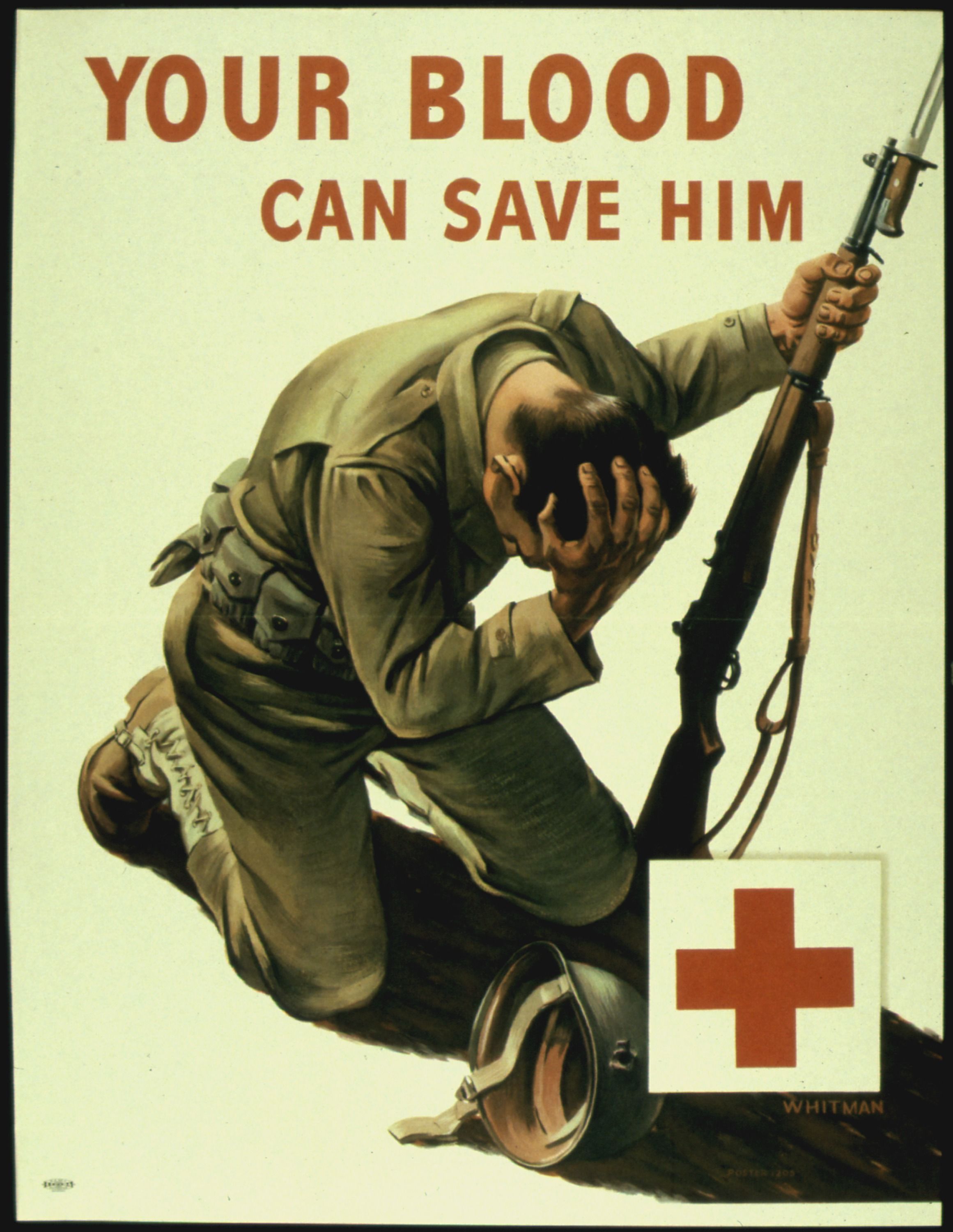
- Blood transfusion:
- Blood transfusions had been tried since the time of William Harvey, but most patients died shortly afterwards
- Major advance in 1900, when Karl Landsteiner discovered blood could be divided into four types and each patient needed blood from someone of the same type
- This advance meant that many soldiers were saved on the Western Front
- However, the problem remained that it was not possible to store blood because it clotted so quickly
-
- Blood transfusion:
- A solution to the blood clotting problem came through a number of discoveries:
- 1914 - American scientist, Richard Lewisohn, discovered sodium citrate could be added to blood to prevent it from clotting
- O. H. Robertson used this method to keep blood fresh during the war
- Scientists discovered keeping blood refrigerated allowed it to be stored for longer periods
- 1917 - British surgeon, Geoffrey Keynes developed a portable machine that could store blood to enable transfusions
- Portable X-rays:
- Discovered by William Rontgen in 1895 and became significant during the First World War
- X-rays saved lives by allowing surgeons to easily locate bullets, shrapnel and fragments of metal in a wounded soldier
- This reduced infection which was a common cause of death
- The problem in 1914 was that there was very few X-ray machines portable enough to be used on the front
- Marie Curie, a pioneer in radiography, at the start of the war concentrated on developing a portable X-ray machine
- October 1914 - 20 radiology vehicles constructed carrying X-ray machines were available on the front line
- By 1916 X-ray machines became the standard across casualty clearing stations
Informações
- Descrição
- O usuário eliminou as informações de disciplina Slides sobre Development of Surgical Methods and Medical Innovation , criado por Usuário eliminado em 12-07-2017.
- Criado por
- Usuário eliminado · jul 2017
- Atualizado
- 12 jul 2017
- Visualizações
- 48
- Histórico
-
- Criado por Andrew Burke · 11 jul 2017
- Copiado por Andrew Burke · 12 jul 2017
- Avaliação