
Notas
Electrolysis to Extract Metals
Conteúdo das notas (3)
Página 1
Basic Principles of Electrolysis
Electrolysis: Chemical decomposition produced by passing an electric current through a liquid or solution containing ions.
Electrolyte: An ionic substance with freely moving ions. Electrolytes conduct electricity.
Cation: A positively charged ion
Anion: A negatively charged ion
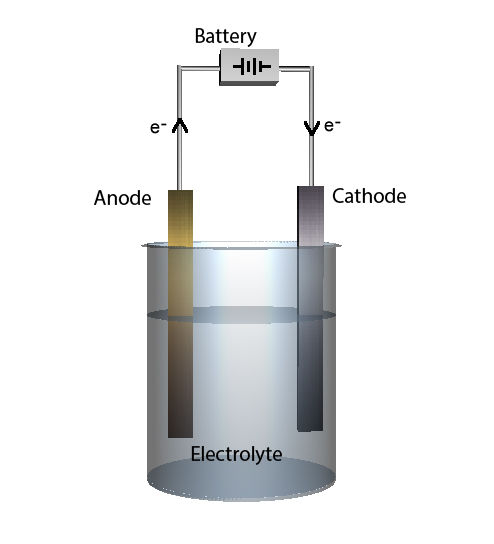
Electrolysis uses electricity to break down an electrolyte.
Two electrodes (usually a carbon or a metal) are connected to a d.c. current and placed in the electrolyte.
The positive electrode is called the anode
The negative electrode is called the cathode
The ions migrate towards the electrode with the opposite charge
Cations collect at the cathode
Anions collect at the anion
Página 2
Electrolysis of Copper Sulfate
During the electrolysis:
Copper atoms in the anode lose two electrons to become copper ions
These ions are attracted to the cathode, where they gain two electrons and are deposited as pure copper
Anode loses mass, cathode gains mass
Impurities from the ions collect as a sludge beneath the anode
Half equations:
Anode: \(Cu(s) \rightarrow Cu^{2+} (aq) +2e^-\)
Cathode: \(Cu^{2+} (aq) +2e^- \rightarrow Cu(s)\)
Electroplating
A technique using electrolysis to coat one metal with a thin layer of the other
In this case the electrodes are referred to as non-inert.
If this experiment were to be repeated using carbon or platinum electrodes, then the electrodes would be intert.
The cathode would show a salmon pink discolouration which is a thin layer of copper atoms.

When using copper electrodes, include variable resistor in experimental set up
Wash electrodes in distilled water and then dip them in propanone before use
Record the masses of the dry electrodes before the start of the experiment
Página 3
Manufacture of Aluminium
Very reactive metallic elements are extracted from ores by electrolysis
Because they are higher up in the reactivity series than carbon, they cannot be displaced from their oxides by carbon
The usual source of aluminium is the ore, bauxite.
This is treated chemically to leave a white aluminium oxide powder, \(Al_2O_3\), commonly known as alumina
Alumina has a very high melting point .
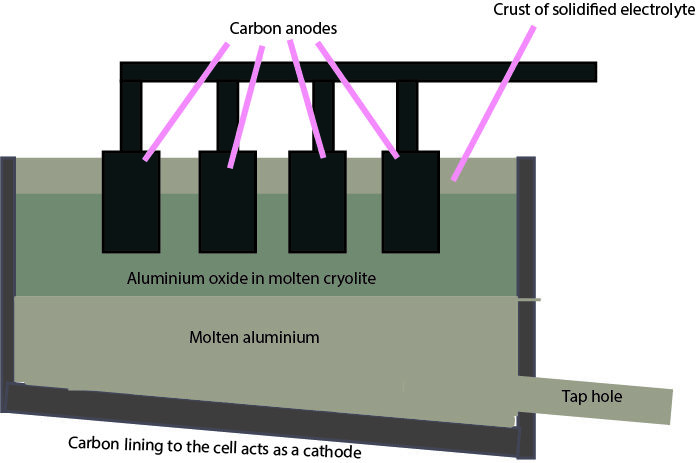
Therefore, in order for it to be electrolysed, it has to be dissolved in molten cryolite
Acts as a solvent for the alumina
Cryolite also has a high melting point
Cathode:
Attracts Al ions where they gain electrons to form aluminium metal
\(Al^{3+}+3e^- \rightarrow Al\)
Anode:
Attracts oxide ions
Lose electrons and form oxygen gas
Oxygen gas reacts with carbon anodes, so they have to be replaced from time to time
\(2O^- \rightarrow O_2 + 4e^-\)
Informações
- Descrição
- O usuário eliminou as informações de disciplina Notas sobre Electrolysis to Extract Metals, criado por Usuário eliminado em 13-07-2017.
- Criado por
- Usuário eliminado · jul 2017
- Atualizado
- 6 mar 2019
- Visualizações
- 33
- Histórico
-
- Criado por Niamh Ryan · 11 jul 2017
- Copiado por Niamh Ryan · 13 jul 2017
- Copiado por Niamh Ryan · 13 jul 2017
- Avaliação