
Notas
Crime and Punishment - Anglo-Saxon Times
Conteúdo das notas (3)
Página 1
Medieval Problems Overview - Poverty, Famine and Warfare
Poverty:
Most medieval people depended on their fields for food, a bad harvest meant hunger or starvation
Population of England was around 4.75 million - with most people living and working in the countryside
Close to 25% had enough land to support themselves
Many had no land; an estimated 40% of rural families had to buy all their food
Most people lived near the poverty line
Diet consisted of bread, pottage and stew
Lack of fodder in winter led to animals being slaughtered in autumn
Child mortality was high and malnutrition common
Famine:
Famine regularly occurred, some more fatal than others
For example, William the Conqueror's anger with Anglo-Saxon rebellions in the north led to crops being destroyed, so land would not produce crops
Thousands died as a famine resulted
One of the worst famines occurred in 1315-1317 when torrential rain destroyed planting and harvesting for three successive years
Poor harvests resulted in the death of animals from disease and a shortage of fodder
Effects of famine continued to around 1325, by then estimated 10-15% of the population died during the famine
Warfare:
Archaeological evidence from Anglo-Saxon and Viking eras demonstrates bodies with infected unhealed wounds
Suggestions that an epidemic killed healthy males in the Viking army in 873-74
In the later medieval period armies grew much larger; Edward I called out an infantry of 30,000 and 10,000 cavalry against Wales and Scotland
E.g. at the Battle of Townton 1461, an estimated 22,000-28,000 men died
Most medieval armies required provision across the country when travelling
Unable to provide for themselves armies frequently left towns and villages short of food

Página 2
Crime and Punishment
In the year 1000, the population of England lay between 1.7-2.2 million. Roughly 90% of people lived in the countryside and few lived in towns. Most communities were vulnerable to warfare, weather, poor harvests and disease. Laws were made by a powerful king and nobility; strong local ties in villages allowed the strict enforcement of law throughout the country. The Church played a role in influencing ideas of crime and punishment also.
There were three main trends in Anglo-Saxon times in regard to crime and punishment:
The king grew in power and influence, therefore, penalties for crimes were increasingly decided by the king, rather than local communities
The role of the Church increased. The Church wanted to give those who had committed crimes the chance to save their souls.
Capital punishment increased - this boosted the power and authority of the king.
Role of the Anglo-Saxon King:
From 978-1016, King Ethelred II ruled over England
During his reign, there was conflict over the border between English and Scottish lands, with Vikings occupying some regions
Around the year 1000, Ethelred attacked Viking settlements through an alliance with Normandy
These actions gave him more control of the kingdom
As the authority of the Anglo-Saxon kings and territory grew, the king became the maker and enforcer of laws
The king did have advisers, but maintained overall authority
The king had to keep king's peace
Structure of Society:
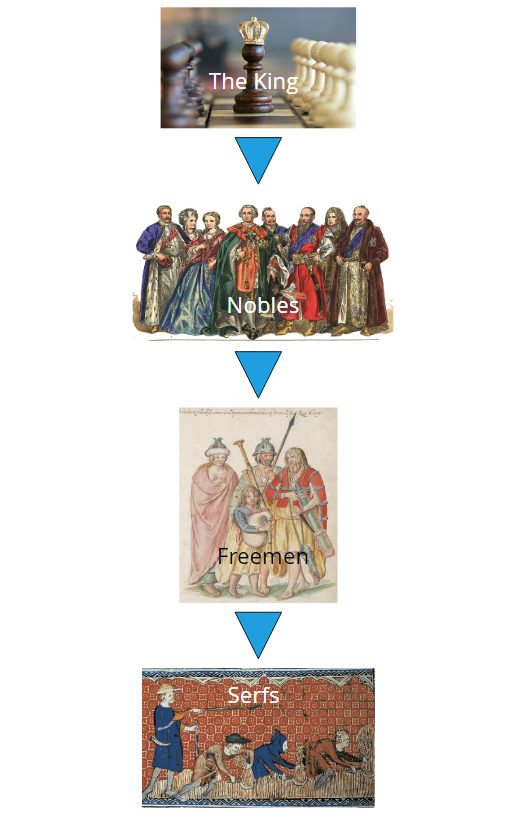
Three-tiered social structure consisting of nobles, freemen and serfs
Nobles: the king gave them land which gave them wealth and power. They were mainly responsible for maintain the king's peace in their local area
Freemen: they would rent or own a small section of land and had no say in how laws were made.
Serfs: they owned no land and worked for very low pay. No say in how laws were made.
All these classes were subject to the authority of the king
The nobles backed the interests of the king because this protected their interests and wealth
Nobles received land from the king for loyal support
Actions that threatened the social structure at the time were called crimes. The worst example was treason (betraying the king - e.g. helping his enemies, plotting to replace or kill him). These types of crimes are called 'crimes against authority'.
Página 3
Crime and Punishment
Crime in Anglo-Saxon Communities:
In c.1000, towns were of growing importance in England, particularly Hamwic (Southampton), Eoforic (York) and Lundenwic (London). Towns began to grow due to greater population, trade with Europe and coined money which made trade easier. In these large communities there was more room to commit crimes: crimes against the person and crimes against property.
Crimes against the person: this included crimes such as assault or murder which cause physical harm to another person
Crimes against property: theft, robbery and arson were property crimes; taking or damaging the belongs of another person
Due to the nature of town life, crowded and high concentration of goods and money, there was plenty of valuable things to steal and you could easily get away with it.
In local villages, it was far easier to identify a criminal as everyone knew each other. Local communities had to take collective responsibility to uphold the law. There was a reeve (a local official, appointed from the community) in each areas who carried out decisions of the local courts.
Some communities were based around churches. There were many great abbeys founded in the 11th century, alongside smaller monasteries. These communities revolved around monks and nuns, as well as daily labourers who ran buildings and supplied food and necessities.
The Church was a very powerful institution, especially in trying to stop moral crimes and crimes against the church (e.g. stealing church property). The Church would punish those who broke Church laws.
Moral Crimes: these actions did not involve physically harming anyone or their property, rather these were actions that did not match up to society's view of decent behaviour e.g. not following the rules and customs of the Church
Informações
- Descrição
- This study note is the first in a series on crime and punishment in the UK through the ages. This focuses on anglo-saxon times, and provides an overview of anglo-saxon communities, poverty, warfare and crime & punishment.
- Criado por
- Andrew Burke · jul 2017
- Atualizado
- 2 out 2018
- Visualizações
- 478
- Tags
- Avaliação