
Notas
Esperanza Spalding: ‘Samba Em Prelúdio’
Conteúdo das notas (6)
Página 1
About the Piece:
Samba Em Prelúdio is a gentle samba in the bossa nova style (a style from Brazil) written by Roberto Baden Powell Aquino in 1962. This song is a fusion of Brazilian samba and jazz.
The lyrics of the song are in Portuguese. Translated, they say:
Verse 1
Without you, I have no purpose
Because without you, I don’t even know how to cry
I’m a flame without glow, a garden without moonlight
Moonlight without love, love without being given
Without you, I’m just lovelessness
A ship without sea, a field without flowers
Sadness that goes, sadness that comes
Without you my love, I’m no one
Verse 2
Ah, what saudade, what desire to see our life reborn
Come back, my dear
My arms need yours, your embraces need mine
I’m so alone, my eyes weary of staring into the distance
Come, behold life
Without you, my love, I’m no one
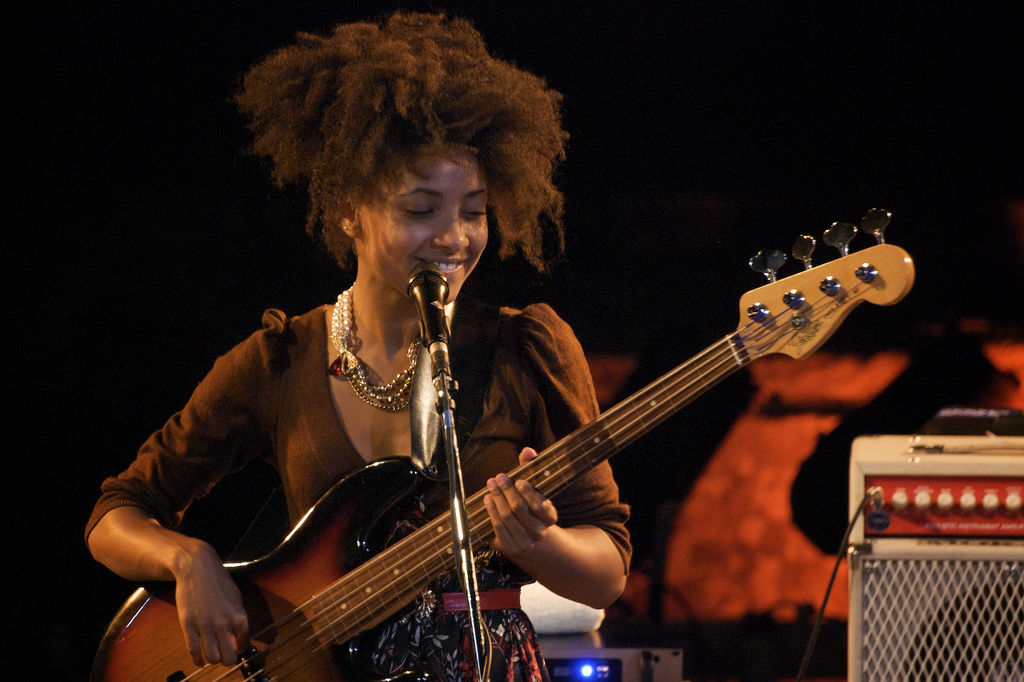
Esperanza Spanding's cover of the song is quite simple, featuring vocals, acoustic guitar and acoustic bass guitar. Esperanza Spalding sings and plays the bass, but there is no specific credit on the album for a guitarist. A second acoustic guitar part appears in the guitar solo, although it is simplified and played by one guitarist in their live performances.
Vocals:
The vocal line is low in the female range, using the chest register.
It covers a range of a minor tenth (an octave plus a minor third) from E below middle C to the G above.
The words are set syllabically, with one musical note to each syllable of text.
The vocal line contains many leaps, and also some quite complex rhythms – triplets, semiquavers, rests.
Esperanza’s performance keeps closely to the printed pitches of the score, but there is variation in the performance of the rhythms and of the tempo – a performance technique known as rubato.
Accompaniment:
The bass part is active and does much more than play the root of the chord.
The very opening of the piece features a virtuosic bass solo with use of double stops, wide leaps, rapid semiquaver passages, a mordent and a harmonic.
In verse 1 (before the acoustic guitar enters), the bass appears to be playing two parts, with lower bass notes alternating with higher chords, rather like a ragtime piano accompaniment.
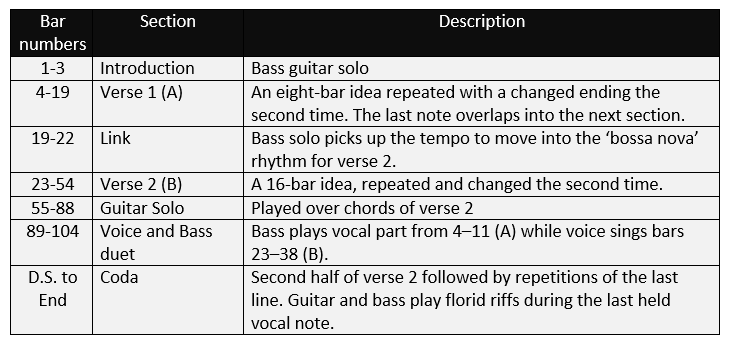
The acoustic guitar joins the accompaniment from bar 23 onwards and plays a virtuosic solo between Verse 2 and bar 89.
The guitar pays a mixture of plucked chords and small melodic passages, some of which cover the long notes at the end of vocal phrases. There are also passages where the guitar line seems to imitate the vocal part.
Página 2
Harmony and Tonality:
The key of the piece is B minor. Many bossa novas use minor keys.
The harmonies are tonal. They show the influence of complex jazz music. However, the song is still based around chords I, ii, IV and V. These chords are popular in American pop music. Despite the complexity of some of the harmony, this song has no modulations.
There are frequent chord extensions – where extra thirds are ‘piled up’ on top of the triad to produce sevenths, ninths, elevenths and thirteenths.
Other types of chords are also used, including diminished 7th (bar 35); flattened 5th (bar 44) chords.
Chromatic chords (containing notes outside the scale of the tonic key) are used, including C♯7 (bar 31) and C and F major chords (bars 27/28).
Although cadences are not used here in quite the same way as in classical styles, the ends of sections tend to land on either chord V (bar 11) or a perfect cadence (bars 52–53).
The chord progressions sometimes create a descending chromatic (by semitone) movement in the bass line (bars 30–38).
Página 3
Texture:
The introduction is monophonic (a single line of music) – apart from a couple of doublestops (two notes or more at once).
The texture in the verses is mostly homophonic.
At times, the bass part becomes almost melodic enough to be a melody in its own right, creating a polyphonic texture.
The voice and bass duet at bars 89–104 is polyphonic as the two melodies of the piece are combined.
Página 4
Tempo, Metre and Rhythm
The tempo in the introduction is very free and it is difficult to recognise a strong pulse. The first verse continues with this slow tempo, featuring rhythmic rubato.
The tempo almost doubles after the first verse, where the bass guitar begins the bossa nova tempo. The slower tempo returns at bar 114.
The piece is 4/4 time, although the change of tempo from bar 19 onwards tends to make the piece from there on sound as if it is moving in two minims to a bar (2/2).
The rhythms of the vocal melody are complex throughout. There are frequent triplets, and rests effectively separate most of the phrases in the melody.
The bass part in verse 1 is also rhythmically complicated, making more use of syncopated rhythms than the vocals and only using a typical bossa nova-type rhythm (shown below).
In the second verse, the vocal line is mostly in longer note values, but the start of the notes tend to be off the beat, syncopated a quaver before the beat sometimes. There are fewer triplets in this section.
From bar 25 the bass part plays much closer to the standard bossa nova rhythm (shown below), although still with some syncopation and quaver movement. The guitar part also adds to the rhythmic interest in this section, with both syncopated and un-syncopated passages.
During the bass and vocal duet, the vocal rhythms are less syncopated, perhaps in order to fit in more easily with the bass line.

Página 5
Melody - Verse 1:
There are two main melodies in this song, heard separately at first, and then combined at bars 89–104.
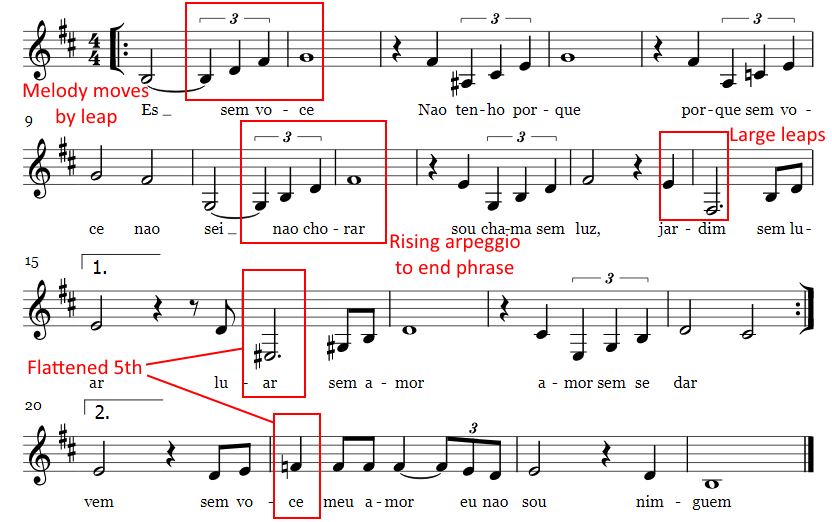
The first verse features eight-bar idea (bars 4–11) which is then repeated with a different ending. Bars 12–17 is a repeat of bars 4–9, however, the melody is developed through rhythmic changes.
The verse is made up of a series of phrases, linked by a common rising arpeggio. The first note of each phrase descends by a semitone or a tone in a long downward sequence.
The music descends almost beneath the female vocal range, to a low E, at bar 17.
The melodic line moves, unusually, mostly by leaps of a third and occasionally of a seventh.
All phrases have a span of a seventh, apart from the first, which spans a minor sixth.
The melody changes towards the end of the verse. A jazzy flattened fifth (F♮/E) is used in bar 16 to prepare for the descent to the tonic.
Página 6
Melody - Verse 2:
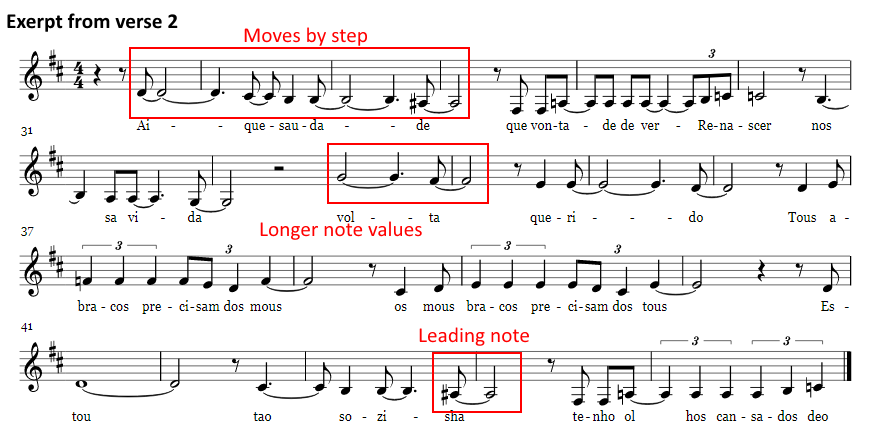
The note values in the melody are doubled in the second verse because of the increase in tempo at bar 19.
The second verse is made up of a 16-bar idea (bars 23–38), repeated with a different ending.
In contrast to the first verse, this melody is almost entirely conjunct in movement.
Bars 23–26 descend to the leading note (raised seventh note of the scale –A♯ here), answered by a rising and falling idea in bars 27–30, which in itself is related to the ending of verse 1 (see bars 17–18).
Bars 31–34 are in sequence with 23–26, a fourth higher.
Bars 34–35 repeat the flattened fifth idea from the end of the first verse twice. The second repeat is in sequence, a note lower (this is to move away from the tonic, in order to set up the repeat).
Informações
- Descrição
- O usuário eliminou as informações de disciplina Notas sobre Esperanza Spalding: ‘Samba Em Prelúdio’, criado por Usuário eliminado em 01-08-2017.
- Criado por
- Usuário eliminado · ago 2017
- Atualizado
- 1 ago 2017
- Visualizações
- 345
- Histórico
-
- Criado por Antonia Blankenberg · 31 jul 2017
- Copiado por Antonia Blankenberg · 1 ago 2017
- Avaliação