
Notas
Electron Configuration
Conteúdo das notas (4)
Página 1
Quantum Shells
According to quantum theory, electrons can only exist in certain well-defined energy levels known as quantum shells.
Electrons in the same shell have similar, but not identical, energies.
Electrons in the first shell have the lowest energy for that atom and are located in the region closest to the nucleus.
The second shell is located in a region outside the first, and the third outside the second etc
Subshells
Each shell contains subshells of slightly different energy levels.
The first quantum shell contains only one subshell - known as the 1s subshell
The second quantum shell contains two subshells - 2s and 2p
The third quantum shell contains three subshells - 3s, 3s and 3d
The fourth quantum shell contains four subshells - 4s, 4p, 4d and 4f
For all of these subshells, s>p>d>f, in terms of energies
S orbitals
Orbital: A region within an atom that can hold up to two electrons with opposite spins
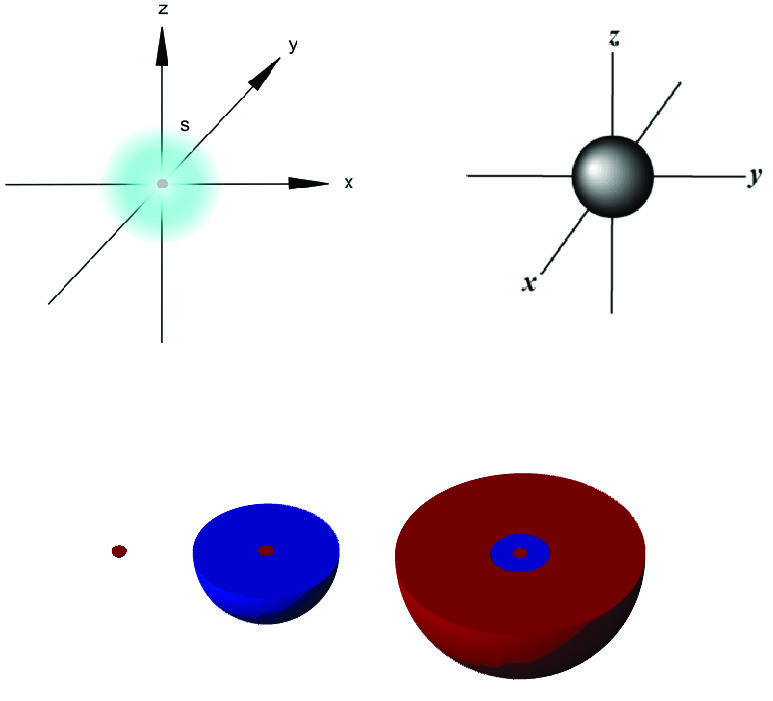
All s orbitals have a spherical shape, and vary only in their size - 1s is the smallest, 2s is bigger, 3s is bigger again etc.
The size and shape of the orbitals is such that there is a 90% probability of finding the electron within their boundaries.
The diagram below shows a number of ways in which s orbitals can be represented.
Página 2
Quantum Shells (Ctd.)
P orbitals
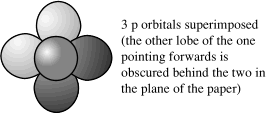
P orbitals are elongated and shaped like dumbbells.
They have non-uniform charge density.
There are 3 p orbitals in each p subshell - these are sometimes labelled as \(p_x\), \(p_y\) and \(p_z\) according to the axes along which they are oriented.
The p orbitals within a subshell differ only in their orientation - they are at mutual right angles.
The diagram below shows a one of the ways in which p orbitals can be represented.
Other orbitals
There are five d orbitals in each d subshell
There are seven f orbitals in each f subshell
You do not need to know the shapes of d or f orbitals
There can be up to two electrons in each orbital. Therfore:
An s subshell can have two electrons.
A p subshell can have up to six electrons (Two in each of the three p orbitals)
D subshell can have up to ten.
The first quantum shell can have two electrons - It only has the 1s orbital
The second quantum shell can have eight electrons - Two in the 1s orbital, two in the 2s orbital and two more in each of the p orbitals
The third quantum shell can have up to 18 - The 18 that the second quantum shell can have, plus two more in each of the five d orbitals
The fourth quantum shell can have up to 32 - 14 more than third quantum shell to seven f orbitals.
Página 3
Electron Configuration
Electron configuration: The electron configuration of an atom is the distribution of the electrons among the atomic orbitals
In general, the lowest energy orbitals are occupied and filled first
Example 1: What is the electron configuration of sodium?
Sodium has eleven electrons - this allows for a fully filled first and second shell and a partially filled third shell (Containing one electron)
Therefore, the electron configuration will be: \[ 1s^2, 2s^2,2p^6, 3s^1\]
Example 2: What is the electron configuration of chlorine?
Chlorine has 17 electrons - fully filled first and second shell, partially filled third shell (Containing 7 electrons)
Therefore, the electron configuration will be: \[ 1s^2, 2s^2,2p^6, 3s^2, 3p^5\]
WATCH OUT FOR EXCEPTIONS TO THE RULE
For potassium and calcium, the energy of the 4s orbital is lower than that of the 3d orbital.
So their shells are filled in the following way:
Potassium: \( 1s^2, 2s^2,2p^6, 3s^2, 3p^6, 3d^1\)
Calcium: \( 1s^2, 2s^2,2p^6, 3s^2, 3p^6, 3d^2\)
Página 4
Electron spin
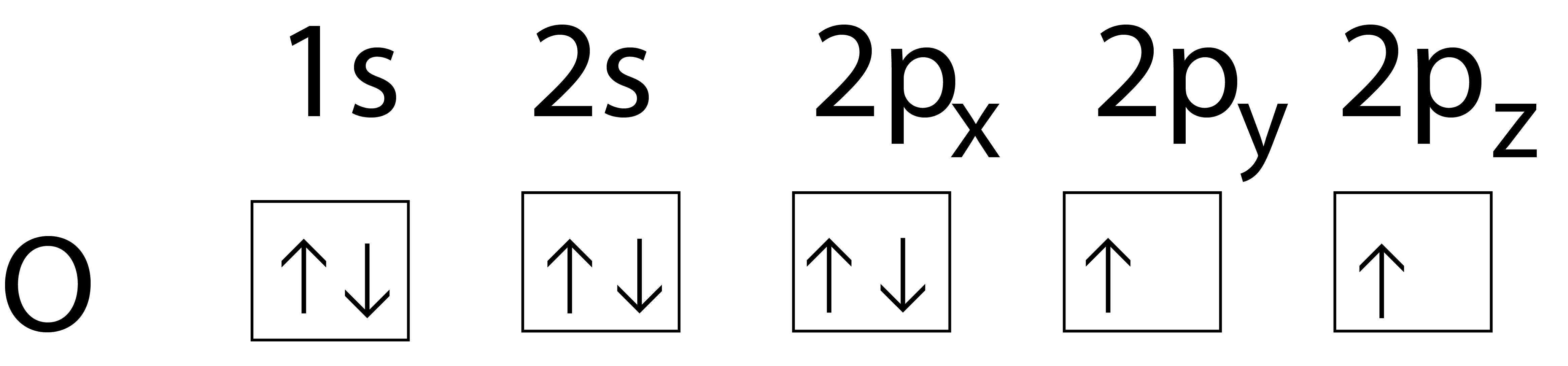
Hund's rule: States that electrons will occupy the orbitals singly before filling them in pairs.
This means, for example, that there must be one electron in each p orbital before any of them can contain two.
Pauli Exclusion Principle: States that two electrons cannot occupy the same orbitals unless they have opposite spins. Electron spin is usually shown by the use of upward and downwards arrows: ↓ and ↑.
For example, the electronic configuration can be represented as follows:
Informações
- Descrição
- O usuário eliminou as informações de disciplina Notas sobre Electron Configuration, criado por Usuário eliminado em 14-08-2017.
- Criado por
- Usuário eliminado · ago 2017
- Atualizado
- 14 ago 2017
- Visualizações
- 38
- Histórico
-
- Criado por Niamh Ryan · 3 ago 2017
- Copiado por Niamh Ryan · 14 ago 2017
- Avaliação