
Notas
Moles
Conteúdo das notas (3)
Página 1
What is a mole?
Mole: The amount of a substance that contains the same number of particles as the number of carbon atoms in exactly 12g of the carbon-12 isotope
Avogadro Constant: The number of atoms of carbon-12 in exactly 12g of carbon-12
Avogadro's constant is \(6.02 \times 10^{-23} \).
The symbol L is sometimes used to represent Avogadro's constant.
You can use the mole to count atoms, molecules, ions, electrons and other species - make sure you always specify which one you are talking about!
Página 2
MOST IMPORTANT FORMULA YOU WILL EVER LEARN
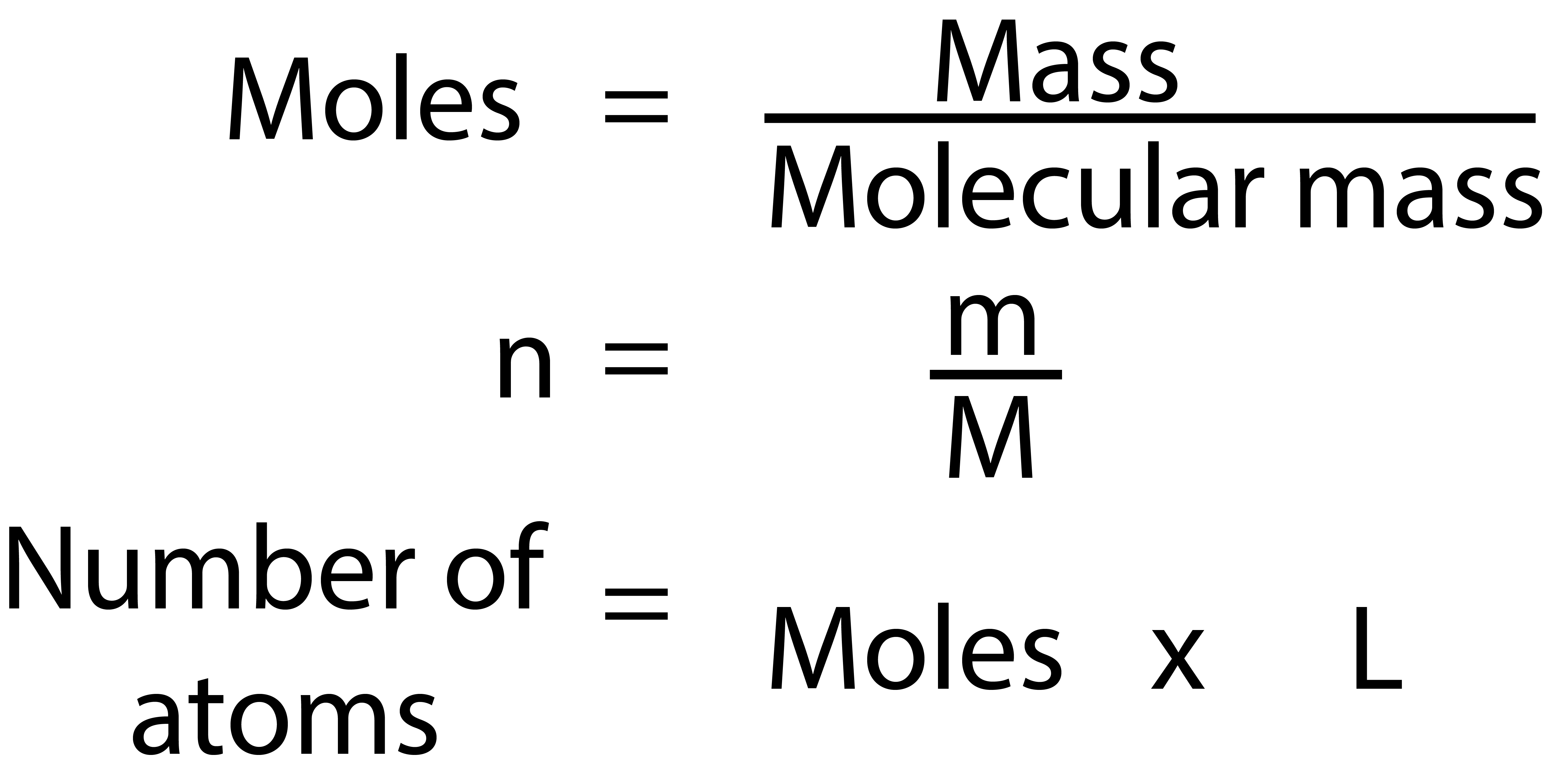
If you can use and easily manipulate this formula, you can do any of the calculations relating to this chapter.
Página 3
Calculations using moles
There are only five possible calculations you will ever have to do using moles. They are simply permutations of the formulae on the previous page.
1. Find the number of moles, given the mass and molar mass
\[ n = \frac{m}{M} \text{ - No manipulation required} \]
Example: How many moles are there in 6.51g of sodium chloride?
\( n = \frac{m}{M} = \frac{6.51}{5.85} = 0.111 mol \)
2. Find the mass, given the number of moles and molar mass
\[ n \times M = m \text { - Multiply both sides by M to find an expression for m} \]
Example: What is the mass of 0.263mol of hydrogen iodide?
\( n \times M = m = 0.263 \times 127.9 = 33.6g \)
3. Find the molar mass, given the mass and number of moles
\[ M = \frac{m}{n} \text{ - Divide previous expression by n to find an expression for M} \]
Example: sample of 0.284mol of a substance has a mass of 17.8g. What is the molar mass of the substance?
\( M = \frac{m}{n} = \frac{17.8}{0.284} = 62.7g \)
4. Find the number of atoms/molecules, given the mass and molar mass
\[ \text{Number of atoms} = n \times L \text{ - No manipulation required}\]
\[n = \frac{m}{M} \text{ - No manipulation required} \]
\[ \therefore \text{Number of atoms} = n \times L = \frac{m}{M} \times L \]
Example: How many water molecules are there in 1.25g of water?
\( \text{Number of atoms} = n \times L = \frac{m}{M} \times L = \frac{1.25}{18} \times 6.02 \times 10^{23} = 4.18 \times 10^{22} \)
5. Find the mass, given the number of atoms/molecules and the molar mass
\[m = \text{Number of atoms} \times \frac {M}{L} \text{ - Divide equation above by L and multiply by M} \]
Example: What is the mass of 100 million atoms of gold?
\( m = \text{Number of atoms} \times \frac {M}{L} = 100 \times 10^{6} \times \frac {197.0}{6.02 \times 10^{23}} = 3.27 \times 10^{-14}\)
Informações
- Descrição
- O usuário eliminou as informações de disciplina Notas sobre Moles, criado por Usuário eliminado em 14-08-2017.
- Criado por
- Usuário eliminado · ago 2017
- Atualizado
- 14 ago 2017
- Visualizações
- 40
- Histórico
-
- Criado por Niamh Ryan · 4 ago 2017
- Copiado por Niamh Ryan · 14 ago 2017
- Avaliação