
Quiz
Atomic Structure Quiz 3 - Eduqas, WJEC, AQA
Este quiz tem tipos de pergunta que abrem no player de sempre.
Perguntas do quiz (16)
1Isotopes are atoms of the same element that contain different numbers of electrons.
- AVerdadeiro
- BFalso
2The mass number is always a whole number.
- AVerdadeiro
- BFalso
3How a mass spectrometer works:
Produces positive ions that are deflected by a [blank_start]magnetic[blank_end] field according to their mass-to-charge ratio (known as their [blank_start]m/z[blank_end] ratio)
Calculates the relative [blank_start]abundance[blank_end] of each ion
Displays abundance as [blank_start]percentage[blank_end]- Amagnetic
- Bm/z
- Cabundance
- Dpercentage
4Chlorine is an example of a [blank_start]diatomic[blank_end] molecule.
- Adiatomic
5Molecular ion peak: The peak with the [blank_start]highest[blank_end] m/z ratio, the [blank_start]M[blank_end] peak. This peak is helpful in figuring out the relative molecular mass of a compound using a mass [blank_start]spectrum[blank_end]
- Ahighest
- BM
- Cspectrum
6Orbital: A region within an atom that can hold up to [blank_start]two[blank_end] electrons with [blank_start]opposite[blank_end] spins
- Atwo
- Bopposite
7For all electron subshells, [blank_start]s[blank_end]>[blank_start]p[blank_end]>[blank_start]d[blank_end]>[blank_start]f[blank_end], in terms of energies.
- As
- Bp
- Cd
- Df
- Es
- Fp
- Gd
- Hf
- Is
- Jp
- Kd
- Lf
- Ms
- Np
- Od
- Pf
8The diagram shows a number of ways of representing
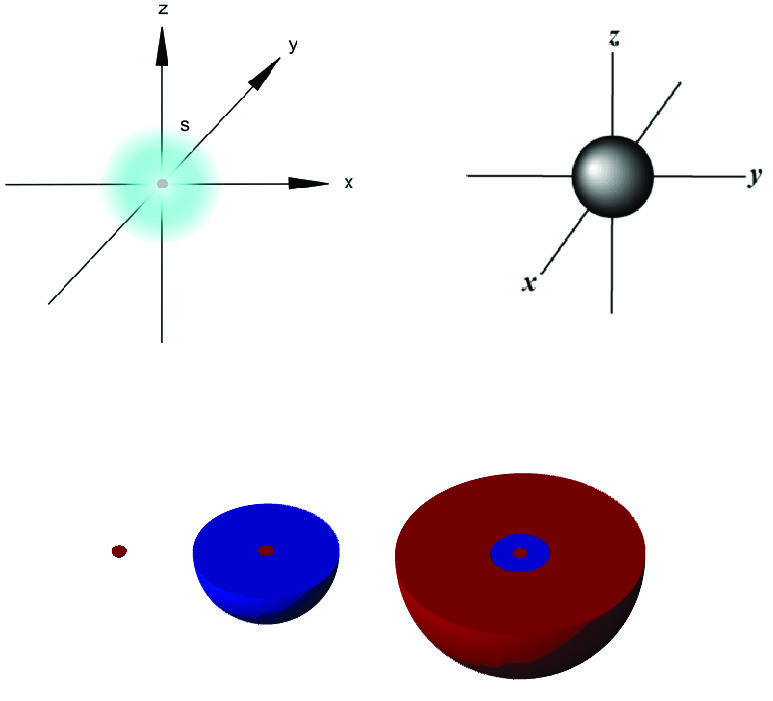
- AAn s oribital
- BA p orbital
- CA d orbital
- DAn f orbital
9The size and shape of the orbitals is such that there is a [blank_start]90[blank_end]% probability of finding the electron within their boundaries
- A90
10P orbitals are elongated and shaped like [blank_start]dumbbells[blank_end].
They have non-uniform charge [blank_start]density[blank_end].
There are 3 p orbitals in each p subshell - these are sometimes labelled as \(p_x\), \(p_y\) and \(p_z\) according to the axes along which they are oriented.
The p orbitals within a subshell differ only in their orientation - they are at mutual [blank_start]right angles[blank_end].- Adumbbells
- Bdensity
- Cright angles
11This is a way of representing
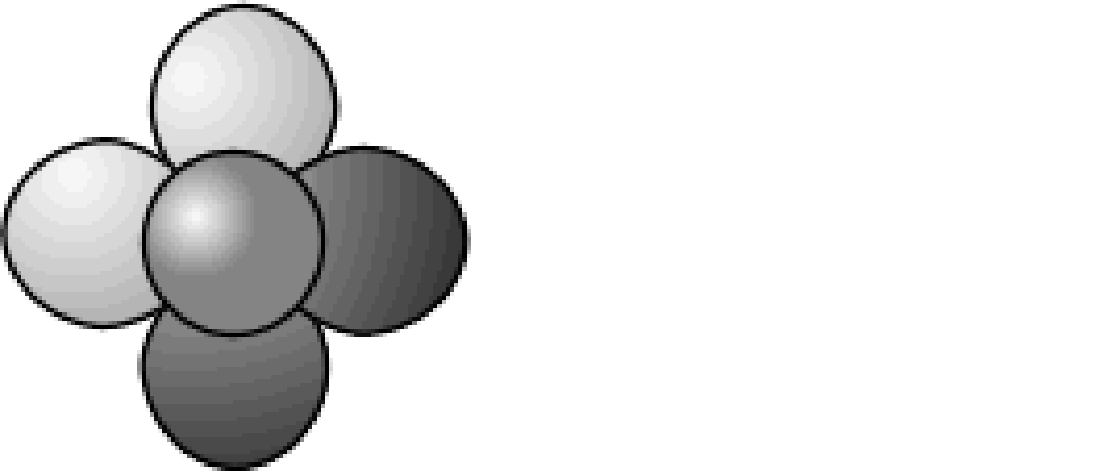
- Ap orbitals
- Bs orbitals
- Cd orbitals
- Df orbitals
12The first quantum shell can have [blank_start]2[blank_end] electrons.
The second quantum shell can have [blank_start]8[blank_end] electrons .
The third quantum shell can have [blank_start]18[blank_end] electrons.
The fourth quantum shell can have [blank_start]32[blank_end] electrons.- A2
- B8
- C18
- D32
13Match the measurements from the gas equation with their SI units:
P : Pressure - [blank_start]Pascals (Pa)[blank_end]
V: Volume -[blank_start]Metres cubed (\(m^3\))[blank_end]
n: Number of moles
R: The gas constant - 8.31 - Joules per mole per kelvin [blank_start](\(J mol^{-1} K{-1}\))[blank_end]
T: Temperature - [blank_start]Kelvins (K)[blank_end]- APascals (Pa)
- BMetres cubed (\(m^3\))
- C(\(J mol^{-1} K{-1}\))
- DKelvins (K)
14What is 30 °C in Kelvin?
[blank_start]303[blank_end]K- A303
15The [blank_start]actual yield[blank_end] of a reaction is the actual mass of product obtained (Measured by weighing, not calculating!).
The [blank_start]theoretical yield[blank_end] is the mass of product we would obtain according to the balanced equation.
[blank_start]Percentage Yield[blank_end] = \(100 \% \times \frac{ \text{Actual Yield}}{\text{Theoretical Yield}}\)- Aactual yield
- Btheoretical yield
- CPercentage Yield
16Primary standards should:
Be solids with [blank_start]high[blank_end] molar masses
Be available in a high degree of [blank_start]purity[blank_end]
Be chemically [blank_start]stable[blank_end]
Not absorb [blank_start]water[blank_end] from the air
Be [blank_start]soluble[blank_end] in water
React rapidly and completely with other substances when used in [blank_start]titrations[blank_end]- Ahigh
- Bpurity
- Cstable
- Dwater
- Esoluble
- Ftitrations
Informações
- Descrição
- O usuário eliminou as informações de disciplina Quiz sobre Atomic Structure Quiz 3 - Eduqas, WJEC, AQA, criado por Usuário eliminado em 14-08-2017.
- Autor
- Usuário eliminado
- Idioma
- English
- Visualizações
- 20
- Histórico
- Criado em 14 ago 2017 · atualizado em 14 ago 2017
- Etiquetas
- Avaliação
- Ainda sem avaliações Avalie este quiz