
Notas
Development of Law Enforcement

Conteúdo das notas (4)
Página 1
Bow Street Runners
At the beginning of the 18th century, law enforcement continued on with a number of methods that had been used before:
Part-times soldiers were used for dealing with riots or revolts
Night watchmen, who, under the guidance of parish constables, reported crimes
Parish constables took charge to prevent disorderly behaviour and arrest criminals
In some towns, there was paid constables who were paid in the same way a modern police force would be.
Bow Street Runners:
In 1748, the Bow Street Runners were set up in London by Chief Magistrate, Henry Fielding. The Bow Street Runners acted as a crime fighting unit, a small group of men who would visit crime scenes and detect criminals. They could be seen as London's first professional police force. Henry's younger brother, John Fielding, became his personal assistant in 1750. The two brothers worked to root our corruption and serve justice in the London area.
The Bow Street Runners were formally attached to the magistrate and were paid by funds received from the government, by 1785 the force was fully funded by the government. Originally, the Fieldings charged fees for their services and collected rewards if crimes were solved successfully.
Henry passed away in 1754, and his brother John took the position of magistrate at Bow Street. John received the nickname 'Blind Beak' as allegedly he could recognise 3,000 criminals by their voices. In the Covent Garden Journal, John published descriptions of known criminals. Moreover, he established the first records for the criminal department.
What was so special about the Fieldings' approach to crime?
Wanted to deter criminal activity by demonstrating the increased risk of being caught and prosecuted for crime
Organised regular patrols (paid constables) along major routeways
Highlighted the importance in collecting and distributing data about criminals, especially with other law enforcement
The activity and success of the Bow Street Runners resulted in detective offices being established in other areas, such as Westminster and Middlesex.
Página 2
Introducing the Police Force
The mixture of local parish constables, night watchmen and groups like the Bow Street Runners was insufficient in dealing with law and order in Britain. People still remain opposed to a police force for a few reasons though:
Questions over whether a police force would infringe on people's privacy and personal freedoms
People were curious as to whether it would really make any difference to crime prevention and law enforcement
Some argued against it due to the expensive costs in funding such a force
In 1829, the Metropolitan Police Act gave London its first uniformed police force. London was divided into seven districts, each contained 144 constables and 4 inspectors. The reason for the police force was to deter criminal activity and caught those in the act of committing illegal activities.
Home Secretary, Robert Peel, wanted the police force to be easily recognisable (uniform) and wanted the force to be a positive addition to the safety of the public. Many people were concerned that the police force would end up preventing political protest and shutting down government opposition.
Developments of the force:
Some areas had a professional police at the start of the 19th century, but many still relied on the older system of parish constables
Development of the force was slow because:
The public were concerned with the costs
Different areas did not coordinate with one another
Development was an option, therefore, many local governing bodies avoided reform
1835 Municipal Corporations Act: gave each borough council the means to set up a local police force
1839 Rural Constabulary Act: permitted all 54 counties to establish a paid police force in their area (only 36/54 did so by 1850)
1856 Police Act:
Police forces were inspected by government officials and only received funding from the government on the basis they were doing their job properly
The principle of deterrence was also established in this act
1869 - the National Crime Records established; telegraph communication allowed police forces to collect and share information quickly about criminals and suspects
1842 - detective branch was established in Scotland Yard; focus on investigating crimes
1878 - Criminal Investigations Department (CID) was founded
CID employed 600 detectives by 1883
1901 - the first fingerprint bureau was established in Scotland Yard (this increased the number of crimes that the CID was able to solve)
Página 3
Robert Peel & Reformation
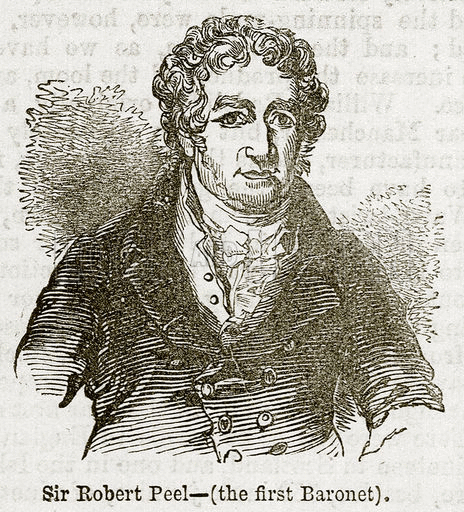
Peel was sometimes labelled as the 'father of modern policing' as he founded the Metropolitan Police Force. Peel was an exemplary individual who worked for penal (involving punishment) reforms and changes in policing. This was helped by his positions of Home Secretary 1822 and Prime Minister 1834-35 and 1841-46.
Peel took on board the ideas of Elizabeth Fry and worked for penal reform
Skilled in seeing that bills were passed through parliament
Used positions of seniority to see through his reforms
Penal Reforms 1820s:
Peel wanted a system of punishment that focused on preventing crime and reforming offenders rather than punishment
He reduced the number of crimes punishable by death by 100
Minor crimes were punished more proportionately (a fairer and more balanced way)
Peel wanted a reform of the prison system also, inspired by reformers such as Elizabeth Fry
1823 Gaols Act
Prisoners should receive regular visits from the prison chaplain
Gaolers should be paid instead of taking money from prisoners
Female prisoners should have female warders
No prisoner should be held in chains
These reforms led to limited improvement; there was nobody to enforce the laws in the first place
A prison inspectorate was established in 1853
Metropolitan Police Form:
In 1826, an economic downturn in Britain resulted in widespread unemployment and poverty. This led to crime wave and rioting too; the army was called in to quash these riots and restore order. After this, Peel believed it would be more reasonable to have a centralised system for dealing with disorder rather than an armed unit. He wanted a standard policing system across the board that would ensure similar standards in both rich and poor areas. The first Metropolitan Police Officers began duties in September 1829.
Criticisms of the force: initially, there were hostile attitudes towards the police force from both the press and the public. Cartoons were published portraying recruits as clueless and idiotic, with poor training. 2,800 recruits signed up to begin, but only 600 stayed on for a year or more. The main fear for people was that the police would limit their personal freedoms would operate like a full-time military patrol in the streets. Some were concerned about the costs this service imposed on the taxpayer.
Página 4
Robert Peel & Reformation
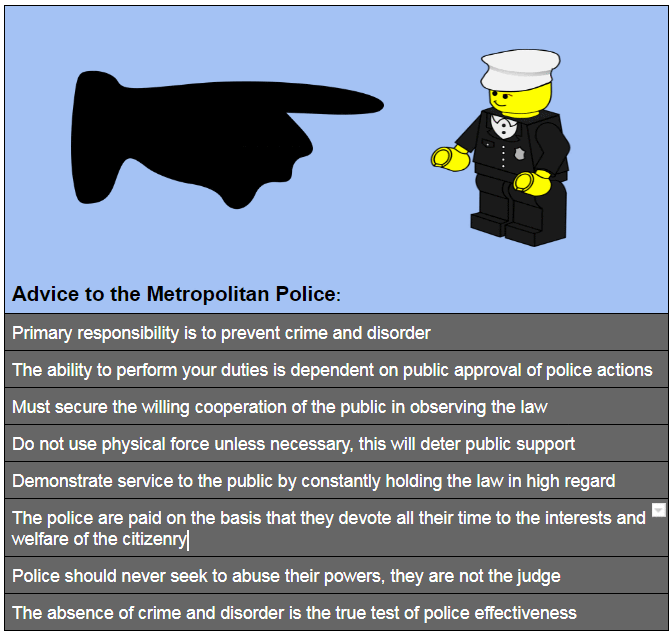
Peel and his fellow police commissioners established a number of guidelines for all new police recruits to familiarise themselves with in order to address the public concerns over the force. The principles below are still adhered to by the force to this day.
Informações
- Descrição
- O usuário eliminou as informações de disciplina Notas sobre Development of Law Enforcement, criado por Usuário eliminado em 14-08-2017.
- Criado por
- Usuário eliminado · ago 2017
- Atualizado
- 14 ago 2017
- Visualizações
- 25
- Histórico
-
- Criado por Andrew Burke · 11 ago 2017
- Copiado por Andrew Burke · 14 ago 2017
- Avaliação