
Notas
Second Order Derivatives
Conteúdo das notas (4)
Página 1
What is a second order derivative?
The second order derivative is the derivative of the derivative.
If we differentiate once, we get \(\frac{dy}{dx}\). Differentiating again gives \(\frac{d^2y}{dx^2}\), which is known as the second derivative. It can also be written as \(f''(x)\).
The second derivative gives the rate of change of the derivative, or the gradient of the curve, with respect to \(x\).
Important:
The second derivative is less than zero at a local maximum.
The second derivative is greater than zero at a local minimum.
The second derivative is zero at a point of inflection.
Página 2
Displacement, velocity and acceleration
Imagine a car is travelling along a straight road. At any given time, its distance from its starting point can be assigned to the value \(x\). Therefore, the rate with which this distance changes with respect to time is \(\frac{dx}{dt}\) - the velocity.
The rate at which their velocity changes with respect to time - the acceleration - can then be expressed as the second order derivative, \(\frac{d^2x}{dt^2}\).
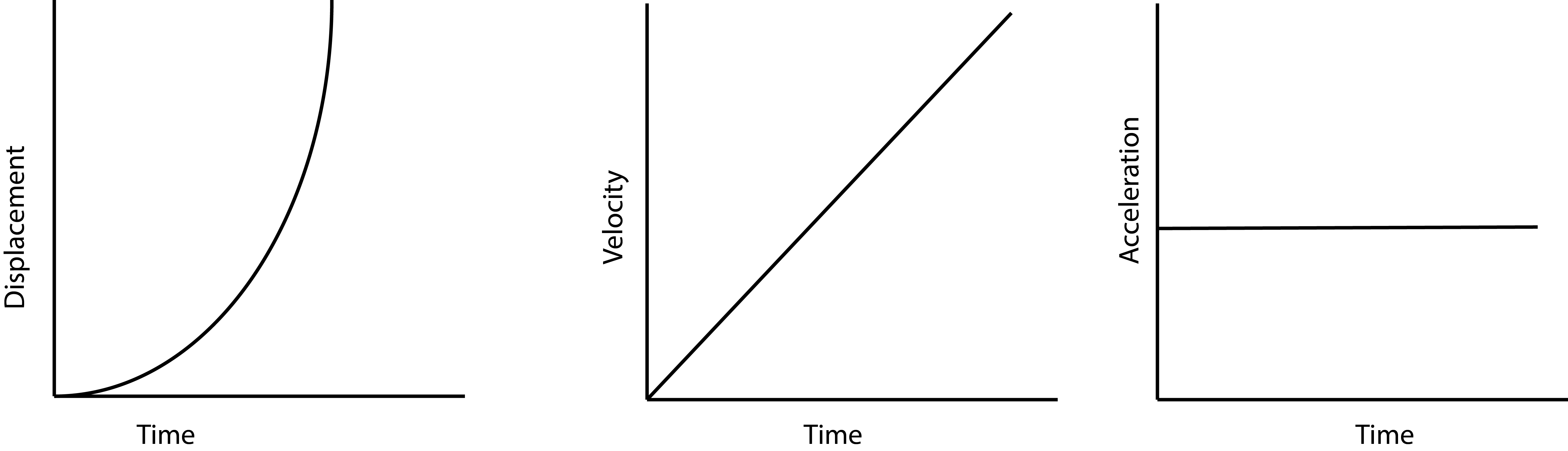
This is demonstrated in the diagram below.
In this example, the Displacement (Distance from starting position) vs Time graph is a quadratic function.
Differentiating this function should give us a linear function. This is because when we differentiate a function containing an \(x^2\) term, this will be come an \(x\) term. This means what was previously a quadratic equation now becomes an equation of a line. The second graph shows \(\frac{dx}{dt}\), the velocity, as a function of time.
The slope of the velocity vs time graph is \(\frac{d^2x}{dt^2}\), the acceleration. As you may already know, the slope of a straight line is constant. This is because when we differentiate the \(x\) term, we get a constant. Therefore, in this case, \(\frac{d^2x}{dt^2}\) is a constant.
As a result, the graph of \(\frac{d^2x}{dt^2}\) as a function of time is simply a constant.
Página 3
Example 1
Part 1: Without detailed calculation, draw a rough sketch of the graph of the slope of the function \[f(x) = 2x^3 - 3x^2 -36x +4\]
Part 2: Use the differentiation rules you have learnt to find and plot the first and second derivatives of the above function.
Answer:
Part 1: \(f(x) \) is a cubic function. Therefore, the graph of its slope will be a quadratic curves.
Part 2: Use the rules you have learnt to differentiate and simplify the equation: \[ f'(x) = (2 \times 3)x^{3-1} - (2 \times 3)x^{2-1} - (6 \times 6)x^{1-1} = 6(x^2 - x - 6)\] Remember that \(x^{0}=1\) and that differentiating a constant always gives zero. This expression can be factorised to give \[6(x-3)(x+2)\] which is easily graphed as shown below

Simply differentiate again to find the second derivative.
\[f''(x) = (6)(2x^{2-1} - x^{1-1}) = 6 (2x-1)\] which is graphed as shown below.

Página 4
Example 2
Question:
A cyclist starts cycling at \(t=0\) from \(x=0\). For the first ten seconds, her journey can be described by the equation \[x=4\sqrt{5t} + 6t^2\]
i) Find the cyclist's velocity after 5 seconds.
ii) Find her acceleration after 5 seconds.
Answer:
i)
The cyclist's velocity is \(\frac{dx}{dt}\), which can be found by differentiating the expression for \(x\) found above.
First, change the surd to an exponent.
\[x= 4\sqrt{5} t^\frac{1}{2} + 6t^2\] Now differentiate x with respect to t to find the general equation for \(\frac{dx}{dt}\).
\[\frac{dx}{dt}=4\sqrt {5} (\frac{1}{2})t^{-\frac{1}{2}} + (6)(2)t = 2\sqrt {\frac{5}{t}} + 12t\] The velocity after five seconds is found by subbing 5 in for \(t\) in the above expression.
\[\frac{dx}{dt}(5)= 2\sqrt {\frac{5}{5}} + 12(5)= 2+60 = 62ms^{-1}\] Make sure to include the units!
ii)
The acceleration can be found by differentiating the general expression for \(\frac{dx}{dt}\).
If \[\frac{dx}{dt}=2\sqrt {5}t^{-\frac{1}{2}} + 12t \] then
\[\frac{d^2x}{dt^2}= 2\sqrt {5} (-\frac{1}{2})t^{-\frac{3}{2}} + 12 = -\sqrt {\frac{5}{t^3}} + 12\] The acceleration after 5 seconds can be found by subbing 5 into the general expression: \[\frac{d^2x}{dt^2}= -\sqrt {\frac{5}{5^3}} + 12=-\sqrt {\frac{5}{125}} + 12=- {\frac{1}{5}} + 12 = \frac{59}{5}ms^{-2}\]

Informações
- Descrição
- O usuário eliminou as informações de disciplina Notas sobre Second Order Derivatives, criado por Usuário eliminado em 16-08-2017.
- Criado por
- Usuário eliminado · ago 2017
- Atualizado
- 16 ago 2017
- Visualizações
- 80
- Histórico
-
- Criado por Niamh Ryan · 8 ago 2017
- Copiado por Niamh Ryan · 16 ago 2017
- Avaliação