
Notas
Defining Desert Landscapes
Conteúdo das notas (4)
Página 1
Defining Aridity and Drylands
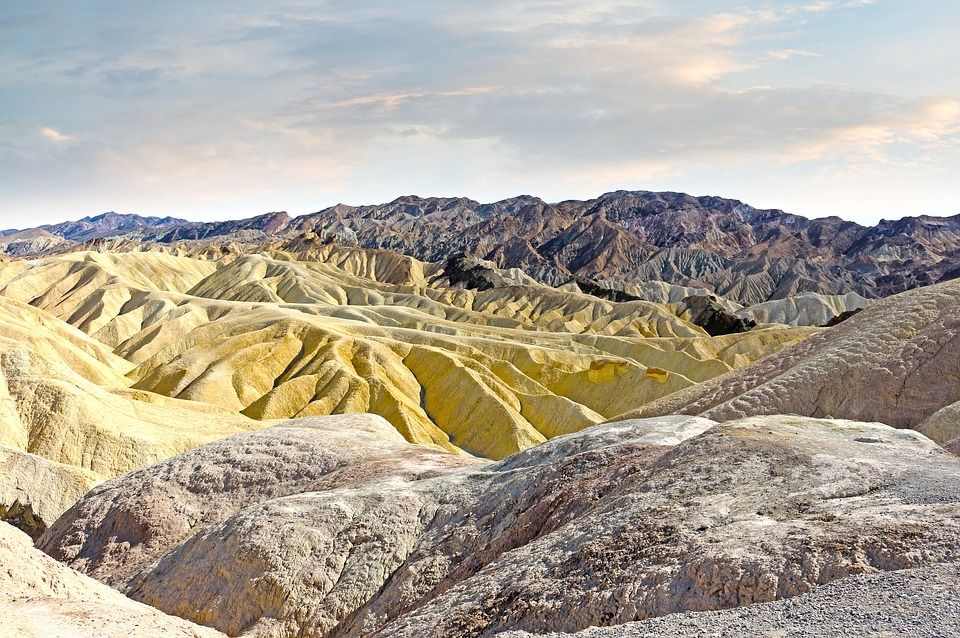
Aridity is a measure of dryness and is the main classification of desert environments.
Aridity is generally measured by amount of rainfall rather than temperature.
The Water Balance Concept is one way to measure aridity. This is how much water is available to a system.
Monthly precipitation (P) is taken over extended periods
Monthly potential evapotranspiration (PET) is the amount of rainfall an area could hypothetically receive
P and PET are compared on the General Aridity Index. An area's aridity index determines how arid it is.
When P=PET, the Index=0
When P=0 throughout the year, the Index=-100
When P greatly exceeds PET throughout the year Index=+100
Subhumid areas have an aridity index of 0 to -20
Semi-arid areas have an aridity index of -20 to -40
Arid areas have an aridity index of -40
Hyper-arid areas experience 12 consecutive months without rainfall & no regular seasonality of rainfall
Página 2
Causes of Aridity
Atmospheric Stability
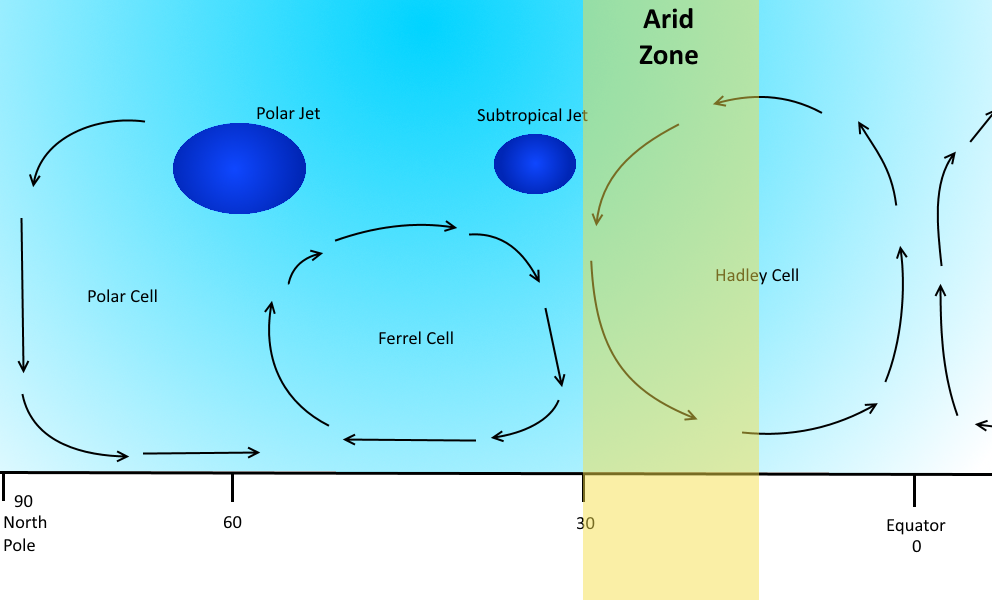
A general cause of aridity is the formation of dry, stable air masses that resist convective currents.
Stability means that there is also a lack of storm events.
Topography:
Air is forced to rise over mountains, air cools and condensation occurs, rain falls over the mountains.
Dry air then sinks down the other side of the mountain, causing aridity.
Continentality (Distance from Oceans):
Central areas of continents are dry because air moving over landmasses does not absorb large amounts of water vapour.
During the last ice age, conversion of water to ice resulted in larger continental areas. This extreme continentality is thought to have facilitated the spread of deserts during the ice age.
Cold Ocean Currents:
Some deserts are found on the western edges of continents. They are causd by cold ocean currents, which run along the coast.
Cold ocean currents cool the air and make it harder for the air to hold moisture.
Página 3
Distribution of Deserts
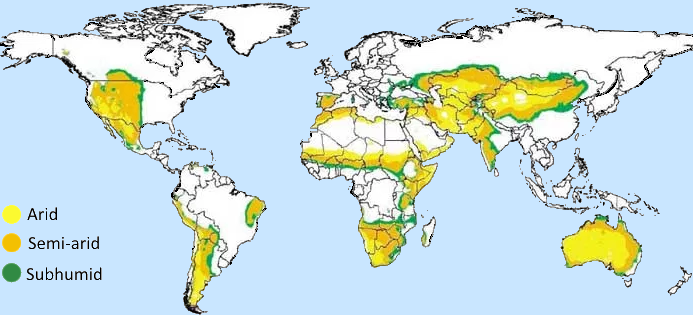
The hot deserts of the world are located between 15° and 30° north or south of the equator.
Hot deserts are usually found on the Western side of continents.
Cold deserts are found in the Antarctic, Greenland, Northern and Western China and Iran.
Cold deserts can also be found in certain mountainous areas, such as the Great Basin area of western United States.
Página 4
Characteristics of Deserts
Hot Deserts:
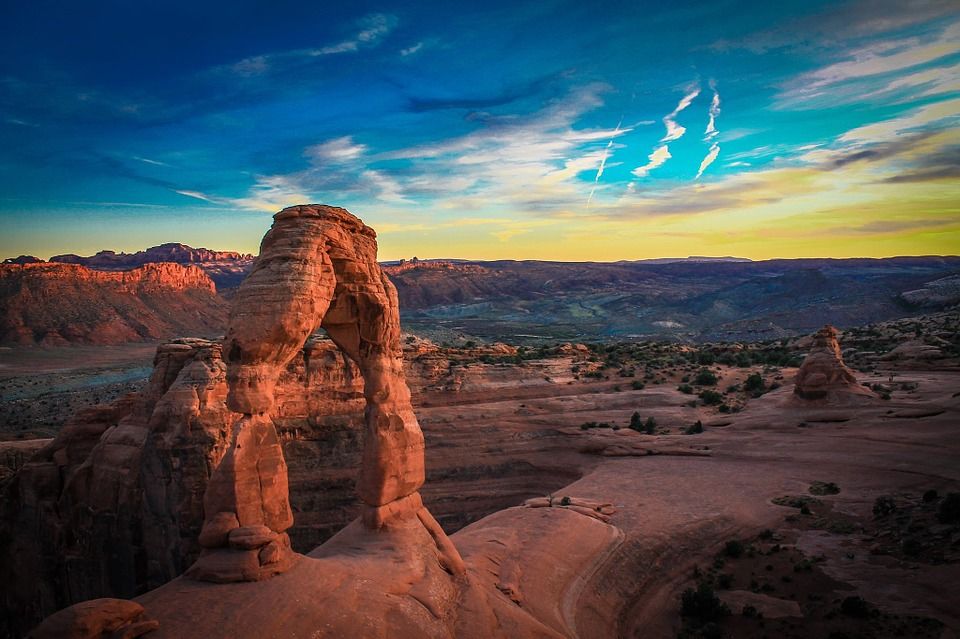
Hot deserts can reach extremely high daytime temperatures (up to 50°C).
Lack of cloud cover means that temperatures can fall to 0°C at night.
Evaporation rates regularly exceed rainfall rates.
Rainfall is usually very low and concentrated in short bursts between long rainless periods.
Soils are course-textured, shallow, rocky or gravely with good drainage and have no subsurface water.
Plants are mainly ground-hugging shrubs and short woody trees.
Lack of plants means that winds are stronger and aeolian erosion can occur.
Semi-Arid Environments:
The summers are moderately long and dry, and like hot deserts, the winters normally bring low concentrations of rainfall.
Summer temperatures range from 21-27°C.
Evening temperatures are warmer than in the hot desert, at around 10°C. Cool nights help both plants and animals by reducing moisture loss from transpiration and sweating.
As in the hot desert, rainfall is often very low and concentrated. The average rainfall ranges from 2-4 cm annually.
The soil can range from sandy and fine-textured to loose rock fragments, gravel or sand.
Plants are generally spiny with waxy leaves.
Cold Deserts:
Cold deserts receive a large amount of snowfall in winter. The mean annual precipitation range is 15-26 cm.
Short, wet moderately warm summers. Mean average summer temperature 21-26ºC.
Mean average winter temperature -2-4ºC.
Cold deserts have heavy, relatively porous soils with a lot of silt and salt.
Animals generally burrow to avoid harsh temperatures.
Informações
- Descrição
- O usuário eliminou as informações de disciplina Notas sobre Defining Desert Landscapes, criado por Usuário eliminado em 17-08-2017.
- Criado por
- Usuário eliminado · ago 2017
- Atualizado
- 17 ago 2017
- Visualizações
- 289
- Histórico
-
- Criado por Antonia Blankenberg · 15 ago 2017
- Copiado por Antonia Blankenberg · 17 ago 2017
- Avaliação