
Quiz
Kinematics in Two Dimensions
Este quiz tem tempo limite, por isso abre no player de sempre.
Perguntas do quiz (21)
1A ball is rolling down one hill and up another. Points A and B are at the same height. How do the velocity and acceleration change as the ball rolls from point A to point B?
- AThe velocity and acceleration are the same at both points.
- BThe velocity and the magnitude of the acceleration are the same at both points, but the direction of the acceleration is opposite at B to the direction it had at A.
- CThe acceleration and the magnitude of the velocity is the same at both points, but the direction of the velocity is opposite at B to the direction it had at A.
- DThe horizontal component of the velocity is the same at points A and B, but the vertical component of the velocity has the same magnitude, but the opposite sign at B. The acceleration at points A and B are the same.
- EThe vertical component of the velocity is the same at points A and B, but the horizontal component of the velocity has the same magnitude, but the opposite sign at B. The acceleration at points A and B has the same magnitude, but opposite direction.
2In two-dimensional motion in the x-y plane, assuming any constant acceleration, what is the relationship between the x part of the motion to the y part of the motion?
- AThe x part of the motion is independent of the y part of the motion.
- BThe y part of the motion goes as the square of the x part of the motion.
- CThe x part of the motion is linearly dependent on the y part of the motion.
- DThe x part of the motion goes as the square of the y part of the motion.
- EIf the y part of the motion is in the vertical direction, then x part of the motion is dependent on the y part.
3A bicyclist is riding at a constant speed along a horizontal, straight-line path. The rider throws a ball straight up to a height a few meters above her head. Ignoring air resistance, where will the ball land? Ignore any effects of air resistance.
- Ain front of the rider
- Bbehind the rider
- Cin the same hand that threw the ball
- Din the opposite hand to the one that threw it
- EThis cannot be determined without knowing the speed of the rider and the maximum height of the ball.
4Balls A, B, and C are identical. From the top of a tall building, ball A is launched with a velocity of 20 m/s at an angle of 45° above the horizontal direction, ball B is launched with a velocity of 20 m/s in the horizontal direction, and ball C is lunched with a velocity of 20 m/s at an angle of 45° below the horizontal direction. Which of the following choices correctly relates the magnitudes of the velocities of the balls just before they hit the ground below? Ignore any effects of air resistance.
- AVa = Vc > Vb
- BVa = Vc= Vb
- CVa > Vc > Vb
- DVa < Vc < Vb
- EVa > Vc < Vb
5A toy rocket is launched at an angle of 45° with a speed Vo. If there is no air resistance, at what points during the time that it is in the air does the speed of the rocket equal 0.5Vo?
- Awhen the rocket is at one half of its maximum height as it is going upward
- Bwhen the rocket is at one half of its maximum height as it is going downward
- Cwhen the rocket is at its maximum height
- Dwhen the rocket is at one fourth of its maximum height as it is going downward
- Eat no time during the flight
6An airplane is flying horizontally at a constant velocity when a package is dropped from its cargo bay. Assuming no air resistance, which one of the following statements is correct?
- AThe package follows a curved path that lags behind the airplane.
- BThe package follows a straight line path that lags behind the airplane.
- CThe package follows a straight line path, but it is always vertically below the airplane.
- DThe package follows a curved path, but it is always vertically below the airplane.
- EThe package follows a curved path, but its horizontal position varies depending on the velocity of the airplane.
7Packages A and B are dropped from the same height simultaneously. Package A is dropped from an airplane that is flying due east at a constant speed. Package B is dropped from rest from a helicopter hovering in a stationary position above the ground. Ignoring air friction effects, which of the following statements is true?
- AA and B reach the ground at the same time, but B has a greater velocity in the vertical direction.
- BA and B reach the ground at the same time; and they have the same velocity in the vertical direction.
- CA and B reach the ground at different times because B has a greater velocity in both the horizontal and vertical direction.
- DA reaches the ground first because it falls straight down.
8At a circus, two clowns, Bippy and Bobo, climb into identical cannons and are launched at identical initial velocities from the same starting height at the same instant of time. Nippy's cannon makes an angle of 55° with respect to the ground and Bobo's cannon makes an angle of 45° with respect to the ground. Both clowns land in a net parallel to the ground at height h. Which clown first, if either? Neglect air resistance.
- ABippy
- BBobo
- CThey land at the same time.
- DThis question cannot be answered without knowing the mass of each clown.
9At a circus, two clowns, Bippy and Bobo, climb into identical cannons and are launched at identical initial velocities from the same starting height at the same instant of time. Each clown lands in a net parallel to the ground at height h, but Bobo lands further away from his cannon than Bippy does from hers. Which clown, if either, lands with greater instantaneous velocity? Neglect any effects due to air resistance.
- ABippy
- BBobo
- CThey land with the same instantaneous velocity.
- DThis question cannot be answered without knowing the mass of each clown.
10Which one of the following statements concerning the displacement of an object is false?
- ADisplacement is a vector quantity that points from the initial position of an object to its final position.
- BThe magnitude of an object's displacement is always equal to the distance it traveled from its initial position its final position.
- CThe magnitude of an object's displacement is the shortest distance from its initial position to its final position.
- DThe direction of an object's displacement is indicated by an arrow that begins on the initial position of the object and ends on its final position.
- EThe length of the arrow representing an object's displacement is proportional to its magnitude.
11A park ranger, lying on the ground, wanted to measure the height of a tall tree. The ranger was 6.10 m from the base of the tree; and he observed that his line of sight made an angle of 73.5° above the horizontal as he looked at the top of the tree. What is the height of the tree?
- A5.84 m
- B8.77 m
- C11.7 m
- D17.3 m
- E20.6 m
12A delivery truck leaves a warehouse and travels 3.20 km east. The truck makes a right turn and travels 2.45 km south to arrive at its destination. What is the magnitude and direction of the truck's displacement from the warehouse?
- A4.03 km, 37.4° south of east
- B2.30 km, 52.5° south of east
- C0.75 km, 37.8° south of east
- D2.40 km, 45.0° south of east
- E5.65 km, 52.5° south of east
13A truck drives due south for 1.8 km in 2.0 minutes. Then, the truck turns and drives due west for 1.8 km in 2.0 minutes. Which one of the following pairs of statements is correct?
- AThe average speed for the two segments is the same. The average velocity for the two segments is the same.
- BThe average speed for the two segments is not the same. The average velocity for the two segments is the same.
- CThe average speed for the two segments is the same. The average velocity for the two segments is not the same.
- DThe average speed for the two segments is the not the same. The average velocity for the two segments is not the same.
14In two-dimensional motion in the x-y plane, what is the relationship between the x part of the motion to the y part of the motion?
- AThe x part of the motion is independent of the y part of the motion.
- BThe y part of the motion goes as the square of the x part of the motion.
- CThe x part of the motion is linearly dependent on the y part of the motion.
- DIf the y part of the motion is in the vertical direction, then x part of the motion is dependent on the y part.
15A football is kicked at an angle 25° with respect to the horizontal. Which one of the following statements best describes the acceleration of the football during this event if air resistance is neglected?
- AThe acceleration is zero m/s2 at all times.
- BThe acceleration is zero m/s2 when the football has reached the highest point in is trajectory
- CThe acceleration is positive as the football rises, and it is negative as the football falls.
- DThe acceleration starts at 9.8 m/s2 and drops to some constant lower value as the ball approaches the ground.
- EThe acceleration is 9.8 m/s2 at all times.
16A baseball is hit upward at an angle to the horizontal and travels along a parabolic arc before it strikes the ground. Which one of the following statements is necessarily true?
- AThe velocity of the ball is a maximum when the ball is at the highest point in the arc.
- BThe x-component of the velocity of the ball is the same throughout the ball’s flight.
- CThe acceleration of the ball decreases as the ball moves upward.
- DThe velocity of the ball is zero m/s when the ball is at the highest point in the arc.
- EThe acceleration of the ball is zero m/s2 when the ball is at the highest point in the arc.
17Two cannons are mounted on a high cliff. Cannon A fires balls with twice the initial velocity of cannon B. Both cannons are aimed horizontally and fired. How does the horizontal range of cannon A compare to that of cannon B?
- AThe range for both balls will be the same.
- BThe range of the cannon ball B is about 0.7 times that of cannon ball A.
- CThe range of cannon ball B is about 1.4 times that of cannon ball A.
- DThe range of cannon ball B is about twice that of cannon ball A.
- EThe range of the cannon ball B is about one-half that of cannon ball A.
185. An airplane is flying horizontally at a constant velocity when a package is dropped from its cargo bay. Assuming no air resistance, which one of the following statements is correct?
- AThe package follows a curved path that lags behind the airplane.
- BThe package follows a straight line path that lags behind the airplane.
- CThe package follows a straight line path, but it is always vertically below the airplane.
- DThe package follows a curved path, but it is always vertically below the airplane.
- EThe package follows a curved path, but its horizontal position varies depending on the velocity of the airplane.
19What remains constant throughout free-fall? Select all that apply.
- AThe acceleration in the horizontal direction remains constant throughout free-fall.
- BThe acceleration in the vertical direction remains constant throughout free-fall.
- CThe velocity in the vertical direction remains constant throughout free-fall.
- DThe velocity in horizontal direction remains constant throughout free-fall.
20A basketball is launched with an initial speed of 8.5 m/s and follows the trajectory shown. The ball enters the basket 0.92 seconds after it is launched. What are the distances x and y. Note: The drawing is not to scale.
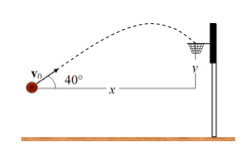
- Ax = 6.0 m, y = 0.88 m
- Bx = 5.0 m, y = 0.73 m
- Cx = 5.0 m, y = 0.91 m
- Dx = 5.0 m, y = 1.1 m
- Ex = 6.0 m, y = 1.96 m
21A bullet is aimed at a target on the wall a distance L away from the firing position. Because of gravity, the bullet strikes the wall a distance delta y below the mark as suggested in the figure. Note: The drawing is not to scale. If the distance L was half as large, and the bullet had the same initial velocity, how would delta y be affected?
- ADelta y will double.
- BDelta y will be half as large.
- CDelta y will be one fourth as large.
- DDelta y will be four times larger.
- EIt is not possible to determine unless numerical values are given.
Informações
- Descrição
- 11th grade Physics Quiz sobre Kinematics in Two Dimensions, criado por bella joy em 22-10-2017.
- Autor
- bella joy
- Idioma
- English
- Visualizações
- 162
- Etiquetas
- Avaliação
- Ainda sem avaliações Avalie este quiz