
Quiz
AP Bio Chapter 7
Este quiz tem tipos de pergunta que abrem no player de sempre.
Perguntas do quiz (47)
1What is the term for metabolic pathways that release stored energy by breaking down complex molecules?
- Aanabolic pathways
- Bcatabolic pathways
- Cfermentation pathways
- Dthermodynamic pathways
- Ebioenergetic pathways
2The molecule that functions as the reducing agent (electron donor) in a redox or oxidation-reduction reaction
- Agains electrons and gains energy.
- Bloses electrons and loses energy.
- Cgains electrons and loses energy.
- Dloses electrons and gains energy.
- Eneither gains nor loses electrons, but gains or loses energy.
3When a molecule of NAD+ (nicotinamide adenine dinucleotide) gains a hydrogen atom (not a hydrogen ion) the molecule becomes
- Ahydrogenated.
- Boxidized.
- Creduced.
- Dredoxed.
- Ea reducing agent.
4Where does glycolysis takes place?
- Amitochondrial matrix
- Bmitochondrial outer membrane
- Cmitochondrial inner membrane
- Dmitochondrial intermembrane space
- Ecytosol
5The ATP made during glycolysis is generated by
- Asubstrate-level phosphorylation.
- Belectron transport
- Cphotophosphorylation.
- Dchemiosmosis.
- Eoxidation of NADH to NAD+.
6The oxygen consumed during cellular respiration is involved directly in which process or event?
- Aglycolysis
- Baccepting electrons at the end of the electron transport chain
- Cthe citric acid cycle
- Dthe oxidation of pyruvate to acetyl CoA
- Ethe phosphorylation of ADP to form ATP
7Which process in eukaryotic cells will proceed normally whether oxygen (O2) is present or absent?
- Aelectron transport
- Bglycolysis
- Cthe citric acid cycle
- Doxidative phosphorylation
- Echemiosmosis
8Why are carbohydrates and fats considered high energy foods?
- AThey have a lot of oxygen atoms.
- BThey have no nitrogen in their makeup.
- CThey can have very long carbon skeletons.
- DThey have a lot of electrons associated with hydrogen.
- EThey are easily reduced.
9During glycolysis, when glucose is catabolized to pyruvate, most of the energy of glucose is
- Atransferred to ADP, forming ATP.
- Btransferred directly to ATP.
- Cretained in the pyruvate.
- Dstored in the NADH produced.
- Eused to phosphorylate fructose to form fructose-6-phosphate.
10In addition to ATP, what are the end products of glycolysis?
- ACO2 and H2O
- BCO2 and pyruvate
- CNADH and pyruvate
- DCO2 and NADH
- EH2O, FADH2, and citrate
11In glycolysis, for each molecule of glucose oxidized to pyruvate
- A2 molecules of ATP are used and 2 molecules of ATP are produced.
- B2 molecules of ATP are used and 4 molecules of ATP are produced.
- C4 molecules of ATP are used and 2 molecules of ATP are produced.
- D2 molecules of ATP are used and 6 molecules of ATP are produced.
- E6 molecules of ATP are used and 6 molecules of ATP are produced.
12A molecule that is phosphorylated
- Ahas been reduced as a result of a redox reaction involving the loss of an inorganic phosphate.
- Bhas a decreased chemical reactivity; it is less likely to provide energy for cellular work.
- Chas been oxidized as a result of a redox reaction involving the gain of an inorganic phosphate.
- Dhas an increased chemical reactivity; it is primed to do cellular work.
- Ehas less energy than before its phosphorylation and therefore less energy for cellular work.
13Which kind of metabolic poison would most directly interfere with glycolysis?
- Aan agent that reacts with oxygen and depletes its concentration in the cell
- Ban agent that binds to pyruvate and inactivates it
- Can agent that closely mimics the structure of glucose but is not metabolized
- Dan agent that reacts with NADH and oxidizes it to NAD+
- Ean agent that blocks the passage of electrons along the electron transport chain
14Why is glycolysis described as having an investment phase and a payoff phase?
- AIt both splits molecules and assembles molecules.
- BIt attaches and detaches phosphate groups.
- CIt uses glucose and generates pyruvate.
- DIt shifts molecules from cytosol to mitochondrion.
- EIt uses stored ATP and then forms a net increase in ATP.
15Starting with one molecule of isocitrate and ending with fumarate, what is the maximum number of ATP molecules that could be made through phosphorylation?
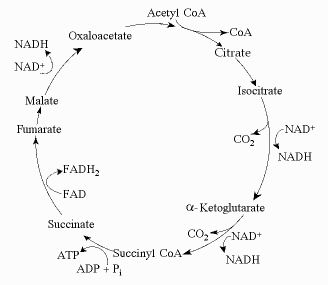
- A1
- B2
- C11
- D12
- E24
16How many molecules of carbon dioxide (CO2) would be produced by five turns of the citric acid cycle?
- A2
- B5
- C10
- D12
- E60
17How many reduced dinucleotides would be produced with four turns of the citric acid cycle?
- A1 FADH2 and 4 NADH
- B2 FADH2 and 8 NADH
- C4 FADH2 and 12 NADH
- D1 FAD and 4 NAD+
- E4 FAD+ and 12 NAD+
18Cellular respiration harvests the most chemical energy from which of the following?
- Asubstrate-level phosphorylation
- Bchemiosmotic phosphorylation
- Cconverting oxygen to ATP
- Dtransferring electrons from organic molecules to pyruvate
- Egenerating carbon dioxide and oxygen in the electron transport chain
19During aerobic respiration, electrons travel downhill in which sequence?
- Afood ® citric acid cycle ® ATP ® NAD+
- Bfood ® NADH ® electron transport chain ® oxygen
- Cglucose ® pyruvate ® ATP ® oxygen
- Dglucose ® ATP ® electron transport chain ® NADH
- Efood ® glycolysis ® citric acid cycle ® NADH ® ATP
20During oxidative phosphorylation, H2O is formed. Where does the oxygen for the synthesis of the water come from?
- Acarbon dioxide (CO2)
- Bglucose (C6H12O6)
- Cmolecular oxygen (O2)
- Dpyruvate (C3H3O3-)
- Elactate (C3H5O3-)
21In chemiosmotic phosphorylation, what is the most direct source of energy that is used to convert ADP + Pi to ATP?
- Aenergy released as electrons flow through the electron transport system
- Benergy released from substrate-level phosphorylation
- Cenergy released from ATP synthase pumping hydrogen ions from the mitochondrial matrix
- Denergy released from movement of protons through ATP synthase
- ENo external source of energy is required because the reaction is exergonic.
22Why is glycolysis considered to be one of the first metabolic pathways to have evolved?
- AIt produces much less ATP than does oxidative phosphorylation.
- BIt is found in the cytosol, does not involve oxygen, and is present in most organisms.
- CIt is found in prokaryotic cells but not in eukaryotic cells.
- DIt relies on chemiosmosis which is a metabolic mechanism present only in the first cells-prokaryotic cells.
- EIt requires the presence of membrane-enclosed cell organelles found only in eukaryotic cells.
23Muscle cells, when an individual is exercising heavily and when the muscle becomes oxygen deprived, convert pyruvate to lactate. What happens to the lactate in skeletal muscle cells?
- AIt is converted to NAD+
- BIt produces CO2 and water.
- CIt is taken to the liver and converted back to pyruvate.
- DIt reduces FADH2 to FAD+
- EIt is converted to alcohol.
24You have a friend who lost 7 kg (about 15 pounds) of fat on a "low carb" diet. How did the fat leave her body?
- AIt was released as CO2 and H2O
- BChemical energy was converted to heat and then released.
- CIt was converted to ATP, which weighs much less than fat.
- DIt was broken down to amino acids and eliminated from the body.
- EIt was converted to urine and eliminated from the body.
25Even though plants carry on photosynthesis, plant cells still use their mitochondria for oxidation of pyruvate. When and where will this occur?
- Ain photosynthetic cells in the light, while photosynthesis occurs concurrently
- Bin non-photosynthesizing cells only
- Cin cells that are storing glucose only
- Din photosynthesizing cells in dark periods and in other tissues all the time
- Ein photosynthesizing cells in the light and in other tissues in the dark
26The primary role of oxygen in cellular respiration is to
- Ayield energy in the form of ATP as it is passed down the respiratory chain.
- Bact as an acceptor for electrons and hydrogen, forming water.
- Ccombine with carbon, forming CO2
- Dcombine with lactate, forming pyruvate.
- Ecatalyze the reactions of glycolysis.
27In liver cells, the inner mitochondrial membranes are about 5 X the area of the outer mitochondrial membranes, and about 17 X that of the cell's plasma membrane. What purpose must this serve?
- AIt allows for increased rate of glycolysis.
- BIt allows for increased rate of the citric acid cycle.
- CIt increases the surface for oxidative phosphoryation.
- DIt increases the surface for substrate-level phosphorylation.
- EIt allows the liver cell to have fewer mitochondria.
28The ATP made during fermentation is generated by which of the following?
- Athe electron transport chain
- Bsubstrate-level phosphorylation
- Cchemiosmosis
- Doxidative phosphorylation
- Eaerobic respiration
29In the absence of oxygen, yeast cells can obtain energy by fermentation, resulting in the production of
- AATP, CO2, and ethanol (ethyl alcohol).
- BATP, CO2, and lactate.
- CATP, NADH, and pyruvate.
- DATP, pyruvate, and oxygen.
- EATP, pyruvate, and acetyl CoA.
30One function of both alcohol fermentation and lactic acid fermentation is to
- Areduce NAD+ to NADH
- Breduce FAD+ to FADH2
- Coxidize NADH to NAD+
- Dreduce FADH2 to FAD+
- Enone of the above
31Which of the following statements describes NAD+?
- ANAD+ is reduced to NADH during both glycolysis and the citric acid cycle.
- BNAD+ has more chemical energy than NADH.
- CNAD+ is reduced by the action of hydrogenases.
- DNAD+ can donate electrons for use in oxidative phosphorylation.
- EIn the absence of NAD+, glycolysis can still function.
32A young animal has never had much energy. He is brought to a veterinarian for help and is sent to the animal hospital for some tests. There they discover his mitochondria can use only fatty acids and amino acids for respiration, and his cells produce more lactate than normal. Of the following, which is the best explanation of his condition?
- AHis mitochondria lack the transport protein that moves pyruvate across the outer mitochondrial membrane.
- BHis cells cannot move NADH from glycolysis into the mitochondria.
- CHis cells contain something that inhibits oxygen use in his mitochondria.
- DHis cells lack the enzyme in glycolysis that forms pyruvate.
- EHis cells have a defective electron transport chain, so glucose goes to lactate instead of to acetyl CoA.
33Where are the proteins of the electron transport chain located?
- Acytosol
- Bmitochondrial outer membrane
- Cmitochondrial inner membrane
- Dmitochondrial intermembrane space
- Emitochondrial matrix
34When hydrogen ions are pumped from the mitochondrial matrix across the inner membrane and into the intermembrane space, the result is the
- Aformation of ATP.
- Breduction of NAD+.
- Crestoration of the Na+/K+ balance across the membrane.
- Dcreation of a proton gradient.
- Elowering of pH in the mitochondrial matrix.
35Carbon dioxide (CO2) is released during which of the following stages of cellular respiration?
- Aglycolysis and the oxidation of pyruvate to acetyl CoA
- Boxidation of pyruvate to acetyl CoA and the citric acid cycle
- Cthe citric acid cycle and oxidative phosphorylation
- Doxidative phosphorylation and fermentation
- Efermentation and glycolysis
36Inside an active mitochondrion, most electrons follow which pathway?
- Aglycolysis ® NADH ® oxidative phosphorylation ® ATP ® oxygen
- Bcitric acid cycle → mc036-1.jpg → electron transport chain → ATP
- Celectron transport chain ® citric acid cycle ® ATP ® oxygen
- Dpyruvate ® citric acid cycle ® ATP ® NADH ® oxygen
- Ecitric acid cycle ® NADH ® electron transport chain ® oxygen
37Where is ATP synthase located in the mitochondrion?
- Acytosol
- Belectron transport chain
- Couter membrane
- Dinner membrane
- Emitochondrial matrix
38Each time a molecule of glucose (C6H12O6) is completely oxidized via aerobic respiration, how many oxygen molecules (O2) are required?
- A1
- B2
- C6
- D12
- E38
39Approximately how many molecules of ATP are produced from the complete oxidation of two molecules of glucose (C6H12O6) in cellular respiration?
- A2
- B4
- C15
- D38
- E76
40Recall that the complete oxidation of a mole of glucose releases 686 kcal of energy (ÄG = -686 kcal/mol). The phosphorylation of ADP to form ATP stores approximately 7.3 kcal per mole of ATP. What is the approximate efficiency of cellular respiration for a "mutant" organism that produces only 29 moles of ATP for every mole of glucose oxidized, rather than the usual 36-38 moles of ATP?
- A0.4%
- B25%
- C30%
- D40%
- E60%
41The accompanying figure shows the electron transport chain. Which of the following is the combination of substances that is initially added to the chain?
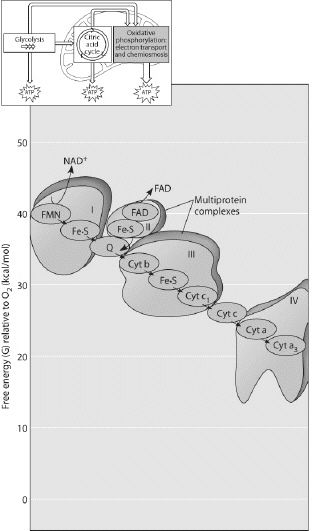
- Aoxygen, carbon dioxide, and water
- BNAD+, FAD, and electrons
- CNADH, FADH2, and protons
- DNADH, FADH2, and electrons
- Eoxygen and electrons
42Which metabolic pathway is common to both cellular respiration and fermentation?
- Athe oxidation of pyruvate to acetyl CoA
- Bthe citric acid cycle
- Coxidative phosphorylation
- Dglycolysis
- Echemiosmosis
43Where do the catabolic products of fatty acid breakdown enter into the citric acid cycle?
- Apyruvate
- Bmalate or fumarate
- Cacetyl CoA
- Dá-ketoglutarate
- Esuccinyl CoA
44Which of the following is a true distinction between fermentation and cellular respiration?
- AOnly respiration oxidizes glucose.
- BNADH is oxidized by the electron transport chain in respiration only.
- CFermentation, but not respiration, is an example of a catabolic pathway.
- DSubstrate-level phosphorylation is unique to fermentation.
- ENAD+ functions as an oxidizing agent only in respiration.
45Most CO2 from catabolism is released during
- Aglycolysis.
- Bthe citric acid cycle.
- Clactate fermentation.
- Delectron transport.
- Eoxidative phosphorylation.
46Step [blank_start]B[blank_end] shows a split of one molecule into two smaller moelecules.
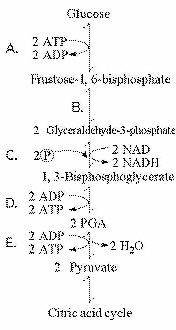
- AB
47Step [blank_start]A[blank_end] involves an endergonic reaction.
- AA
Informações
- Descrição
- Quiz sobre AP Bio Chapter 7, criado por Brooke Nyenhuis em 20-01-2018.
- Autor
- Brooke Nyenhuis
- Idioma
- English
- Visualizações
- 8
- Etiquetas
- Avaliação
- Ainda sem avaliações Avalie este quiz