
Quiz
stats exam
Este quiz tem tipos de pergunta que abrem no player de sempre.
Perguntas do quiz (60)
1The variables of house size in 'big' 'medium' and 'small' are
- AContinuous
- BDiscrete
- COrdinal
- DNominal
2How many components are involved in hypothesis testing?
- A0
- B1
- C2
- D3
3Which of the following do you NOT need to consider when deciding on an appropriate statistical analysis?
- AType of variables you have
- BHow many variables you have
- CYour research design
- DNotion and terminology
4Bella has observed a correlation between air conditioning sales and drownings, finding that as air conditioning sales increase, drownings also increase. What is the likely explanation for this correlation?
- AThere is a causal relationship between air conditioning sales and drownings
- BThere is a third variable problem
- CThis is likely a coincidence
- DConfounding variables have influenced this relationship
5I am trying to find out whether swimming and running can influence mental health. I am measuring all variables as continuous, except for swimming which is measured as categorical involving a 'low level' and 'high level'. Which analysis best suits my plans?
- AMultiple regression
- BFactorial independent ANOVA
- CFactorial repeated measures ANOVA
- DModeration
6Which type of test assesses group medians?
- AParametric
- BNon-parametric
- CCubic
- DMonotonic
7Which of the following is NOT an assumption of parametric tests?
- AAdditivity
- BHomogeneity of variance
- CTonicity
- DIndependence of observations
8I am doing a parametric test and have decided to plot my residuals vs predicted values in a graph. The following result is obtained. What can I conclude?
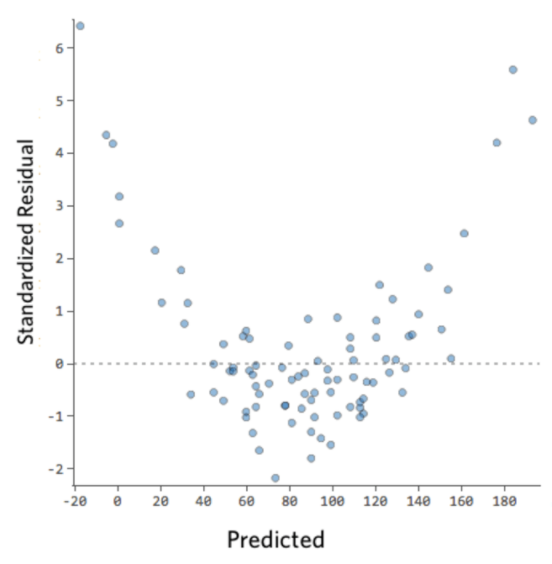
- AMy data is not linear. I will not be able to run a parametric test.
- BMy data is linear. I will be able to run a parametric test.
- CMy data is not linear. I will be able to run a parametric test.
- DMy data is linear. I will not be able to run a parametric test.
9A distribution assigned a negative kurtosis value with a light tail can be described as [blank_start]platykurtic[blank_end]
- Aplatykurtic
10Which of the following statements best describes the term 'residual'?
- AThe variance of a data point from the regression line
- BThe assumption that all groups or data points have the same or similar variance
- CData points that are unrelated
- DLeftover data points from analysis that were excluded due to assumption violations
11Univariate outliers bias the mean and _______ the standard deviation
- Ainflate
- Bbias
- Cdeflate
- Ddo not effect
12Laura is completing an analysis and would like to use a parametric test, however her normality assumption has been violated and she has been recommended to transform her data due to her small sample size of 10. Laura looks over her data set, and notes down that she is experiencing a positive skew, and that her data set has values ranging from (and inclusive of) 0 to 67. Which transformation should she use?
- ALog
- BReciprocal
- CSquare root
- DCubic
13Population pyramids can be described as
- Atwo side by side smoothed histograms
- Btextual graphs that classify data items according to their most significant digits
- Cdistributions of single variables
- Da visualisation of the relationship between two numerical variables
14In general, smaller sample sizes require ________ r values to achieve statistical significance
- Ahigher
- Bthe same
- Clower
- Dmore robust
15[blank_start]Covariance[blank_end] indicates how much two variables differ from their means
- ACovariance
16When would you use a Spearman over a Pearson correlation?
- AWhen data isn't normal and N<30
- BWhen data isn't normal and N>30
- CWhen data isn't independent and N<30
- DWhen data isn't independent and N>30
17Relationships that are consistently one-directional but not linear can be described as
- Amonotonic
- Bbitonic
- Cnon-parametric
- Dparametric
18Sarah wants to examine the unique effect of exercise on sleep quality while controlling for the effects of depression on both exercise and sleep quality. What should she use?
- APearson's correlation coefficient
- BPartial correlation
- CSemi-partial correlation
- DCoefficient of determination (R2)
19Spearman correlations can be described as
- AZero order
- BFirst order
- CSecond order
- DThird order
20Alcohol use has been seen to increase anxiety, and anxiety has been seen to increase alcohol use. This relationship can thus be described as
- Arestricted range
- Bbidirectional
- Ccausal
- Dthird variable
21Lolly runs two separate simple linear regressions. In her first linear regression, she examines exercise and sleep quality in men (r = .345, p<.001), and in her second linear regression, she examines exercise and sleep quality in women (r = .456, p<.001). What can we conclude from this?
- AThe relationship between exercise and sleep quality is stronger in men than in women
- BThe relationship between exercise and sleep quality is stronger in women than in men
- CThe relationship between exercise and sleep quality in the first regression is moderate, and the relationship between exercise and sleep quality in the second relationship is also moderate
- DYou cannot make any of these conclusions from the information given
22I am completing a study with many different variables, and have a lot of missing data. I have decided to exclude participants without a score for every variable, even if they are only missing data for one of my variables, so that my sample size will be the same for all reported correlations. This is an example of ______ exlcusion
- Alistwise
- Bpairwise
- Clinear
- Dadditive
23In linear regression, the beta value represents
- AValue of Y when X is 0
- BSlope of the predictor
- CRange of the predictor
- DMagnitude of the predictor
24In linear regression, B1 represents
- ASlope of the predictor
- BValue of Y when X is 0
- CRange of the predictor
- DMagnitude of the predictor
25What is the standardised version of covariance?
- Ar
- BR2
- Cp
- Dt
26An R2 value of 0.26 (26%) would generally be considered
- Anegligible
- Bsmall
- Cmedium
- Dlarge
27[blank_start]Adjusted R2[blank_end] gives an estimate of R2 in the population, and takes into account the fact that the regression model may overfit the data set
- AAdjusted R2
28Sampling error ________ as the sample size ______ and the number of predictors increase
- Adecreases; decreases
- Bdecreases; increases
- Cincreases; increases
- Dincreases; decreases
29Which of the following is NOT an assumption of linear regression?
- ANon-zero variance
- BLinearity
- CNormality of the IV
- DHomoscedasticity
30I am testing the effects of jellybeans (X1) and chocolate (X2) on blood sugar. My regression equation looks like this:
Yi = 103 + 2.7X1 - 6.8X2 + error
Which of the following conclusions is the most correct?- AWhen someone has not had any jellybeans or chocolate, their blood sugar is 103
- BFor every 1 standard deviation increase in jellybeans eaten, there is a 2.7 standard deviation increase in blood sugar
- CFor every unit of chocolate eaten, there is a 6.8 unit increase in blood sugar
- DJellybeans cause higher blood sugar, chocolate causes lower blood sugar
31I am completing an experiment comparing people's scores on a test based on their heights. I have decided to dummy code heights, and I have two groups (above 180cm and below 180cm). How many dummy variables do I include in my equation?
- A1
- B2
- C3
- D4
32I want to determine how much the covariates in my experiment contribute uniquely beyond the predictors. All of my variables are continuous. What should I do?
- ARun a hierarchical regression in which I firstly enter a set of covariates and then enter my predictors of interest, and compare R2 changes
- BRun a hierarchical regression in which I firstly enter the predictors and then enter the covariates, and compare R2 changes
- CRun an ANOVA in which I firstly enter the predictors and then enter the covariates, and compare R2 changes
- DRun an ANOVA in which I firstly enter a set of covariates and then enter my predictors of interest, and compare R2 changes
33I am running a model in which I firstly enter the variables of age and gender, and then I enter the variables of age, gender, and IQ into my equation. What is this an example of?
- ANested model
- BNon-nested model
- CPiecewise model
- DQuadratic association
34Which metric of 'goodness' is the best out of the following options for model comparison in non-nested models?
- ALog likelihood comparison
- BBayesian information criterion
- CNormality
- DGoodness of fit (r)
35In ANOVA, a(n) [blank_start]interaction[blank_end] effect examines two or more factors at a time, i.e. their combined effect which may not be predictable based on the effects of either factor on their own
- Ainteraction
36In regression, which of the following combinations can be used for interactions?
- A1 categorical and 1 continuous variable
- B2 categorical variables
- C2 continuous variables
- DAll of these options are possible
37I am running a moderation analysis and find that my interaction coefficient is negative. What is a correct interpretation of this?
- AIncreasing the moderator variable decreases the relationship between the other variables
- BDecreasing the moderator variable decreases the relationship between the other variables
- CThe interaction effect is significant, but not the main effects
- DBoth the interaction and main effects are significant
38What values are typically used to define simple slopes?
- A1, 2, 3
- B+1SD, mean, -1SD
- C+1, mean, -1
- DNo values are used to define simple slopes as they are categorical
39I am running an experiment to determine whether stress (continuous) affects happiness (continuous). I have found that stress is interacting with itself. What does this mean?
- AAt one level of stress the relationship between stress and happiness is significant, but at another it is not
- BThe currently observed relationship is linear and should not be used for moderation
- CI made an error when calculating multicollinearity variables and need to re-check my assumptions
- DStress has been winsorised and should be interpreted accordingly
40I am determining whether my variables are suitable for a moderation analysis, and find that my multicollinearity statistic for X*M and X is 0.7, which suggests multicollinearity. What should I do?
- ANo action needed
- BGet rid of X
- CCombine X and X*M into X*X*M
- DWinsorise the data
41[blank_start]Family-wise[blank_end] alpha level is the probability of making at least one type 1 error among a series of comparisons
- AFamily-wise
42[blank_start]Decision-wise[blank_end] alpha level is the probability of obtaining a false positive within a single comparison
- ADecision-wise
43For a test to be significant in ANOVA, we need ____ to be higher than ____
- AModel sum of squares; residual sum of squares
- BResidual sum of squares; model sum of squares
- CTotal sum of squares; residual sum of squares
- DResidual sum of squares; total sum of squares
44In ANOVA, if the sample sizes in groups are unequal, or small, it is more sensitive to violations of
- Anormality
- Bhomogeneity of variance
- Cindependence of observations
- Dinterval/ratio data
45I am doing an ANOVA and find that I have a significant F-ratio. What should I do next?
- AOrthogonal contrasts
- BPost hoc tests
- CMultiple t-tests
- DTrend analysis
46The key difference when considering variabilty in repeated measures vs independent measures ANOVA is that repeated measures uses
- Awithin-group variability rather than residual variability
- Bresidual variability rather than within-group variability
- Cwithin-group variability rather than between-group variability
- Dbetween-group variability rather than within-group variability
47I want to use an effect size for my ANOVA. My sample size is 7, and I am not too concerned about being able to transform my effect size to use in other calculations. Which is the best choice for me?
- AEta-squared
- BOmega-squared
- CCohen's d
- DR squared
48I am running a factorial 3x4x9x8 ANOVA. How many F-ratios will I have?
- A3
- B7
- C15
- D5
49What type of effect in factorial ANOVA looks at the effect of one variable on the DV, ignoring the effects of the other variables?
- AMain
- BMarginal
- CInteraction
- DSignificant
50I am determining whether there are differences between certain types of treatment for bipolar, and also whether the effects are different in men and women. I look at my results and am particularly interested in the effect that receiving lithium only has in females. This effect is an example of a(n)
- AInteraction effect
- BMain effect
- CMarginal effect
- DSignificant effect
51Which is the best explanation for the results observed here?

- AThere is a main effect of both treatment and gender, alongside an interaction effect, and it is disordinal
- BThere is a main effect of both treatment and gender, alongside an interaction effect, and it is ordinal
- CThere is a main effect of gender but not treatment, alongside an interaction effect, and it is disordinal
- DThere is a main effect of treatment but not gender, alongside an interaction effect, and it is ordinal
52In planned contrasts, each contrast should compare _____ chunks of a variation
- A1
- B2
- C3
- D4
53If I had 10 groups, _____ coefficients would be required to perform ______ orthogonal contrasts
- A10, 9
- B9, 10
- C9, 9
- D10, 10
54In coding contrasts, the sum of weights for a comparison should be
- A0
- B1
- C2
- D3
55I am conducting a study in which I am analysis the same data that my friend already has analysed, in hopes that we will both achieve the same result. This study is an example of
- Areplicability
- Breproducibility
- Cfalse positive
- Dtransparent methods
56The phenomena in which only one data path makes a statistically significant result despite equal validity in other methods is called
- Agarden of forking paths
- Bsimpson's paradox
- Cgeneralisability and bias
- Dtype 2 error
57I am comparing treatment responses in Oak trees and Birch trees to a new anti-pesticide I have developed. Upon examining my data, I find results that look like this. What is this called?
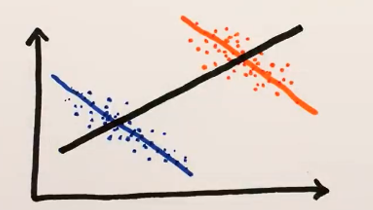
- ASimpson's paradox
- BGarden of forking paths
- CGeneralisability and bias
- DType 2 error
58Listing all variables collected in a study, deciding a rule for terminating data collection apriori, and reporting the statistical results of analysis without covariates are methods for reducing
- AType 1 error
- BType 2 error
- CBias
- DSimpson's paradox
59Imputation can be used to avoid
- Abias
- Btype 1 error
- Ctype 2 error
- Dsimpson's paradox
60In one-way ANOVA, ______ compares all possible combinations of pairs of groups, accounting for multiple comparisons
- ATukey HSD
- BGames-Howell
- CBonferroni
- DKolmogorov-Smirnov
Informações
- Descrição
- Quiz sobre stats exam, criado por Rachael Martin em 11-11-2021.
- Autor
- Rachael Martin
- Idioma
- English
- Visualizações
- 7
- Histórico
- Criado em 11 nov 2021 · atualizado em 13 nov 2021
- Avaliação
- Ainda sem avaliações Avalie este quiz