
Quiz
Chapter 3 Quiz: The Revolutionary War
Perguntas do quiz (29)
1How were women who stayed home and did not follow the troops affected by the Revolutionary War?
- AThose who remained at home found little to distress them because both armies promised to leave civilians unmolested.
- BWomen often welcomed the presence of troops near their homes because of the profits that could be made selling supplies to the armies.
- CThey were often unable to run the farm or family business without their husbands and ended up homeless and starving, along with their children.
- DWomen often found their homes commandeered by occupying armies and bore the brunt of the soldiers' demands for food and firewood.
2After the American Revolution, many free black women in the North helped their communities by participating in
- Achurches, which represented the most important institutions for racial integration.
- Bblack institutions, illustrating that segregation was common in the North.
- Celection campaigns that would put black voters firmly into northern politics.
- Dthe formation of early labor unions, which helped raise their wages and economic mobility.
3How did colonial men's attitudes toward the boycotting of British cloth and the production of colonial homespun change as the protests against new taxes continued?
- AColonial men quickly realized their dependence on women's efforts to create homespun and went from ignoring their participation to praising it.
- BColonial men initially praised women for their creation of homespun but later worried that women were too involved in politics and discouraged the activity.
- CColonial men encouraged women to boycott British cloth but worried that the production of homespun cloth was hurting the New England textile factories' profits.
- DColonial men felt the boycott was ineffective and disliked the feel of homespun, so they began a campaign to stop women from producing it.
4How did southern women's protests against British imported cloth differ from northern women's protests?
- AThe plantation mistresses got together in large groups to produce their homespun.
- BSouthern women tended to produce homespun on their own rather than in groups.
- CSouthern women refused to produce homespun because it violated their aristocratic lifestyle.
- DWealthy southern women hired poor white women to produce homespun.
5Some Iroquois women, such as Molly Brant, actively participated in the Revolutionary War by
- Aencouraging their tribes to support the British forces.
- Bdemanding that their tribes remain neutral.
- Cmediating between the British and patriot forces.
- Dserving as nurses for the patriot army.
6Why were slaves sometimes able to negotiate new relationships with their masters during the Revolutionary War?
- AFood shortages in the North placed a heavier emphasis on southern food production, and southern planters needed the cooperation of their slaves to increase their output
- BThe need for more soldiers led many southern slaveowners to free their slaves and their families if the slaves agreed to enlist in the Continental Army.
- CWartime labor shortages and the British promise of freedom to slaves who agreed to fight for them gave slaves more power to ask for privileges.
- DThe emancipation of slaves in the northern states during the war put added pressure on southern slaveowners to convince their slaves not to run away.
7How were slave women affected by the war?
- AMany male slaves left southern plantations to join the Continental Army, leaving female slaves to do most of the work.
- BMore female slaves and their children were able to escape slavery because of the confusion of war and British policies.
- CAlthough the British welcomed male slaves who would fight, they returned runaway female slaves to their masters.
- DBecause of the deprivations of war, female slaves and their mistresses bonded more closely, and many southern mistresses freed their slaves at the war's end.
8Most women camp followers were
- Asingle women who sought the excitement of the battlefield
- Boften poor men's wives who could not function on their own financially.
- Cprofessional nurses who were paid well by the American army for their services.
- Dprostitutes who were paid by the American army to follow the troops.
9Men responded to women's efforts to organize and raise funds for the revolutionary cause by
- Apressuring women to express their patriotism through conventionally domestic activities.
- Binsisting that participation by genteel women in fund-raising was unacceptable.
- Cdemanding that the money raised by women be given directly to the soldiers.
- Dencouraging women to take on other male roles, such as serving in the new government.
10Spinning homespun and brewing herbal teas and coffee were ways in which colonial women contributed to
- Acolonial boycotts of British goods.
- Bthe loyalist cause during the war.
- Cthe pacifist effort to avert war.
- Dboosting the colonial economy.
11What was one effect of the Revolutionary War on the slave population?
- AIt created opportunities for many slaves, especially women and children, to escape slavery.
- BIt provoked slaveowners to be vigilant, making it more difficult for slaves to escape.
- CSlaves who fought for the colonial side won freedom for themselves and their families.
- DIt forced a large number of slaveowners to emancipate their slaves in light of the ideology of liberty.
12How did the position of Native American women evolve in the post-revolutionary period?
- ANative Americans rejected whites' missionary ideas about the subservience of women.
- BA revival of traditional tribal ways led to the reestablishment of women's spiritual roles.
- CHeavy population losses led to pressure on Native women to bear more children.
- DNative men took up farming while Native women worked on spinning, weaving, and other domestic concerns.
13When Abigail Adams urged her husband John to "remember the ladies," she meant for him
- Ato write home often from Philadelphia and not to neglect his domestic relationships.
- Bto offer pensions to the widows of slain Revolutionary War soldiers.
- Cto create a constitutional amendment guaranteeing equality to women.
- Dto honor the ideology of liberty by giving women more legal rights.
14How did patriot legislatures treat the wives of loyalists whose husbands had been exiled or had gone to fight with the British?
- AMost states presumed women's political views were independent of their husbands and allowed loyalists' wives to remain in their homes.
- BMost states considered loyalists' wives to be a dangerous source of information and imprisoned them all until the end of the war.
- CMost states presumed that a woman's allegiance followed her husband's and often plundered their land and personal goods.
- DMost states considered women to be too naïve to understand political issues and thus did not hold them responsible for their husbands' actions.
15What two charismatic women led radical religious groups during the Great Awakening?
- AJemima Wilkinson and Mother Ann Lee
- BAbigail Adams and Anne Hutchinson
- CMercy Otis Warren and Judith Sargent Murray
- DLucy Knox and Elizabeth Fields
16What have scholars concluded about slave women's religious experiences?
- ASlave women resisted conversion to Christianity because they had been spiritual leaders in African traditions.
- BSlave women may have been significant in promoting conversion to evangelical Christianity because of their intimate roles in southern households.
- CWhite slaveowners suppressed signs of religious fervor in slave women because they feared that the values of Christianity would lead to slave unrest.
- DSlave women followed the religious preferences of their husbands.
17In addition to boycotts, what other forms of political action did women take to resist British power?
- ADozens of women in many states ran as candidates for public office.
- BWomen lobbied their legislatures to make peace and reach a compromise with Parliament.
- CWomen helped raise funds to build American textile mills to replace the need for British cloth.
- DWomen wrote newspaper articles and poems encouraging others to resist unfair British measures.
18The premise of the ideology that historians call Republican Motherhood was that women
- Ashould have a greater voice in public affairs in order to protect their children.
- Bshould be educated for the sole purpose of learning domestic skills.
- Chave vital roles in educating their children for their duties as citizens.
- Dare the most valued members of the republic.
19How did the Great Awakening of the 1740s and the Second Great Awakening of the 1790s affect women's lives?
- AWhite women were given more latitude in religious expression and increased their participation in religious groups.
- BWomen's dominant roles in organized religion were suppressed, as men returned to churches in large numbers
- CWomen were briefly given the opportunity to preach and to exercise leadership in the churches.
- DThe new religious ideas that spread as a result of these movements reinforced women's submission to men.
20Why were African Americans attracted to evangelical Protestantism?
- AMost slaveowners were Catholic, so slaves were naturally more attracted to Protestantism.
- BThe evangelical emphasis on spontaneous conversion was similar to West African religious beliefs.
- CThe slaves liked the formal ritual and services of the evangelical Protestant churches.
- DMost southern planters opposed evangelical Protestantism, so slaves joined as a form of protest.
21What is a reason that women were denied the vote in most states after the American Revolution?
- AMost women could not read or write.
- BWomen were assumed to be dependent.
- CWomen were too weak-minded to understand politics.
- DMost women were not members of a political party.
22How did the Revolutionary War affect the role of women?
- AWomen questioned their own competence and relied more on their husband's advice.
- BWhite women's status in the home and politics became a subject of debate after the war.
- CWomen demanded equal political rights as their husbands.
- DThe economy suffered due to women's poor handling of their husbands' businesses.
23After the war, why did slavery became more entrenched in the Lower South?
- AThe tobacco market declined, and the economy became more diversified.
- BSales of slaves from the North to the South increased.
- CThe importation of slaves from Africa decreased.
- DThe invention of the cotton gin in 1793 allowed for the growth of more cotton.
24As northern states gradually abolished slavery, most of the newly freed women
- Astayed at home and cared for their families.
- Bbecame indentured to their former masters.
- Cfound jobs doing domestic work or child care.
- Dfound work as agricultural laborers.
25What was the fate of some African Americans who turned to the British to secure their freedom during the Revolutionary War?
- AThey were sent to England, where they started that island's small Anglo-African population.
- BThey were transported to an uncertain fate in the West Indies, Nova Scotia, or Sierra Leone.
- CThey returned to slavery when the British army sold them back to their American owners.
- DThey were freed and settled in northern cities such as Boston, Philadelphia, and New York.
26Why did the Revolutionary War cause particular problems for Quaker women?
- AMost of the battles took place in Pennsylvania, where Quakers lived.
- BQuaker women supported the British government even while their husbands were patriots.
- CWhen the British invaded Pennsylvania, they began imprisoning American Quakers.
- DQuaker women suffered from their neutral stance, which arose from their pacifism.
27During the American Revolution, how were women camp followers generally treated?
- AThey were generously compensated for their valuable service as laundresses, cooks, and nurses.
- BThey were considered useful to the army as long as they stayed in their traditional roles.
- CAs upper-class, genteel women, they were treated with respect and deference.
- DSince most were prostitutes, they were kept far from the troops.
28Read the following excerpt and then choose the statements that best apply. There are multiple answers that are correct.
To “SM, a young African painter,” Phillis Wheatley
To show the lab’ring bosom’s deep intent,
And thought in living characters to paint,
When first thy pencil did those beauties give,
and breathing figures learnt from thee to live,
How did those prospects give my soul delight,
A new creation rushing on my sight?
Still, wond’rous youth! Each noble path pursue,
On deathless glories fix thine ardent view:
Still may the painter’s and the poet’s fire
To aid thy pencil, and thy verse conspire!”
Source: Through Women’s Eyes: An American History with Documents, 5th edition, Ellen Carol DuBois and Lynn Dumenil, Bedford St. Martins, Boston: 2019, 142.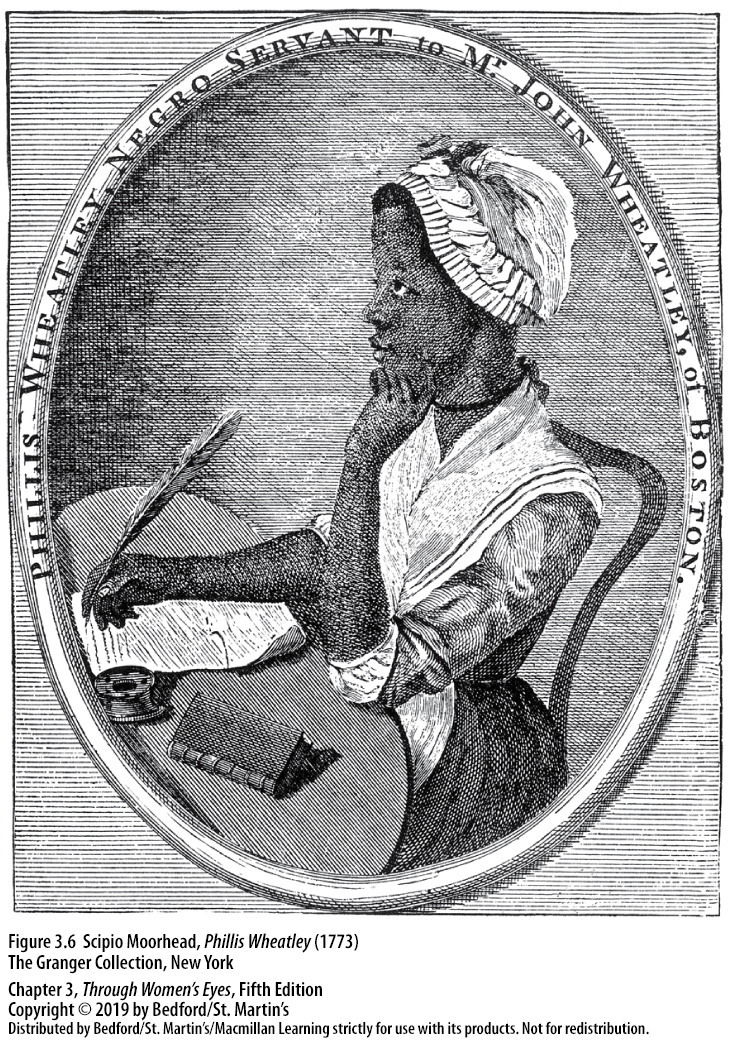
- AWheatley's poem begs her master to free her.
- BIt could be argued that Phillis Wheatley appreciated the painting because it portrayed her as an educated woman.
- CIn this poem Phillis argues that slavery needs to end soon.
- DThis document is a private document.
29Read the following excerpt and then choose the statement that best applies.
To “SM, a young African painter,” Phillis Wheatley
To show the lab’ring bosom’s deep intent,
And thought in living characters to paint,
When first thy pencil did those beauties give,
and breathing figures learnt from thee to live,
How did those prospects give my soul delight,
A new creation rushing on my sight?
Still, wond’rous youth! Each noble path pursue,
On deathless glories fix thine ardent view:
Still may the painter’s and the poet’s fire
To aid thy pencil, and thy verse conspire!”
Source: Through Women’s Eyes: An American History with Documents, 5th edition, Ellen Carol DuBois and Lynn Dumenil, Bedford St. Martins, Boston: 2019, 142.- AThe painting includes the information that Phillis Wheatley is the “negro servant” of Mr. John Wheatley.
- BIn the poem Phillis Wheatley praises the sermons of Jonathan Edwards.
- CThis document demonstrates that in eighteenth-century Boston some slaves were forbidden to read and write.
- DWheatley's poem is dedicated to the white painter, Samuel Meadows.
Informações
- Descrição
- 1. 100
- Autor
- Sarahy Perez
- Idioma
- English
- Visualizações
- 22
- Etiquetas
- Avaliação
- Ainda sem avaliações Avalie este quiz