
Quiz
Fantastic 4 Quiz
Este quiz tem tempo limite, por isso abre no player de sempre.
Perguntas do quiz (30)
1As a newly-employed researcher in Berjaya Company, the manager requested you to calculate the capacity of a single-effect evaporator. You know that the area of this evaporator is 40m^2 and it has an overall heat transfer coefficient of 2500W/m^2K. The evaporator is used to concentrate an aqueous solution which contains 6% of solids at a feed temperature of 18°C to 20% solids. The saturated steam is going in with a pressure of 313 kPa while the evaporator is operating at a vacuum pressure of 76.27 kPa. The BPR (boiling point rise) is known to be 8K. Perform the calculation and inform the value of capacity to your manager.
(Hint: Capacity is the amount of solvent vapourised per time)- A1.00kg/s
- B2.33kg/s
- C4.53kg/s
- D5.00kg/s
2The Yeoh’s Company would like to produce concentrated grape juice for new-year sales. A 4% solids raw juice at 22°C is entered into a single-effect evaporator and the company plans to produce a 38% solids grape concentrate from the feed. The pressure in the evaporator is at an absolute pressure of 25kPa while the steam entering is at a gauge pressure of 130.8kPa. The boiling temperature of the grape juice in the evaporator is at 65°C. The overall heat transfer coefficient is known to be 390Jm^(-2) s^(-1) 〖°C〗^(-1) and the evaporator’s heat transfer surface area is approximately 10.5m^2. What is the flow rate of the raw juice need to be supplied to the evaporator to produce the desired product?
- A403.25 kg/hr
- B517.25 kg/hr
- C386.46 kg/hr
- D228.28 kg/hr
3A client requested you to replace the single effect evaporator in his factory with multiple effect evaporator (specifically triple effect evaporator). He told you that the evaporator is used to evaporate a solution with negligible boiling point rise using saturated steam at 232.1kPa. Meanwhile, the pressure in the last effect is 40kPa. Heat transfer coefficient are given as U1 = 1980W/m^2 K; U2 = 2042 W/m^2 K and U3 = 2166 W/m^2 K. Calculate the boiling point in each effect with the assumption that the heat transfer surface areas of each effect are equal.
- AT1= 58.75°C; T2= 59.27°C; T3= 60.22°C
- BT1= 58.75°C; T2= 38.44°C; T3= 45.87°C
- CT1= 17.06°C; T2= 16.54°C; T3= 15.59°C
- DT1= 20.02°C; T2= 54.43°C; T3= 60.22°C
4What is the difference between forward feed and backward feed of multiple effect evaporators?
- AForward feed reuses the latent heat of vapour but backward feed does not reuse the latent heat of vapour.
- BForward feed is used for cold feed while backward feed is used for hot feed.
- CIn forward feed, the feed flows to the direction of vapour flow but in backward feed, feed flows opposite to the direction of vapour flow.
- DForward feed decreases steam economy while backward feed increases steam economy.
5Which of the following statements is NOT TRUE about vertical tube evaporator?
- AIt is not applicable for liquids with high viscosity.
- BThe liquid in the tube rises by natural circulation.
- CThe natural circulation is caused by boiling and the decrease in density.
- DThe steam enters the tube and condenses and leaves out as condensate.
6Which sections below are involved in a typical evaporator?
I) Separator
II) Condenser
III) Evaporating section
IV) Heat exchanger- AI and II
- BI, II and III
- CII, III and IV
- DI, III, IV
7To produce a product which doubled the initial feed solids concentration, an evaporator can be used. To investigate this, a 30% solution of NaOH in water is entered into the evaporator with a rate of 3899 kg/hr at a temperature of 55°C. The overall heat coefficient is 1200 W/m^2K. In the evaporator, the vapour space is having a pressure of 10kPa while the saturated steam has a pressure of 143.27kPa. Estimate the steam used and also the steam economy.
(Hint: Cp of water is 1.893 kJ/kgK)- AS = 1949.50 kJ/kg; Economy = 0.778
- BS = 2754.08 kJ/kg; Economy = 0.708
- CS = 2754.08 kJ/kg; Economy = 1.412
- DS = 1949.50 kJ/kg; Economy = 1.412
8Which of the following statements is NOT TRUE about drying?
- ARemoval of water can be done thermally.
- BRemoval of water can be done by the centrifuging process.
- CIt is the process of removal of large amount of water from solid material.
- DIt is the process of removal of small amount of water from solid material.
9In a room, the temperature of the air is known to be at 33.5°C while the pressure is 101.3kPa. The air contains water vapour and the partial pressure, P_A is found out to be 2.98kPa. You are required to estimate the humidity, saturation humidity and also the percentage humidity respectively.
- A0.0188 kg water/ kg air; 0.0336 kg H_2 O/ kg air; 57.46%
- B0.0188 kg water/ kg air; 0.0336 kg H_2 O/ kg air; 55.95%
- C0.0336 kg water/ kg air; 0.0188 kg H_2 O/ kg air; 57.46%
- D0.0336 kg water/ kg air; 0.0188 kg H_2 O/ kg air; 55.95%
10You are a research assistant in a laboratory and your research officer requested you to find out the humid heat and the humid volume of a dryer. Given the air entering the dryer is having a dew point of 302.2K and its dry bulb temperature is 343K. By using the humidity chart, find out the values.
- A1.056 kJ/kg dry air; 1.013m^3/ kg dry air
- B1.013 kJ/kg dry air; 1.056m^3/ kg dry air
- C2.078 kJ/kg dry air; 1.983m^3/ kg dry air
- D2.435 kJ/kg dry air; 1.983m^3/ kg dry air
11At 361K, the air stream is having a humidity H= 0.05 kg H_2 O/ kg dry air. It is in contact with an adiabatic saturator with water. Find the value of H and T if it is cooled and humidified to 80% saturation. For 100% saturation, are the H and T going to increase or decrease?
- AH= 0.067 kg H_2 O/ kg dry air; T= 48.5K; H will increase but T will decrease.
- BH= 0.067 kg H_2 O/ kg dry air; T= 321.5K; H will increase but T will decrease.
- CH= 0.055 kg H_2 O/ kg dry air; T= 48.5K; H will decrease and T will decrease.
- DH= 0.055 kg H_2 O/ kg dry air; T= 321.5K; H will decrease but T will increase.
12Why large chamber is preferable in spray dryer instead of small chamber?
- ATo allow particles to stick on wall.
- BTo allow drying to occur rapidly.
- CTo increase the amount of end product.
- DTo prevent particles from striking on sticking on wall.
13What are the steps in the formation of crystals?
I) Precipitation
II) Nucleation
III) Growth to macroscopic size
IV) Extraction- AI and II
- BII and III
- CIII and IV
- DII, III and IV
14We can measure the solubility in crystallisation by using polythermal method. What is meant by polythermal method?
- AAdding solvents at constant temperature.
- BAdding solvents at constant pressure.
- CHeating solutions initially containing excess solutes.
- DHeating solutions initially containing limited solutes.
15What do you think should be the main reason for the very low solubility of NaCl in benzene (C_6 H_6)?
- AHydrogen bonding in C_6 H_6.
- BStrong solvent-solvent interaction.
- CStrength of the covalent bond in NaCl.
- DWeak solvation of 〖Na〗^+ and 〖Cl〗^- by C_6 H_6.
16Consider a reaction, X + Y --> Z . The rate for this reaction is k[X][Y]2. The three cubes above shows a reaction for the production of a mixture in which X is the yellow balls and Y is the black balls. Based on the rate law, which one either [X] or [Y] has a greater influence? Why?
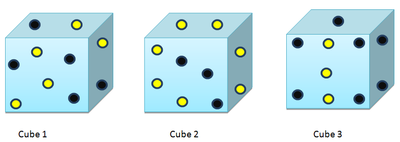
- AY has a greater influence.
- BX has a greater influence.
- CBoth have the same influence.
- DBoth have no influence.
17Pasteurization can be defined as the process of heating milk to high temperatures for a a period time in order to kill bacteria that is present in the milk. F&N Dairies (M) Sdn Bhd, uses pasteurization method to heat the milk to 650 C for 30 minutes. However, if it is heated to 750 C it only needs 15 seconds for the same result. Find the activation energy for this treatment of milk process.
Hint : Use Arrhenius equation, rate is inversely proportional to time, R=8.314.- A424130.50 J/mol
- B550748.62 J/mol
- C468181.23 J/mol
- D621328.45 J/mol
18A gas mixture enters a reactor with a flow rate of 4 dm3/s at 420K. The gas mixture contains equimolar of A and inerts at 12 atm. Given R=0.082dm3.atm/mol.K.
Determine the entering concentration of A, CAO.- A0.220 mol/dm3
- B0.183 mol/dm3
- C0.142 mol/dm3
- D0.174 mol/dm3
19Consider a reaction taking place as shown above.
The activation energies for k1 and k2 are given to 120 and 30 kJ/mol respectively. Both the reactions are said to be first-order. Which of the following is the best choice in order to maximize the yield of B?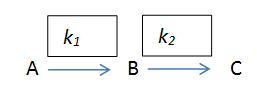
- APFR at low temperature
- BCSTR at high temperature
- CPFR at high temperature
- DCSTR at low temperature
20N plug flow reactor which are in series with a total volume of V will give the same conversion as in a single plug flow reactor of volume ‘V’ for any order reactions.
- ATrue
- BFalse
21The rate constant of a chemical reaction decreases by decreasing the temperature. The production sulfur trioxide is shown in the reaction above. Applying Le Chatelier’s Principle, will the amount of SO3(g) formed from a given amount of SO2(g) and O2(g) be higher when at ________.

- AHigh temperature
- BLow temperature
22Najeb is a Malaysian student who weighs about 65kg. He eats rice everyday. He consumes about 6200kJ of food per day. Taking his main source of food as rice which is glucose, the overall reaction is shown above. Taking the density of a average human being as 1000kg/m3, find Najeb’s metabolic rate in terms of moles of oxygen consumed per meter cube of person per second.

- A0.00132 mol O2 used / m3.s
- B0.00244 mol O2 used / m3.s
- C0.00359 mol O2 used / m3.s
- D0.00141 mol O2 used / m3.s
23A --> B+C
The exothermic reaction was carried out adiabatically and the above data was obtained.
It is given that the entering molar flow rate of A was 150 mol/min. At the end of the reaction, it is found that A was only 20% of its’ initial amount. Calculate the CSTR and PFR volume in this reaction.
- ACSTR: 9.6 dm3, PFR: 2.8 dm3
- BCSTR: 2.8 dm3, PFR: 9.6 dm3
- CCSTR: 2.4 dm3, PFR: 2.8 dm3
24In a chemical plant, a reactor with the following specifications is needed and you have been asked to design it: conversion after reactor 1, X1=0.1 and conversion after reactor 2, X2=0.6 with entering flowrate of 0.55 mol/s. What is the smallest volume of reactors series that you can achieve and how you are going to arrange the reactors?

- APFR ---> CSTR
- BCSTR ---> PFR
- CPFR ---> PFR
25Space velocity
- Adescribes the extensive operating characteristics of a tubular flow reactor.
- Bis the maximum feed rate per unit volume of reactor for a given conversion.
- Cis a measure of the ease of the reaction.
- DAll of the above
26Consider a reaction, X + Y Z The rate for this reaction is k[X][Y]2. The three cubes above shows a reaction for the production of a mixture in which X is the yellow balls and Y is the black balls. Which of the following order is of increasing rate of reaction?
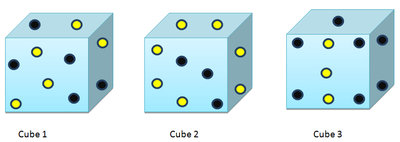
- ACube 3 > Cube 1 > Cube 2
- BCube 2 > Cube 3 > Cube 1
- CCube 1 > Cube 2 > Cube 3
- DCube 3 > Cube 2 > Cube 1
27What is the similarity between all mole balances of reactors?
- AAll have flow rate into the reactor.
- BAll have accumulation at the end of the reactor system.
- CAll have generation of the product in the system.
28Specific rate constant for a second order reaction
- Achange with temperature
- Bdoes not depend on temperature
- Cdepends on the nature of the reactants.
- Dall of the above.
29An Associate Professor from University of Auckland carried an experiment to calculate the total heat transferred in a crystallizer. The details of the crystallizer is as follows.
Feed= 5000Ibm at 200F
The concentrated solution comes out of the crystallizer at 60F.
The crystal produced is a sodium sulfate decahydrate with the yield of 3000Ibm.
The heat capacity of the feed is 0.90 btu/Ibm.F.
The heat of solution at 60F is (-26.48 btu/Ibm).- A-897623 btu
- B345722 btu
- C-897323 btu
- D-709440 btu
30The following determines the identity of a chemical species except:
- AConfiguration
- BNumber of atoms
- CType of atoms
- DReactivity
Informações
- Descrição
- This is an online quiz for two subjects which are Reaction Engineering and Separation Process II. It is specially created for Chemical Engineering students.
- Autor
- hui_950110
- Idioma
- English
- Visualizações
- 96
- Etiquetas
- Avaliação
- Ainda sem avaliações Avalie este quiz